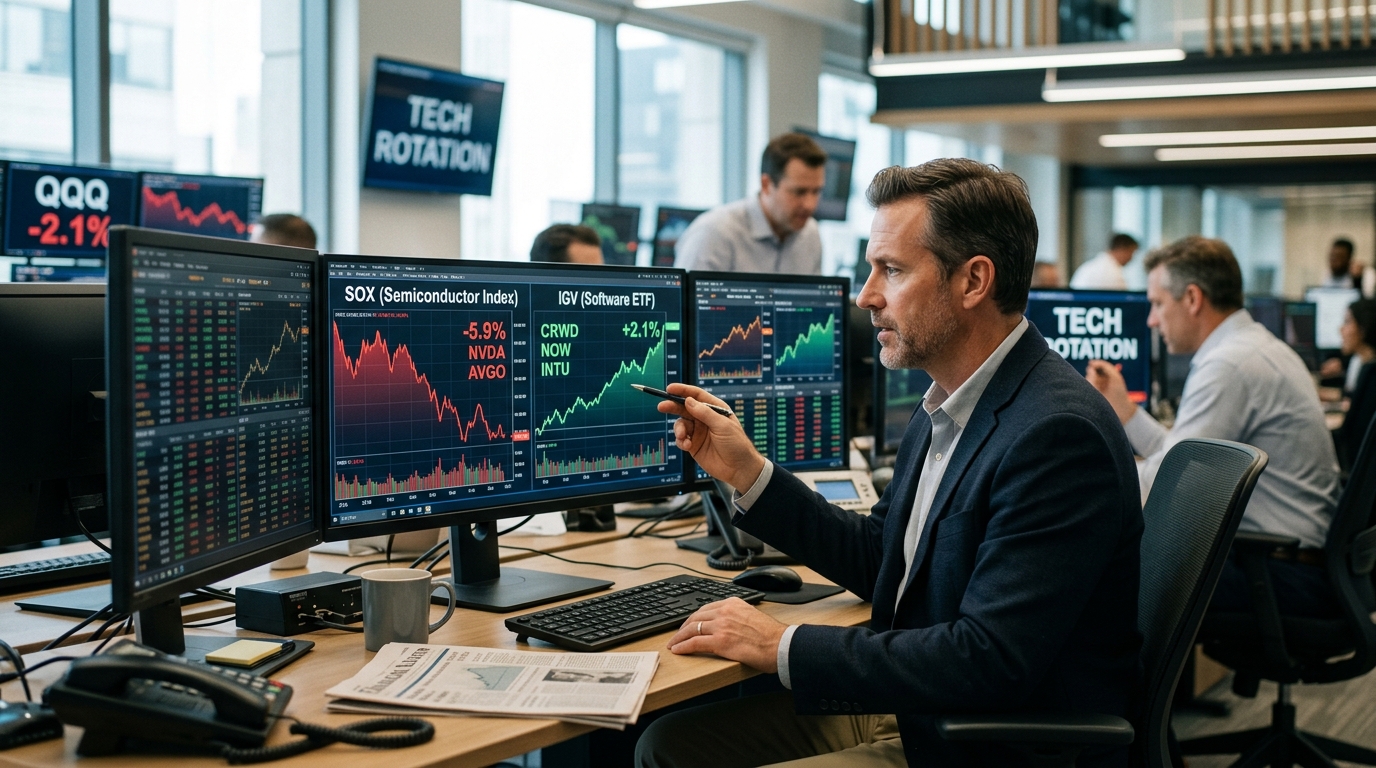
Monday’s session was not a technology selloff. It was a surgical reallocation inside technology, and the numbers make that precise. The rout in Nvidia and Broadcom sent the Philadelphia Semiconductor Index down 5.9%. At the same time, IGV, the iShares Expanded Tech-Software ETF, rose about 2%, while QQQ dropped about 2%, framing the session as a rotation inside technology rather than a broad tech retreat.
The Catalyst and the Flow
The trigger was a weekend essay from Anthropic CEO Dario Amodei urging frontier AI labs to slow the pace of model capability development. That commentary was read two ways at once: as relief for enterprise software vendors AI was supposed to displace, and as pressure on chipmakers carrying the heaviest AI-buildout expectations.
The chip damage was broad and steep. AMD declined 4.40%, Broadcom slipped 4.77%, and Intel lost 5.59%. The irony for Broadcom is pointed: in its fiscal Q3 FY2026 results and outlook last week, the company reiterated that it expects Q4 FY2026 AI semiconductor revenue of $21.7 billion, after Q3 AI semiconductor revenue of $16.7 billion, up 221% year over year. The fundamentals did not change Monday. The positioning did.
Capital landed in enterprise software. ServiceNow climbed into the low $140s, Adobe jumped more than 5% to about $265.60, and Salesforce rose roughly 4.7% to about $259.43 in Monday trading. Software was being bought while AI infrastructure and semiconductor names absorbed the selling.
The Businesses Behind the Moves
ServiceNow’s numbers support the rerating. The company reported $3.99 billion in Q2 2026 revenue, representing 24% year-over-year growth, and subscription revenue of $3.877 billion. ServiceNow AI crossed $1 billion in annual contract value in that quarter. The remaining performance obligation backlog of $29.0 billion signals durable forward revenue. Management has described its long-term plan as setting a course to $32 billion in revenue in 2030.
Adobe’s most recent quarter is equally clean. In Q3 FY2026, Adobe achieved record revenue of $6.76 billion, growing 13% year over year, with non-GAAP earnings per share of $6.13. AI-first ending ARR exceeded $650 million and grew more than 150% year over year. The selloff thesis, that AI models would cannibalize creative and document workflow software, has not shown up in the revenue line.
Salesforce brings the most complex read. In recent company reporting, Salesforce has said Agentforce ARR topped $1.5 billion, up more than 240% year over year, while CRM shares have gained just 1.65% over 12 months. That ARR figure has also drawn scrutiny externally because of changes in what is included in the metric, which matters for how traders interpret the growth rate. The gap between AI traction and stock performance is the central Dreamforce question. Salesforce has also said Agentforce and Data 360 ARR combined reached nearly $3.9 billion, up more than 210% year over year. Clear pricing, customers sticking around, and evidence that AI adoption lifts revenue would give investors something firmer to value.
Dreamforce as the Pressure Test
The Benioff-Altman keynote conversation is scheduled for Tuesday, September 15, at 2:00 PM PDT at Dreamforce, which runs September 15-17 at Moscone Center in San Francisco. Sam Altman joins Benioff for a conversation on advancing the AI frontier and what it means for enterprise business. That framing matters: Altman’s presence at a Salesforce event, on the same week his industry has publicly debated slowing AI capability development, forces a question about whether the AI slowdown argument actually benefits software or merely removes a threat narrative without adding a growth one.
A Fed rate decision this week could determine whether the software-semiconductor split holds. The FOMC meeting runs September 15-16, with the decision expected Wednesday. Oil has also been a live inflation catalyst in recent sessions, and 10-year Treasury yields have hovered near 5%, a backdrop that can compress multiples across high-growth software.
Scenario Framework
Bull Case: Dreamforce keynotes produce concrete Agentforce enterprise commitments. Hyperscalers confirm capex plans unchanged through October earnings. The IGV/SOXX ratio extends higher, NOW holds $140, CRM moves toward $270, and the rotation deepens into WDAY and ADBE as the week progresses.
Base Case: Software holds Monday’s gains but stalls without new catalysts. One earnings-driven squeeze can look like a structural turn for several days and then completely unwind. A genuine rotation needs breadth. CRM consolidates near $260, NOW fades slightly from the session high, and the rotation waits on the Fed decision for confirmation.
Bear Case: The Fed signals a rate hike. Altman’s Dreamforce remarks rekindle AI disruption fears for software rather than calming them. Ongoing uncertainty weighs on markets in the coming days as investors assess the potential implications for corporate profits. Software gives back Monday’s gains; chips do not recover enough to absorb the selloff, and both groups drift lower into October.
Trader Framework
The IGV/SOXX ratio is the session’s most informative signal. If that ratio continues rising, it means capital is rotating toward software even when the absolute market is choppy. That is a regime signal.
Watch whether NOW can hold above $138 on volume through the Dreamforce keynote window; a fade on high volume into the afternoon would suggest the move was tactical rather than structural. For CRM, the Investor Day on September 16 at the St. Regis carries as much weight as today’s keynote for institutional positioning.
The distinction between a single-session rotation and a durable regime shift rests on what Benioff and Altman put on the table this afternoon, and whether the Fed gives the software trade room to breathe. Preparation, not prediction, is the edge here.