There is a category of corporate influence that goes beyond lobbying, beyond campaign contributions, beyond even the revolving door between industry and government. It is the kind that shapes what a president believes to be true. Jensen Huang now occupies that category.
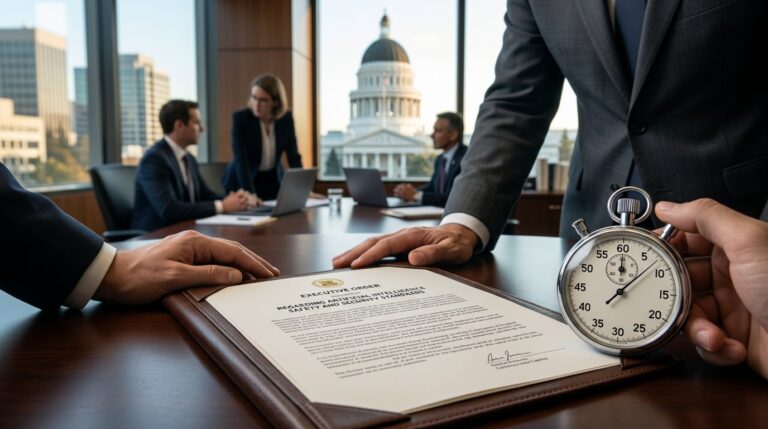
With the debate about regulating artificial intelligence raging in Washington this month, President Trump picked up the phone to call Huang directly. The Nvidia CEO put the president on speakerphone while on stage at the All-In Summit in Los Angeles, and Trump told the crowd, “The robots are not going to be taking over the world.”
That alignment has structural consequences for Nvidia as a business, not just as a political ally.
On Saturday, September 19, 2026, Trump announced he is creating an “AI Force” modeled on Space Force and will soon name a new AI czar, doubling down on his push to accelerate AI development with limited regulation. He offered few details on what this AI Force would actually do, what budget it would have, or where it would be placed in the federal government. The philosophical direction, however, was unambiguous. Huang’s own public position is that AI can be controlled by humans and existing laws, and he has argued that “safety is an engineering problem, not a legal one,” including in remarks at Salesforce’s Dreamforce conference last week.
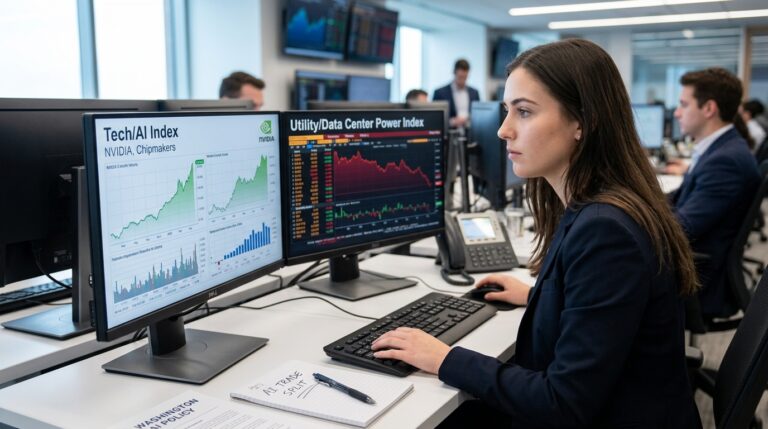
This matters to investors because it removes the single biggest overhang that could have compressed Nvidia’s addressable market: a regulatory regime that slows compute demand. Nvidia commands an estimated 85% to 92% share of the AI accelerator market as we move through 2026, and the company stands at the epicenter of an unprecedented technological transformation. In fiscal 2026, Nvidia reported 65% revenue growth, reaching $215.9 billion with net income of $120.1 billion. These are numbers that reflect genuine dominance, not hype. A Washington posture hostile to AI buildout would have been the most credible threat to those figures. That threat has been substantially reduced.
The counterargument deserves a serious hearing. A New York Times/Siena University poll of 1,503 likely voters, conducted September 8 to 13, 2026, found 61% oppose the construction of data centers to power AI. Opposition reached 75% among Democrats and 47% among Republicans. That is a wide and durable public sentiment, and it is already showing up in local permitting battles and utility negotiations. Political cover from Washington does not automatically override a county zoning board.
There is also the competitive question. Amazon has said its chip business saw nearly 40% quarter-over-quarter growth in the first quarter of 2026, reaching an annual revenue run rate of more than $20 billion. Google, Microsoft, and Meta are all scaling custom silicon. Huang’s grip on the market is real; it is not forever guaranteed.
But step back and consider what has actually happened. He is slated to attend Trump’s state dinner for Chinese President Xi Jinping this week. No other semiconductor CEO is in that room.
History’s best investors have long recognized that regulatory and political moats can be as durable as technological ones, sometimes more so. The Space Force analogy Trump keeps reaching for is instructive: that branch created a concentrated, captive procurement market for defense contractors who positioned early. The AI Force, whatever form it eventually takes, signals a federal commitment to acceleration over restriction. Nvidia’s entire business model runs on acceleration.
The risk is not that Huang’s influence disappears. The risk is that it creates complacency. When one company’s worldview becomes sovereign policy, management has less pressure to stay ahead of competitors on merit alone. Investors in Nvidia should want the technology lead to remain the primary reason to own the stock, with the Washington relationship as a secondary advantage, not the other way around. Right now, both are pointing in the same direction. That combination, at Nvidia’s scale, is rare enough to take seriously.