September 21, 2026
Section 232 hits remaining importers on September 29.
The pharmaceutical supply chain is pricing itself in real time. September 29 is the date every drug importer outside the original Annex III cohort has been dreading since Proclamation 11020 landed on April 2. At that point, a 100% Section 232 tariff applies to patented pharmaceutical products and their active pharmaceutical ingredients for any company that has not secured an approved onshoring or Most Favored Nation agreement.
Cash From Oil in Days. Not Years.
No stocks. No waiting years for a payoff. A former hedge fund manager has a strategy that can turn an oil move into cash in a matter of days, and the chances come up again and again. He calls it “Oil Skimming.” And he’s giving away the entire three-step system for free.
The scope is substantial. Commerce and FDA data cited in the proclamation shows roughly 53% of domestically distributed patented pharmaceuticals are produced abroad. That is not a niche exposure problem. It is a structural one, and the tariff architecture was designed to force a structural response.
The Rate Tiers and What They Require
Three pathways exist to avoid the full 100% rate. Companies that secured both an approved onshoring plan and a Most Favored Nation pricing agreement with HHS qualify for a 0% rate through January 20, 2029. Those with only an approved onshoring plan pay 20% from September 29, 2026, with that rate escalating back to 100% on April 2, 2030. Companies that missed the Commerce Department’s onshoring agreement application process are working within whatever framework they already have.
Even the 20% temporary relief tier is not a resting place. The April 2, 2030 escalation date means every company that bought itself a reduced rate still faces the same structural pressure: build domestic capacity or pay full freight. The tariff regime is not a negotiating chip. It is a multi-year industrial policy.
Where Thermo Fisher Fits
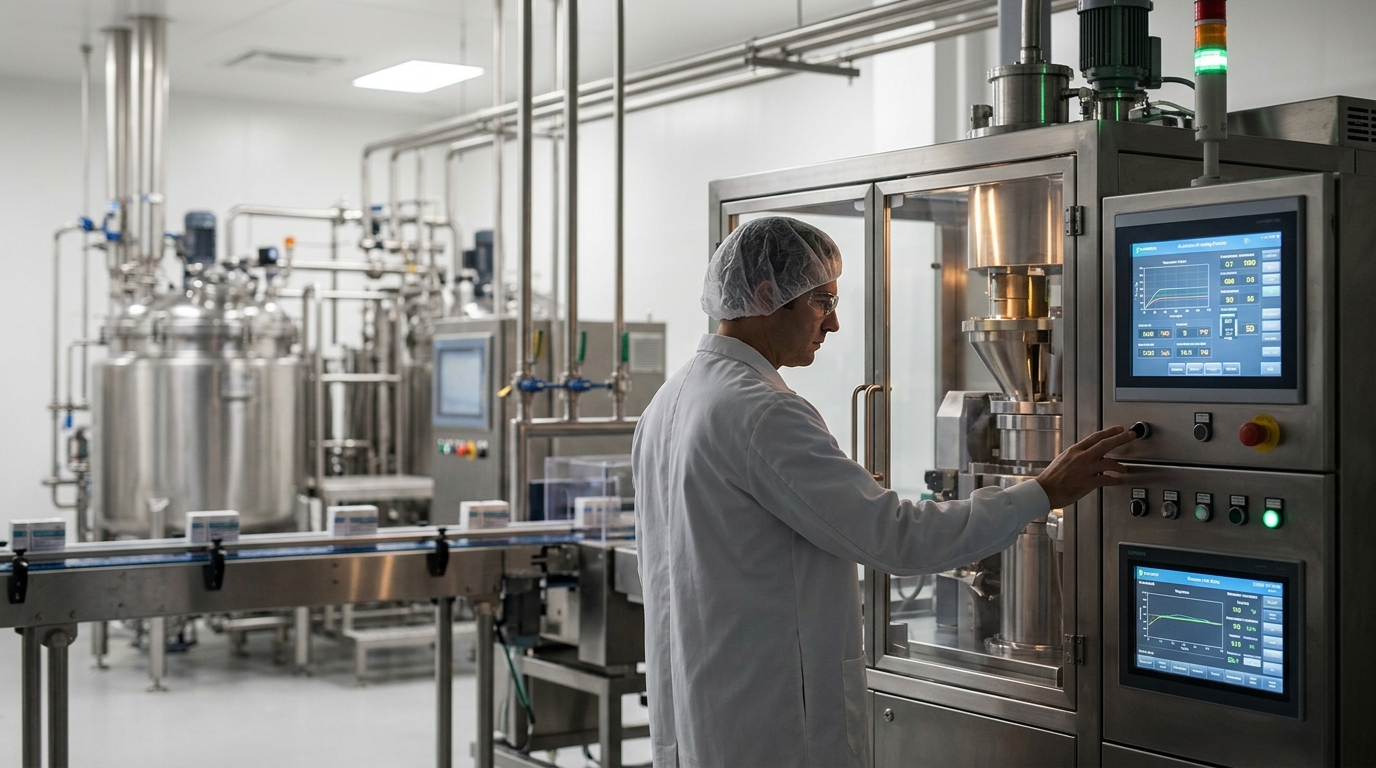
Thermo Fisher Scientific (TMO) operates what is arguably the most commercially ready domestic CDMO infrastructure in the country through its Patheon pharma services division. The platform covers oral solid dose, sterile injectables, biologics fill-finish, and cell and gene therapy. These capabilities span the full commercial manufacturing stack that a multinational drug company needs when it decides to move production onshore under deadline pressure.
That footprint accumulated over decades, not months. In 2025, Thermo Fisher completed the acquisition of Sanofi’s sterile drug product manufacturing facility in Ridgefield, New Jersey, adding fill-finish and aseptic injectable packaging capacity to the U.S. network. CEO Marc Casper framed the acquisition as a capacity expansion to accelerate reshoring for other clients.
Man Who Predicted Rise of Bitcoin in 1994 Returns with Brand New Call on A.I.
When Karim Rahemtulla told readers in 1994 to buy the companies building the backbone of the Internet, those stocks had the chance to make as much as 10x, 20x, even 25x their money during the internet boom.
Not on AI chips.
Not on software.
But on the one thing the entire AI revolution can’t run without.
A major government catalyst arrives in August. Karim believes the window may be closing.
At the Morgan Stanley Global Healthcare Conference on September 15, Casper described the CDMO dynamic directly: customers who formerly produced medicines overseas sign contracts with Thermo Fisher, execute a tech transfer, and domestic production begins. No greenfield construction, no years-long site qualification from scratch. He added that pharma services is expected to see a step-up in the second half of 2026, supported by contracts and shipment schedules already in hand. The larger reshoring revenue, Casper has said consistently, builds through 2027 and 2028.
The Numbers in Context
Thermo Fisher reported Q1 2026 revenue of $11.01 billion, up 6% year-over-year, with adjusted EPS of $5.44. The company subsequently raised full-year guidance to $47.3 billion to $48.1 billion, representing 6% to 8% reported growth. Alongside the Q1 results, Thermo Fisher raised its dividend 10% and repurchased $3 billion in shares during the quarter.
The company has also committed $2 billion in U.S. capital over four years, with $1.5 billion earmarked for manufacturing expansion. President Trump visited Thermo Fisher’s Reading, Ohio facility on March 11, 2026, a visit that underscored the political alignment between the company’s domestic expansion and the administration’s onshoring agenda.
Risks That Deserve Attention
TMO is not a pure-play tariff beneficiary. The analytical instruments, diagnostics, and research consumables segments carry independent risks. China operations have been running at low single-digit revenue declines, with a widely cited estimate of roughly a $400 million sales headwind tied to tariffs and related conditions. U.S. academic and government spending remains below historical norms. These drags do not disappear because Patheon is winning CDMO contracts.
There is also execution risk embedded in the opportunity itself. Signing a contract and completing a validated commercial tech transfer are different things. Regulatory approval of a manufacturing site change adds time and complexity. Casper’s own guidance positions the most significant reshoring revenue contribution in 2027 and 2028, which means traders watching for a near-term step-change in pharma services margin should calibrate their timeframe accordingly.
Scenario Modeling
Bull Case: September 29 compliance pressure accelerates a second wave of CDMO signings beyond what Casper described at the Morgan Stanley conference. Pharma services revenue growth inflects above the high single-digit baseline through H2 2026, with 2027 guidance raised materially on reshoring volume. TMO re-rates toward the top of its historical forward multiple range as investors price a durable, policy-backstopped demand cycle.
Nuclear Energy’s Comeback Could Spark Before 2026
Global energy demand is surging and one overlooked power source is quietly returning to the spotlight. New policy support and supply constraints are setting the stage for a surprising shift in the energy markets.
Base Case: Reshoring contracts continue accumulating at the pace Casper described, with H2 pharma services delivering the guided step-up. Full-year revenue lands near the midpoint of the $47.3 billion to $48.1 billion range. China headwinds and academic spending softness offset some of the CDMO tailwind. TMO holds its multiple with modest upward bias as 2027 reshoring visibility improves.
Bear Case: A critical mass of remaining importers reaches MFN or onshoring agreements, reducing the urgency for CDMO capacity in the near term. Tech transfer delays push expected revenue into 2028 and beyond. China conditions worsen beyond the $400 million headwind estimate. TMO drifts lower on earnings revisions in non-pharma-services segments, and the reshoring thesis becomes a 2027 story that the market prices at a discount.
Active Trader Framework
Key levels to monitor include TMO’s 50-day and 200-day moving averages as anchors for trend confirmation. Volume behavior around the September 29 deadline itself could produce a catalyst-driven move in either direction, since the actual contract activity is already partially in the numbers while market perception may lag. Volatility around any news of major CDMO deals or negative China revision should be treated as an information event, not noise.
Position sizing should account for the asymmetry between the near-term complexity and the multi-year structural case. The April 2, 2030 escalation date creates a floor under CDMO demand that does not expire with the September 29 headlines.
The Structural Read
Proclamation 11020 is not a temporary executive posture. The tariff structure was engineered with escalation built in, and every company that secured a reduced rate remains on a clock to demonstrate onshoring progress. That construct sustains CDMO demand well beyond any single compliance date. Thermo Fisher’s Patheon network, with its FDA-registered sites, proven tech-transfer infrastructure, and freshly expanded U.S. sterile capacity, sits at the center of that demand runway. Preparation and position sizing matter more here than trying to predict the September 29 reaction. The structural case has years to run.