October 26, 2026
Bonus Content: Brazil Repriced the Region. Chile Decides Tomorrow, Colombia and Mexico Follow.
Dear Reader,
I’m Marc Lichtenfeld, Chief Income Strategist at The Oxford Club. I’ve been featured as an income expert by The Wall Street Journal, Bloomberg and Fox Business.
In November 2021, while the Federal Reserve called inflation “transitory,” I warned it could exceed 8% within 18 months and favored energy. Inflation reached 9%, and energy became the best-performing asset class of 2022.
A $0.47 quarterly distribution may not sound dramatic.
But when the underlying investment traded at $14.31 at the source date, that payout annualized to a double digit yield.
And the business behind it did not have to drill a single well to participate in the income.
Run the income math behind this little-known oil play
Most investors see rising oil and reach for Exxon, Chevron or a smaller producer.
But producers pay for leases, rigs, workers, transport, maintenance and debt. The investment I found can benefit from production without paying those operating bills.
It has paid a distribution every quarter since going public in 2017, including during the 2020 oil crash. Its latest stated quarter marked a third consecutive increase.
The payout is not fixed. Commodity prices and production change, distributions can be reduced, and the investment can lose money.
But I believe the underlying numbers deserve attention: record second-quarter 2026 revenue and net income, 91 active rigs on its acreage, and a 15% increase in forecast fourth-quarter production at the midpoint after a major acquisition.
Watch my full oil income briefing for FREE – no email or credit card required
I walk through the distribution history, unusual structure and risks in my new presentation.
Good investing,
Marc Lichtenfeld
Chief Income Strategist, The Oxford Club
P.S. From its March 2020 low to its June 2022 high, this investment rose 419% while its quarterly distribution climbed from $0.13 to $0.55. Past performance is not a forecast. See why this overlooked structure deserves a fresh look.
Brazil Repriced the Region. Chile Decides Tomorrow, Colombia and Mexico Follow.
The result that markets spent weeks pricing out arrived anyway. Lula, 81, won a fourth term with about 51.79% of valid votes; his challenger, Flávio Bolsonaro, took about 48.21%, according to Brazil’s electoral court. The reaction in offshore markets was instant. Brazilian real futures fell around 10% on Sunday, October 25, with November contracts implying approximately R$5.56 per dollar, against a pre-election spot close near R$4.99. The partial recovery into early Monday trading does not resolve the question that now frames every Latin American position: how much of Brazil’s fiscal reset bleeds across borders?
The 48-Hour Policy Calendar
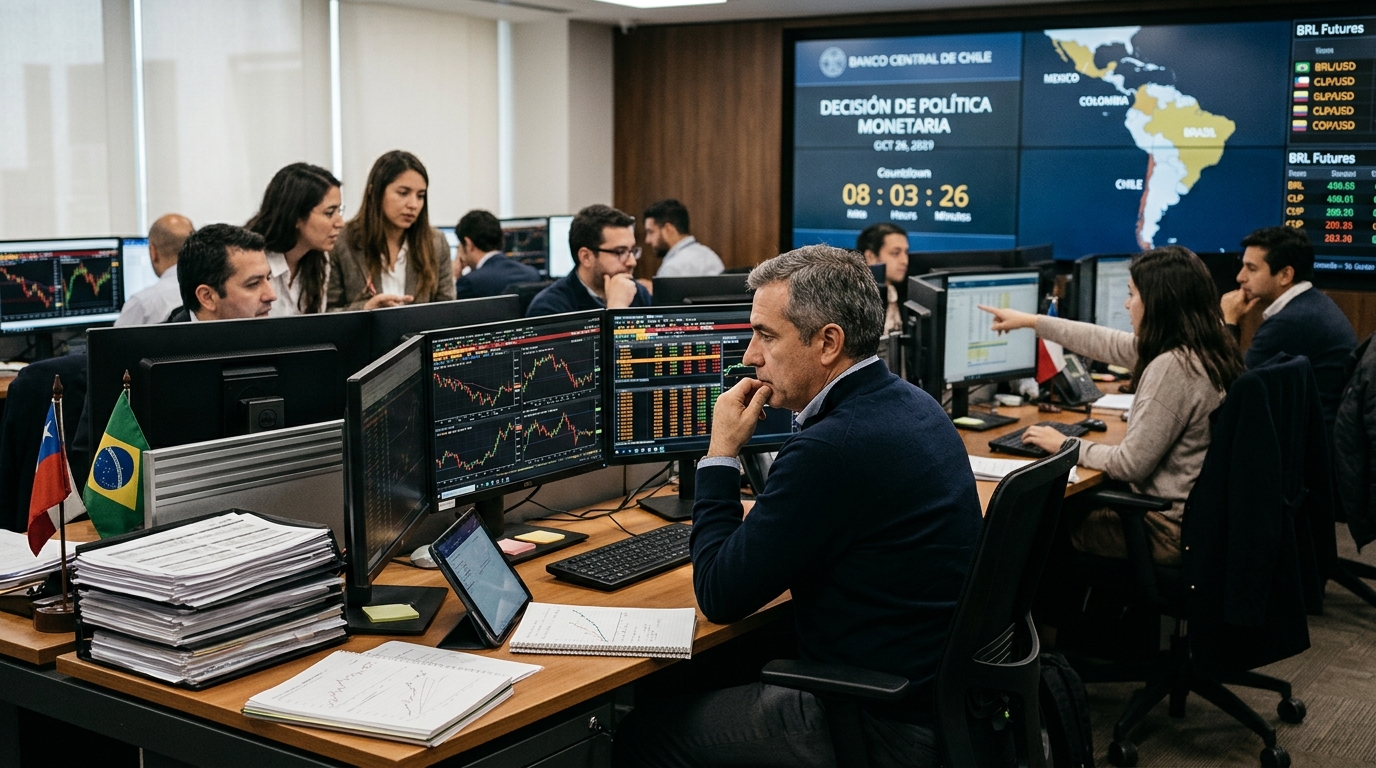
Chile’s central bank decision is released Tuesday, October 27, with the policy rate at 4.5% and the market broadly pricing no change. The Banco Central de Chile has held its benchmark rate at 4.5% at every meeting in 2026. Inflation rose 4.1% in the 12 months to September, sitting just above the bank’s 2% to 4% tolerance range, according to Chile’s statistics agency. That single data point is the tension in Tuesday’s decision. A hold is nearly certain, but the signal embedded in the statement matters more than the rate itself.
Some forecasters see a December hike. That minority is small but louder than it was three months ago. The bank aims for 3% inflation with a tolerance band of 2% to 4%, and the latest reading above the top of that range may make a pause harder to defend over time. Traders holding CLP exposure should watch the post-decision statement for any revision to the phrase about the rate path, not the rate itself.
Rate signals from smaller central banks rarely move in isolation from the broader dollar complex. The dollar’s anomalous slide even as Fed rate-hike odds were rising shows how cross-currency flows can override domestic policy signals.
Colombia’s central bank meets on Friday, after raising its rate by 25 basis points to 12.25% on September 30. Banco de la República said the decision was by majority vote. The rate has now risen 300 basis points from the 9.25% level where it stood at the opening of 2026, representing one of the most aggressive monetary adjustments in the region this cycle. Standard Chartered has flagged a potential final 25-basis-point hike at the October 30 meeting. With COP already firming ahead of the September move, the board faces the secondary problem of tightening into currency strength.
Mexico’s economic activity grew 3.5% in the year to August, according to INEGI’s IGAE release, with the next test being Q3 GDP on October 30. Banco Base’s director of economic analysis has argued Q3 GDP could show quarter-over-quarter growth near 0.99% and annual growth near 3.04%. Private-sector consensus for full-year expansion has hovered around the mid-1% area, and the IMF has put its 2026 projection at 1.5%. A stronger-than-expected print would reduce the pressure on Banxico to cut, keeping MXN supported on a relative basis within the region.
Scenario Modeling
Bull Case: Chile holds with a neutral statement, Banrep pauses at 12.25% against consensus, and Mexico GDP prints above 3% year-over-year. Regional currencies stabilize as the BRL finds a floor around R$5.00. USD/CLP retreats from the 994 level seen in Saturday trade, USD/MXN holds below 18.80, and the Brazil shock is contained as an idiosyncratic event rather than a contagion catalyst.
Base Case: Chile holds Tuesday as priced, statement is neutral, and December hike odds drift higher from a small minority of forecasters. Banrep hikes 25 basis points Friday as Standard Chartered outlines. Mexico GDP lands in a 2.5% to 3% year-over-year band. A clean break above R$5.00 in USD/BRL during the first hour of Monday’s session would open the door toward 5.10 and then 5.20, maintaining moderate pressure on regional peers through the week but not triggering a disorderly move.
Bear Case: BRL fails to hold R$5.00, spills toward the 5.20 to 5.30 range. Contagion pressures CLP and COP, with USD/CLP testing the 1,000 handle. Chile’s statement acknowledges upside inflation risks more forcefully, accelerating December hike pricing. Banrep’s Friday decision is a hawkish 50 basis points, tightening financial conditions into already-weak credit demand. Mexico GDP disappoints below 2%, pressuring MXN toward 19.00 and triggering a re-rating of the broader EM Latin America complex.
Energy costs compound the bear case for the region’s current-account dynamics. Elevated oil prices driven by Hormuz disruptions add an external inflation shock that tightens the policy bind for commodity-importing Latin American economies.
Active Trader Framework
The sequencing matters. Chile’s policy statement hits Tuesday evening Santiago time, about 48 hours before Banrep. A hawkish Chile statement shifts the regional rate framing before Colombia decides. Monitor USD/CLP at 994 to 1,000 as a near-term resistance cluster. For COP, the 3,100 to 3,150 range has contained spot in recent sessions; a Banrep pause would test the lower bound, a 50-basis-point hike would compress the pair further. MXN positioning hinges heavily on Thursday GDP. Trading Economics-style nowcasts and local-bank estimates have not always converged this quarter; that forecast dispersion is where MXN volatility lives Friday morning.
Manage size across all three currency pairs this week. Four central-bank decisions globally, a Fed meeting Wednesday, and Brazil’s still-settling political situation make correlation assumptions unreliable. Position sizing that accounts for simultaneous moves across CLP, COP, and MXN is not overcaution, it is the only disciplined response to a calendar this compressed. Preparation, not prediction, is the edge here.