
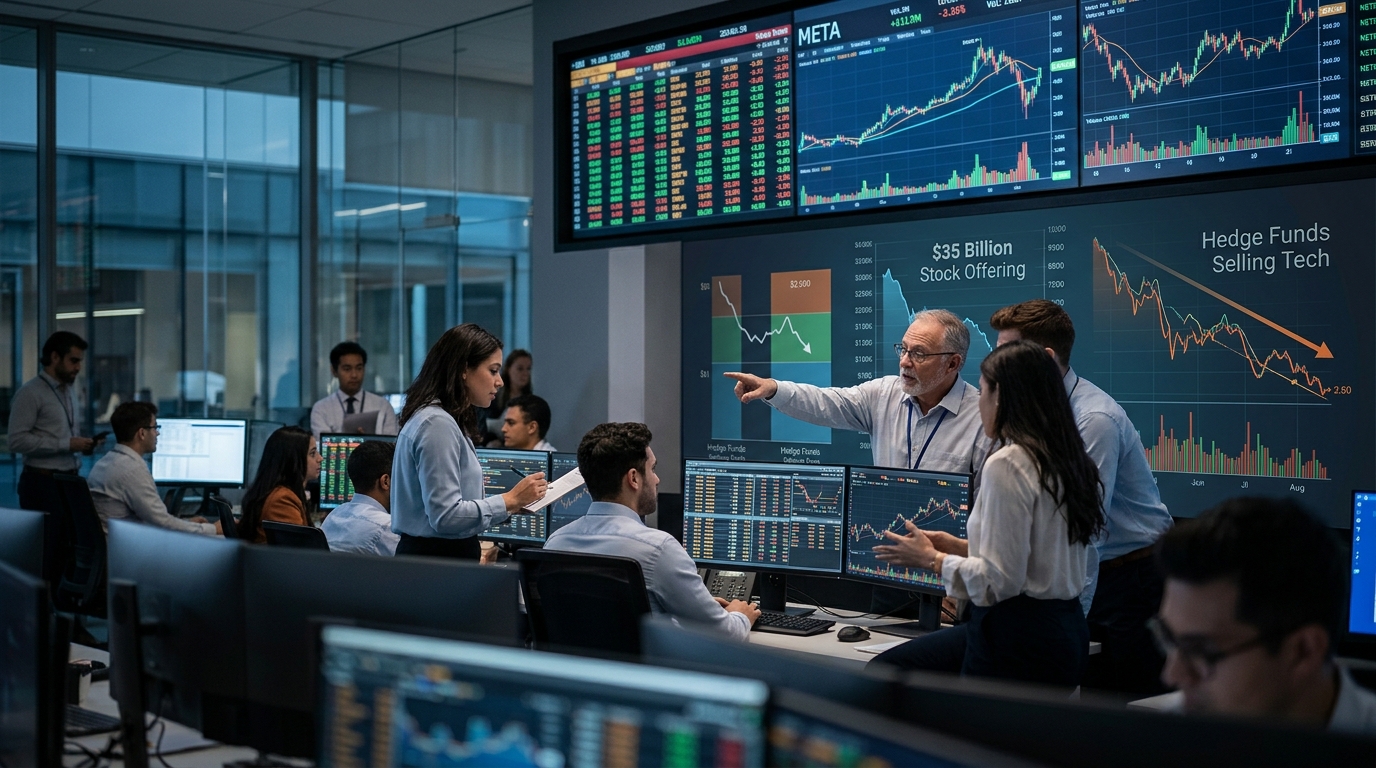
October 27, 2026
A $95 billion equity program lands days after free cash flow turned negative and hedge funds cut tech at the fastest pace in a decade.
Meta hit the equity market on Monday with the largest stock offering in its history, and the timing is impossible to ignore. The company is launching about $35 billion in two concurrent underwritten offerings, and it has also outlined a separate $60 billion at-the-market program that is expected to begin in the first quarter of 2027 after its new Class C common stock starts trading. Total potential program size: up to $95 billion.
971 Trades. One Surprisingly Simple Approach.
Five years. Bull markets, selloffs, sideways stretches – and 971 trades along the way. Dave Aquino’s Ultimate Income System focuses less on predicting the next big move and more on finding consistent trading opportunities. His new report explains the approach, why it works differently, and what most traders may be missing.
Why the Offering Arrived Now
Meta reported negative free cash flow of $2.12 billion in the third quarter, compared with positive $10.63 billion a year ago. The company reported $34.91 billion of capital expenditures in the quarter, equal to roughly 54% of its $64.60 billion of revenue. Full-year capex guidance stands at $135 billion to $145 billion. Operating cash flow is struggling to keep pace with that spending trajectory, and management clearly decided against relying solely on the balance sheet. Cash, cash equivalents and marketable securities stood at $82.45 billion as of September 30, while long-term debt was $80.92 billion. That buffer is no longer a set-and-forget backstop.
The latest fundraising further underscores a shift among large technology companies leaning harder on external financing to bolster AI infrastructure, after years of funding big investment cycles primarily out of internally generated cash. Goldman Sachs Research has put baseline aggregate AI capex at about $7.6 trillion from 2026 through 2031 across compute, data centers and power infrastructure.
The Supply Problem for Active Traders
This is where the mechanics matter. Reuters reported that, over the five sessions through October 15, hedge funds cut technology exposure by the biggest share in Goldman Sachs’ records going back to 2016. The same reporting tied the move to a sharp reversal in AI-linked equities, with the Nasdaq 100 down 5.5% for the week, its steepest weekly fall since April 2025.
That context reframes the offering. Meta is bringing roughly $35 billion of new equity-linked supply to a market where the marginal buyer for AI-linked stocks just spent days reducing risk. Goldman characterized the activity primarily as long liquidation, not a wave of fresh short bets. Funds were not broadly bearish; they were reducing crowded longs. Even after that retreat, technology positioning in prime brokerage remained elevated in Goldman’s framing, which matters because the supply has to clear against an already-heavy sector baseline.
The 30-Minute Rule for 0DTE Trading
Before you place a same-day trade, wait 30 minutes.
What the market does in that first half hour tells you whether to trade today, which way to lean, or whether to sit on your hands.
It’s one of the rules in my free report, The 0DTE Game Plan.
Normally $29.97. Free today.
Meta also disclosed interest of up to $5 billion in total from Nvidia, Advanced Micro Devices and Broadcom in the Class A common stock offering. Their stated interest adds to concerns about an increasingly circular flow of capital in the AI industry, as chip suppliers help finance the expansion of one of their biggest customers. For Nvidia and Broadcom specifically, the optics cut both ways: it validates the scale of the infrastructure opportunity while raising questions about capital discipline across the sector.
The circular capital dynamic cuts deeper than optics. Meta’s push to monetize its AI infrastructure by selling compute to outside customers reframes chip suppliers as both financiers and future competitors.
Scenario Framework
Bull case: The roughly $35 billion initial package prices cleanly, forward sale structures absorb Class A supply without forcing immediate open-market selling, and META holds the $620 support zone. Q4 revenue guidance of $73 billion to $76 billion gives the fundamental floor. Analyst consensus carries an average price target around $845 to $850. A stabilization above $630 with fading volume pressure would reopen that gap.
Base case: Meta shares were volatile after the announcement, and early moves included a dip of more than 2% intraday before swings in both directions. META trades in a $600 to $660 range through November as the market digests both the dilution risk and the at-the-market overhang on any rally. The additional $60 billion at-the-market program is not expected to commence until the first quarter of 2027 following the start of trading in the previously announced Class C common stock. That secondary overhang limits the multiple re-rating even if Q4 revenue lands at the top of guidance.
The Profit Potential of a Rare Producing Copper Mine
The world is in dire need of copper. It can’t just come from anywhere. It needs to be of a certain grade and from a safe mining jurisdiction. Only then will it be able to meet growing demand and only then will traders begin paying attention to it. There aren’t many copper mines that fit that criteria, but one in the Yukon does and anyone who invests in it will do very well in the emerging copper bull market.
Bear case: A risk-off catalyst, whether a hotter-than-expected CPI reading or a credit event tied to AI infrastructure, turns the at-the-market program into a sustained ceiling once it is live. META tests its 200-day moving average. Capital expenditures have climbed quarter by quarter this year, culminating in $34.91 billion in Q3. A Q4 figure at the high end of guidance would likely keep free cash flow under pressure and renew questions about the pace of the build.
Active Trader Framework
The $630 to $635 zone is the immediate reference. That is where Monday’s session settled and where forward-sale-related positioning can anchor near-term dealer hedging activity. Volume above 30 million shares on any given session signals institutional rather than retail-driven flow. Watch NVDA and MSFT as cross-sector reads: if the Nvidia bid holds even as it is linked to Meta’s financing ecosystem, that is a signal the market is treating circular capital flows as strategically supportive rather than a red flag. If MSFT continues weakening on its own capex concerns, the sector multiple faces sustained compression regardless of Meta’s specific fundamentals.
The core discipline here is straightforward: know whether you are trading the offering mechanics or the underlying business. The advertising engine is intact, with Q3 revenue up 26% year over year. The cash flow problem is real and, for now, self-imposed. Those are two different bets, and conflating them is how traders get caught on the wrong side of both.