Editor’s Note: Our friend Louis Navellier has spent 47 years spotting big shifts before the crowd. He was early to Amazon, Apple, Microsoft, Google and Nvidia. Now he says the energy crisis everyone is worried about is quietly sending a wave of money toward one stretch of American coastline. Watch his free interview, or read more below.
Dear Reader,
In early February, 129 tankers a day were moving through the Strait of Hormuz.
Within a week… four.
The mainstream media covered it as a crisis. For a lot of countries, it was.
But here’s what the evening news mostly missed…
The countries that got burned aren’t sitting around waiting for the Strait to reopen. They’re lining up for American energy instead. Germany signed for 20 years.
Even Saudi Arabia, Qatar and Abu Dhabi – some of the richest oil nations on Earth – are putting billions into the American Gulf Coast – Texas and Louisiana.
The old energy powers are betting BIG on America.
See where all that money is going.
I’ve been doing this for 47 years. I’ve never seen a country’s position in the world change this fast.
And I don’t think energy is even the biggest part of the story.
What’s happening along that coastline is tied to something President Trump set in motion last year… something I’ve seen only once before in American history.
The last time, ordinary families who got in early collected income for years. Some of them passed that wealth down for generations.
I call this one America’s $31.5 TRILLION IPO. And I believe the Gulf of America could become the new Middle East.
Click here to find out what Trump is really building.
In my new interview with John Burke, I explain what’s going on… why the money is moving now… and the companies I’d want to own before Wall Street catches on.
It’s free to watch.
|
Regards,
Louis Navellier
Editor, Growth Investor
P.S. Most people are watching the price at the gas station. I’m watching who’s collecting the checks. Here’s the full story.
FedEx Shed Its Freight Arm. Express Has to Prove Itself.
Five months after FedEx completed the June 1 spin-off of its North American less-than-truckload division, the conversation has shifted. The separation is done. FDX now trades without its LTL freight segment, and the market’s initial verdict has been generous: the stock is up roughly 59% over the past twelve months, sitting near $318 as of early November. The harder question is whether the remaining business can earn that re-rating.
What the Spin-Off Actually Changed
The mechanics were clean. FedEx distributed 80.1% of FDXF shares to holders of record on May 15, at a ratio of one FDXF share for every two FDX shares held. FedEx retained a 19.9% stake in FDXF, earmarked for disposal within 24 months, likely through debt retirement exchanges.
The logic behind the split is straightforward: an LTL trucking operation and a global air express network have different capital requirements, different customer bases, and different margin profiles. Bundled together, neither commanded its full valuation. Separated, each can be priced on its own terms.
The Express Stub and Its Remaining Work
FedEx reported its first post-separation quarterly results on October 28. Revenue came in at $22.86 billion, up 12% year over year, with adjusted EPS of $3.74 beating the $3.36 consensus. Full-year adjusted EPS guidance was raised to $18.00 to $18.60, with approximately $4 billion in adjusted free cash flow expected for the year.
Those are real numbers. The complication is that FedEx is still in the middle of converting gross margin improvement into durable operating leverage, with labor, purchased transportation, and compensation items still doing damage when volumes soften.
One detail worth keeping straight: the October 28 release was for the quarter ended September 30, 2026, which FedEx labels its third quarter of calendar 2026. So when you see “Q3” in the company’s materials, that is the same quarter being discussed here.
Network 2.0: The Conversion Risk
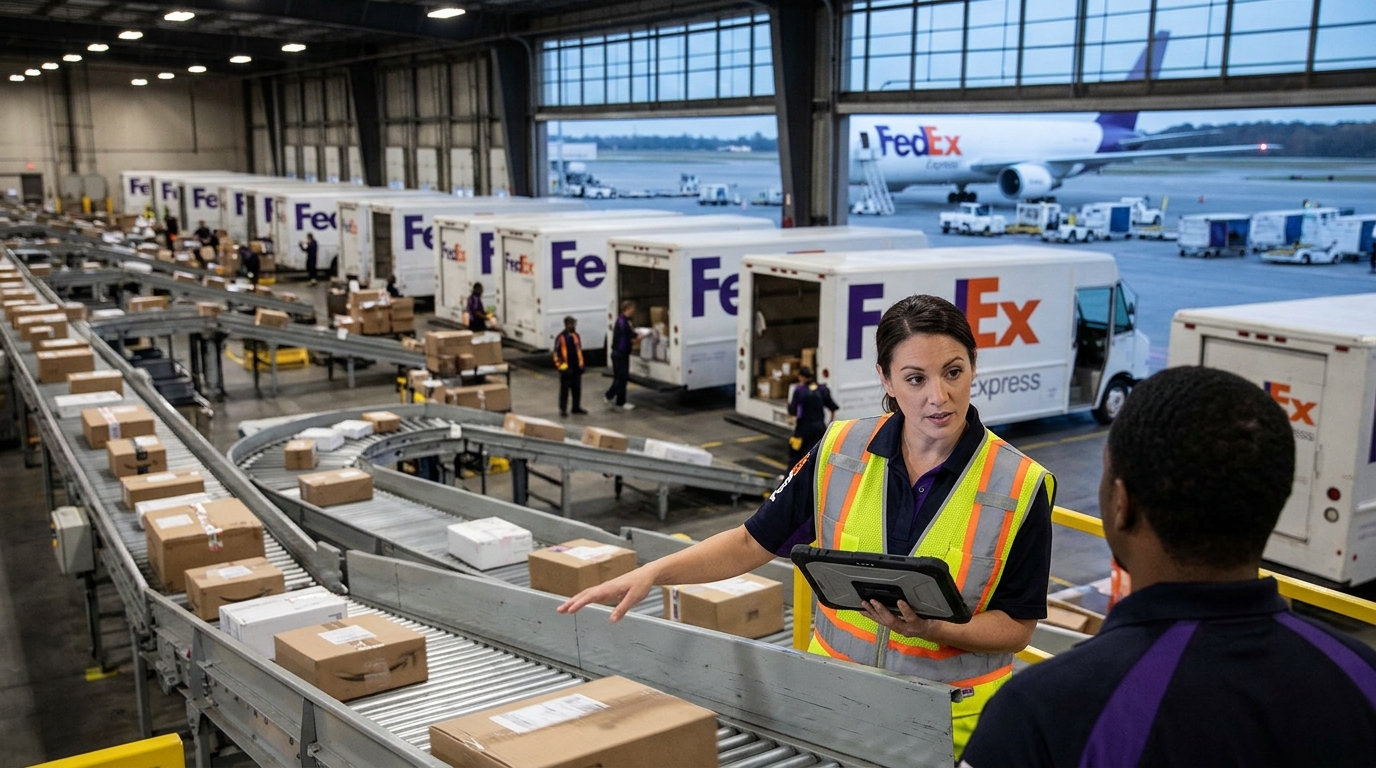
The bull thesis on FDX post-spin rests almost entirely on Network 2.0, the program consolidating Ground and Express into a unified pickup-and-delivery structure. Management has closed more than 260 stations so far, targeting over 475 total. Dallas, San Francisco, Phoenix, and Washington D.C. are fully converted; Los Angeles follows after the peak season.
That path is credible. It is not guaranteed. Converted terminals carry cost redundancies for several quarters before margin maturity is achieved, per TD Cowen’s read of management commentary. The company repurchased $2 billion of stock since June and has $4.3 billion remaining in buyback authorization, which signals confidence but also compresses the cushion if savings delivery slips.
Scenario Modeling
Bull Case: Network 2.0 hits the $2 billion savings target by late 2027 on schedule. Express U.S. Domestic margin recovers above 7.5%. FDX re-rates toward 20x forward earnings, implying a price above $370. The 19.9% FDXF stake gets exchanged against debt, reducing interest expense and further lifting EPS.
Base Case: Savings accumulate at a measured pace, margin recovery is visible but partial through mid-2027. FDX holds the $300 to $325 range on a forward P/E near 17x to 18x. The FDXF stake disposal is orderly and accretive to the balance sheet. Guidance of $18.00 to $18.60 adjusted EPS for calendar 2026 is met.
Bear Case: Pilot costs and peak-season volume shortfalls compress Express margins further. Network 2.0 station closures trigger service disruptions that push commercial accounts toward UPS. FDX slides toward $260, where long-duration valuation support may show up, but only if the earnings trajectory holds.
The bear case assumes commercial accounts have somewhere to go. UPS enters that conversation carrying a dividend that consumes nearly all of its free cash flow, which limits how aggressively it can price to win volume from a stumbling FedEx.
Trading Framework
The technical range to monitor is $300 support and $340 resistance, where the stock has stalled on two attempts since the spin-off. Volume on down days has been lighter than on advances, suggesting institutional holders are adding on weakness rather than distributing. The VWAP since the June separation sits near $310.
Volatility around the next earnings print is elevated given the first full quarter with no freight contribution. Traders should size accordingly. The core discipline here is distinguishing between a structurally improving business that the market has partially priced and one where execution risk remains. FedEx has earned the former label. It has not yet fully delivered the latter.