Friday’s October jobs report did something in a single session that the midterm election took three days to undo. The U.S. economy added 165,000 nonfarm jobs in October, more than double the forecast of 65,000, and the unemployment rate held at 4.1%, down from 4.2% in September.
That move matters beyond the exchange rate table. It reverses, in one morning, the dollar weakness that followed the Democrats’ midterm sweep on November 3 and returns USD/JPY to territory that has already drawn real money from both Tokyo and Washington.
What Actually Moved
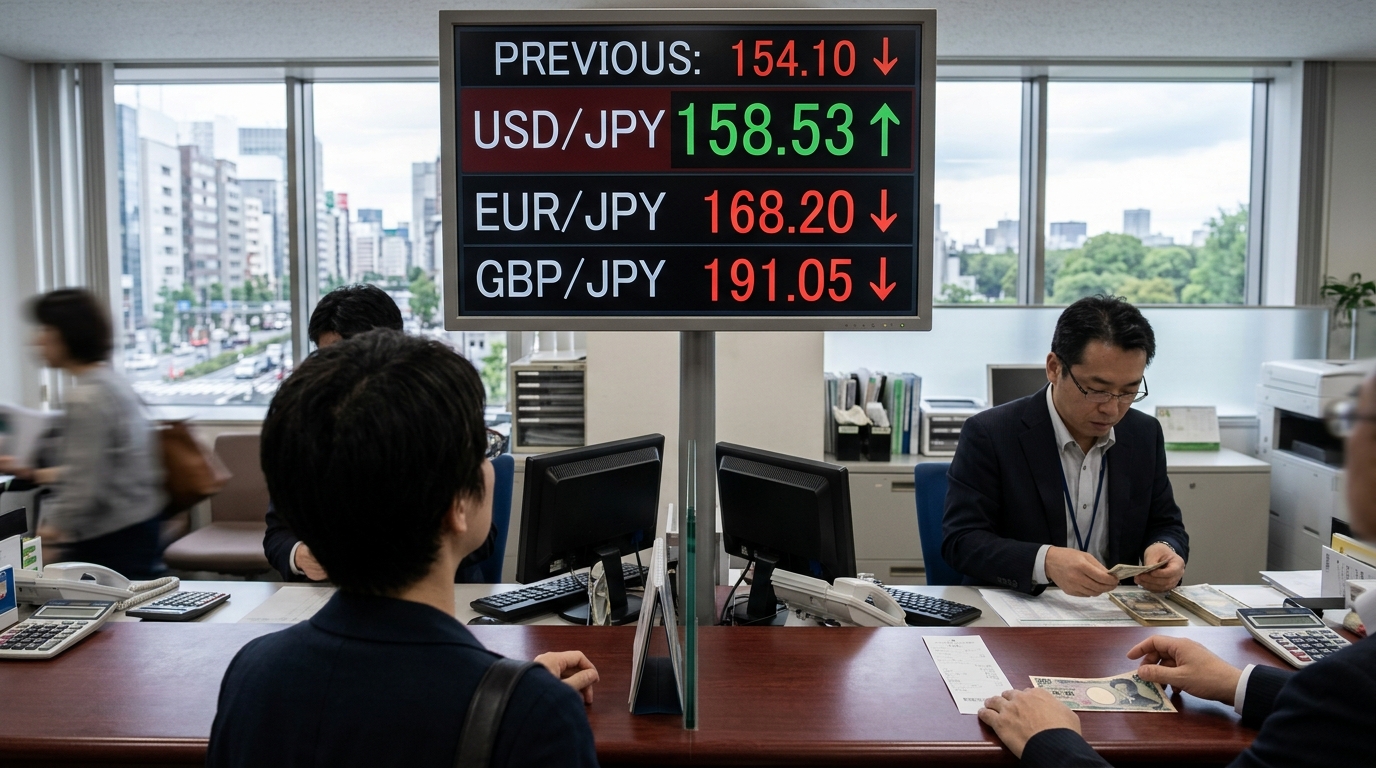
USD/JPY rose to 158.53 on November 6, up about 0.52% from the prior session. Treasury yields climbed alongside the dollar, with the 10-year yield around 4.86% and the 2-year around 4.51%. The euro fell about 0.55% against the dollar. Every major currency lost ground to the greenback on the day, but the yen’s slide carries the sharpest geopolitical edge.
The jobs data itself was hard to dismiss. August and September payrolls were revised higher by a combined 84,000, lifting the three-month hiring average to roughly 137,000. Average hourly earnings also ran hot, rising 0.4% in October and 3.1% year-over-year, against forecasts of 0.3% and 2.9%. For the Fed, that combination of volume and wage growth is not a report that invites patience.
Why It Happened
The report gives the Federal Reserve latitude to continue hiking interest rates, and market expectations for a 25-basis-point increase at the December meeting moved back toward the high-70% range in the wake of the data. That is what drove the dollar: not just the headline payroll beat, but the shift in odds for the Fed’s December meeting from a coin flip back toward something closer to a base case.
The yen’s particular vulnerability here is structural. The Bank of Japan’s policy rate is around 1.25%, against a Fed funds target range of 3.75% to 4.00%. That spread keeps downward pressure on the yen regardless of Tokyo’s warnings. The longer-term trajectory of the yen depends primarily on U.S. interest rates rather than the Bank of Japan, making the currency a barometer for global rates and liquidity.
What the Market May Be Missing
The 158.53 level is not arbitrary. In July 2026, the United States and Japan launched a rare joint currency intervention to strengthen the yen after it hit a four-decade low against the dollar. The coordinated intervention came as dollar-yen pushed toward the mid-160s, with the market widely described as nearing 164 per dollar. Friday’s close is still well below that extreme, but the speed of the move is what tends to trigger Tokyo’s hand, not the level alone.
Finance Minister Satsuki Katayama said just days ago that a joint FX statement with the U.S. remains in effect and that Tokyo will act against disorderly currency moves, though she gave traders no specific line in the sand. The ministry’s pattern is consistent: verbal warnings escalate, then come rate checks, then intervention. Friday’s one-day move of 0.52% is not yet “disorderly” by historical standards, but a continuation into next week could change that assessment quickly.
What complicates Tokyo’s calculus is that the BOJ itself may help: 83% of economists surveyed by Bloomberg forecast the Bank of Japan will raise borrowing costs from 1.25% at its December meeting. A confirmed hike would narrow the rate differential from Japan’s side, providing organic yen support that intervention cannot.
Risks and Counterpoints
The case that this move is temporary rests on two pillars. First, the BOJ’s December hike expectation is real. Second, with U.S. backing, currency interventions that are typically short-lived when conducted alone could prove more effective and more lasting.
The case that dollar strength persists is simpler: the rate differential is wide, the Fed now has cover to hike again, and the dollar is drawing additional support from safe-haven demand amid a global equity selloff driven by mounting concerns over AI-related valuations and the prospect of tighter regulation.
What to Watch Next
The October CPI report lands Tuesday, November 10, at 8:30 a.m. ET. Because the Bureau of Labor Statistics did not publish an October 2025 CPI report during the 2025 shutdown, year-over-year comparisons for October 2026 inflation are likely to be distorted or unavailable for some series; the focus may shift to what is observable in the month-over-month figures. The BOJ’s December 17-18 meeting, meanwhile, is the structural event: if it delivers the hike economists expect, some of Friday’s move unwinds on its own. If it does not, the yen’s defenders lose their best argument.