July 24, 2026
SpaceX Got Cut in Half. Now What?
SPCX is at a critical inflection point with earnings and a massive lockup expiry days away.
First a note from Stocks to Trade
When SpaceX went public, retail traders rushed in like it was the only stock on Earth.
They’re chasing SPCX itself, hoping that owning the biggest IPO ever is enough to make them rich…
But in my view, that’s a HUGE mistake.
Because history shows that when a company of SpaceX’s size hits the market, the REAL opportunities come in the aftermath…
And with Elon now the world’s first trillionaire, I think the opportunities are going to dwarf anything that’s come before.
My name is Tim Bohen. I’ve been trading the markets for more than 20 years…
And no one has made me more money than Elon Musk.
I recommended Tesla in 2020 when it was trading for just $37…
But right now, I’m more bullish than I’ve ever been based on what I see coming.
–Tim Bohen
SpaceX Got Cut in Half. Now What?
Market Snapshot
The broader market has largely shrugged off the volatility that has defined post-IPO SPCX trading. As of July 22, the S&P 500 was holding near record levels, the Nasdaq had bounced off recent lows, and investor appetite for AI infrastructure names remained intact. That context matters. SpaceX is not selling off because the macro is broken. It is selling off because the stock was priced for a version of the future that the current financials do not yet support, and because a wall of supply is approaching fast. The divergence between the index and SPCX is not subtle. It is the defining feature of this trade right now.
Why SPCX Is in Focus
SpaceX went public on June 12, 2026, priced at $135 per share in what became the largest IPO in U.S. history, raising $75 billion. Within days, the stock surged to an intraday peak of $225.64 on June 16, briefly pushing the company’s market cap above $2 trillion and vaulting it past both Amazon and Microsoft in market value. That was then.
By the close of trading on July 23, 2026, SPCX had settled at $115.26, down 6.7% on the session alone. That put the stock roughly 49% below its June peak and approximately 15% beneath its IPO price. In dollar terms, more than $1 trillion in market value has been erased in roughly five weeks of trading.
This is not a quiet drift lower. It is a full-scale post-IPO unwind, and it is happening into the two most important events the stock will face as a public company: a first-ever earnings report on August 4, and a lockup expiry that could release up to 911.5 million shares just two trading days later.
The space sector got pulled in immediately. On the day SpaceX began trading in June, every publicly traded space name declined. Planet Labs fell 8.8%, Virgin Galactic dropped 31.8%, AST SpaceMobile slid more than 15%, and Rocket Lab gave back meaningful gains. The rotation out of smaller space names and into the newly listed industry leader was direct and synchronized. It was not a judgment on those individual businesses. It was capital moving toward the dominant player now that it was finally available.
What is different now is that SPCX itself has joined the selloff. The stock that caused the sector to crater in mid-June is now the one under the most pressure.
Iran War Shock: What I Was Told In That Private Meeting
On January 7th… just outside Washington, D.C… I sat across from a man whose family has been tied to global power for decades.
Oil deals. Intelligence circles. Government insiders.
He leaned in and told me something that changed everything I thought I knew about the Iran war.
What you’re seeing on the news? It’s not the real story.
The strikes… the chaos… the escalation…It’s all part of something much bigger.
And the only reason I know this is because of him – an anonymous contact who risked everything to pass this information along.
The Financial Reality
Here is what the numbers actually show. SpaceX reported $18.7 billion in total revenue for 2025, up 33% year over year. Q1 2026 revenue came in at $4.69 billion, up 15% versus the same period a year prior. On the surface, those are solid growth figures.
But the profit picture is where the debate gets complicated. The company posted a GAAP net loss of $4.937 billion in 2025 and followed that with another $4.276 billion net loss in Q1 2026 alone. Free cash flow was negative $9.1 billion in the quarter. The AI segment, which includes xAI, Grok, and X, generated a $6.355 billion operating loss in 2025 while the company spent $7.7 billion on AI capital expenditures in the first quarter of 2026. S&P projects SpaceX will generate negative free cash flow through 2029.
The one business that works, clearly, is Starlink. The connectivity segment generated $11.4 billion in revenue in 2025, accounting for 61% of total company sales, and produced $4.4 billion in operating income for the year. By Q1 2026, Starlink’s share of total revenue had grown to 69%. Subscribers hit 10.3 million across 160 countries as of March 31, 2026, more than double the 4.6 million reported at the end of 2024. Starlink’s adjusted EBITDA margin sits near 63%, a software-like profile embedded inside what investors were sold as a space company.
The tension is real. Starlink is a high-quality, growing, capital-efficient business. Everything around it is burning cash at a rate that concerns serious analysts. Morningstar’s discounted cash flow model pegs fair value at $780 billion, roughly 48% below the private market valuation at IPO. NYU Stern’s Aswath Damodaran called the IPO valuation 27% too high based on his own model and described the company’s $28.5 trillion TAM estimate as a figure he would be embarrassed to publish.
Even after the correction, InvestingPro’s model puts fair value at $111.37, implying the stock at current levels around $115 is still slightly elevated on a fundamentals basis. With a market cap still exceeding $1.5 trillion and Q1 EPS of -$1.19, analysts have been cutting estimates fast. EPS revisions over the last 30 days collapsed by 46.2%.
The Lockup Clock
This is the structural issue that towers over everything else right now.
SpaceX’s lockup is staggered, not a single cliff. Only about 4 to 5% of shares made up the public float at IPO. The rest were locked. The first major wave unlocks two trading days after Q2 earnings, which are scheduled for August 4, 2026. That first tranche allows insiders to sell up to 20% of their eligible restricted shares, equivalent to as many as 911.5 million shares. At current prices, that represents approximately $105 billion in potential supply entering the market at once.
Smaller tranches of roughly 7% of locked shares each follow approximately every two to three weeks from late August through late October. A second large release of about 28% follows after Q3 earnings. By December 8, 2026, roughly 40% of all SpaceX shares will be freely tradable. Elon Musk’s own 6.4 billion shares carry a separate 366-day lockup, keeping them locked until approximately June 2027.
Historical context is relevant here. Buying into a massive lockup expiry before it clears has historically been a low-probability trade. Facebook, Beyond Meat, and Rivian all saw meaningful pressure as lockup shares began entering the market. SpaceX’s situation is more extreme. The total addressable supply dwarfs typical large-cap lockup expiries by roughly 68 times.
Institutional investors who got IPO allocations at $135 are not waiting around. Some are selling now to avoid being caught holding through that supply wave. Short sellers have taken notice. According to data from Ortex Technologies, nearly 196 million shares were being shorted in late July, representing approximately 31% of the free float. Short sellers have accumulated an estimated $15.5 billion in unrealized gains since the IPO. SPCX ranked as one of the most shorted large-cap stocks in the U.S. market.
In at 9:35 AM. Out by 10.
I call it the “Opening Bell Breakout.” It’s the same setup I used to catch moves like 113% on GOOGL and 240% on META. I trade one simple 15-minute window each morning – and I’m usually done by 10 AM.
Technical Picture
The chart is straightforward and it is not friendly to bulls right now. SPCX has put in a series of lower highs from its June 16 peak at $225.64. The 52-week low registered at $115.19, and the July 23 close of $115.26 essentially tested that low within a few cents. There is no established technical support below the IPO price of $135 because the stock has no trading history below that level. The entire public history of this stock sits between $115 and $226, a roughly six-week window.
Volume has been elevated on the down days, which confirms the selling pressure is real and not just thin-market noise. Approximately 56% of the free float was out on loan as of mid-week, which means short interest alone could amplify any large directional move in either direction.
The $115 area is the line that matters most. A sustained close below $115 would mark a new all-time low for the stock and likely accelerate selling from holders who bought at or near the IPO price. On the upside, the first area of meaningful overhead resistance sits near $135, the IPO price, followed by $150 and then the $169 to $175 range where the stock spent time during the first week of trading. Reclaiming $135 would be a meaningful technical signal that demand is absorbing supply.
The Macquarie analyst team stepped in on July 22, calling the pullback a buying opportunity and reiterating their outperform rating with a price target of $250. That briefly lifted SPCX from below $120 to $128 intraday before the stock settled back to $123.54 on the close. The bounce faded. That tells you something about the current balance of supply and demand.
Catalysts Driving the Next Move
There are four specific catalysts that will shape SPCX over the next one to five trading sessions, and traders should have a clear framework for each one before acting.
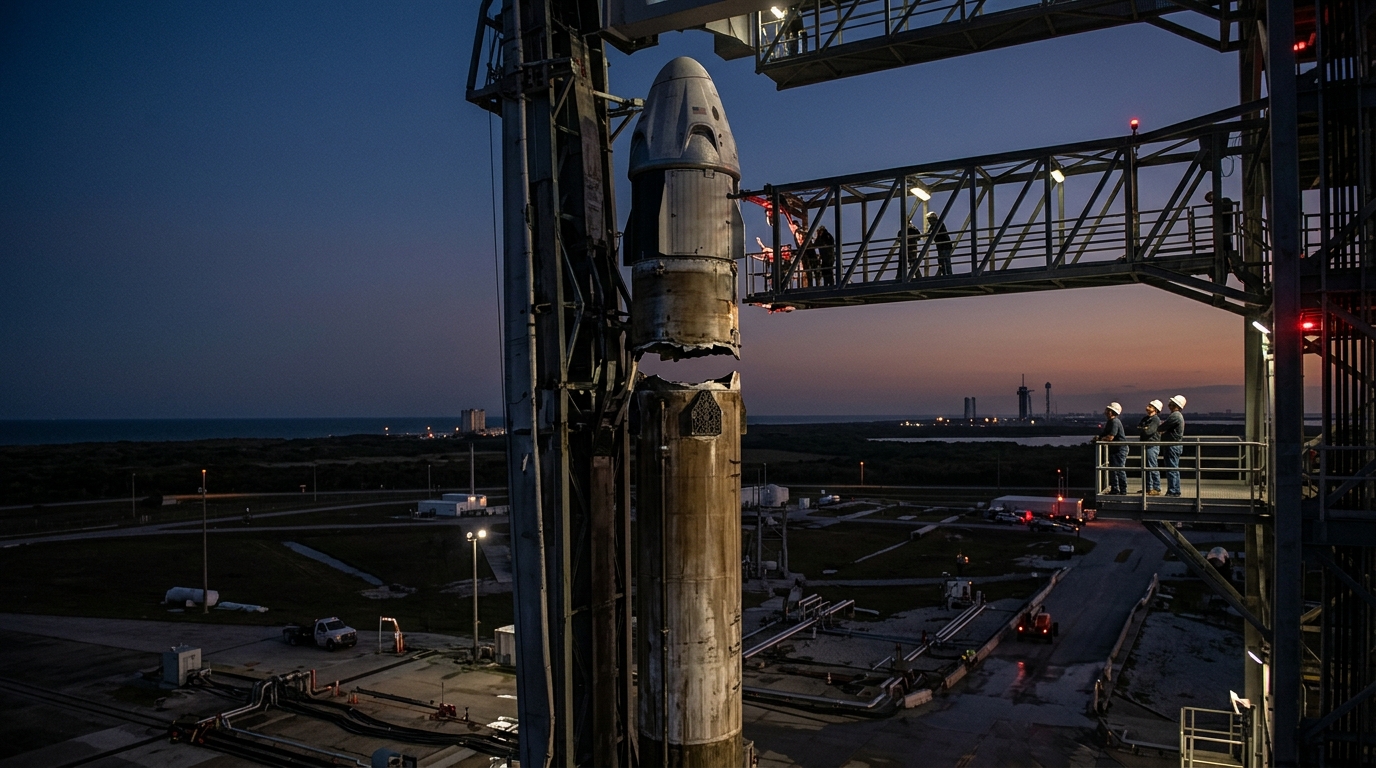
- Starship Flight 13 (July 23-24, 2026): SpaceX rescheduled the 13th Starship test flight to July 24 after a weather delay on July 16. This mission would deploy 20 next-generation Starlink V3 satellites for the first time. Starship is not a side project. It is the infrastructure required to launch V3 satellites, which will deliver roughly 1 terabit per second of downlink throughput compared to 80 gigabits on the current V2 Mini. Without operational Starship flights, Starlink’s next growth leg stalls. A successful flight could lift SPCX sentiment meaningfully. A second abort or vehicle loss could wipe another $100 billion in market cap, similar to what the July 16 abort already did.
- Q2 2026 Earnings (August 4): This will be SpaceX’s first-ever earnings report as a public company. Investors will focus on Starlink subscriber additions and ARPU trends, AI segment losses and capex pace, and any guidance around the path toward profitability. There is no analyst consensus estimate yet, which creates the conditions for a large price gap in either direction. Q1 EPS came in at -$1.19, and the AI segment’s cash burn rate has been the most destabilizing element of the financial story.
- Lockup Expiry (August 6): Two trading days after earnings, the first major tranche of insider shares becomes eligible for sale. Up to 911.5 million shares. The stock’s behavior in the 48 hours between the earnings release and the lockup open will be closely watched. If earnings disappoint and insiders sell aggressively, the pressure could be severe. If earnings are strong enough to absorb the supply, that would be a powerful signal about the floor.
- Tesla Merger Speculation: On Tesla’s July 22 earnings call, Elon Musk declined to dismiss the possibility of a SPCX-TSLA combination. Deepwater Asset Management’s Gene Munster has cited 90% odds of an eventual merger. This is speculative, but it adds an asymmetric wildcard to any short-side thesis. A confirmed merger announcement could create a sharp gap higher regardless of the short interest picture.
Sector Context
The damage to the broader space sector has been significant and is worth understanding as a separate dynamic. When SpaceX went public in June, it removed the scarcity premium that had been supporting smaller public space stocks. Before the IPO, investors wanting space exposure had to buy Rocket Lab, AST SpaceMobile, Planet Labs, or Intuitive Machines because SpaceX was unavailable. That scarcity premium inflated valuations across the board.
Once SPCX became tradable, that premium evaporated in a single session. Rocket Lab’s revenue grew 63.5% year over year in Q1 2026 and it has the most established small-launch business in the public market. But it still trades near 80 times sales and remains unprofitable. AST SpaceMobile, which is building a satellite broadband network designed to serve ordinary smartphones directly, took the hardest hit in the sector rotation. With a $4.3 billion market cap and just $187 million in Q1 revenue, the valuation demands execution on an ambitious vision that is still largely unproven.
SpaceX’s entry into the Nasdaq-100 in early July was expected to generate approximately $4.3 billion in passive buying from index-tracking funds. It did not stop the decline. From July 2 through mid-July, SPCX fell 10.3% even as the index inclusion drove mechanical buying. An equal-weight basket of Rocket Lab, AST SpaceMobile, and Planet Labs fell 16.7% over the same stretch. The conclusion from this: index inclusion does not override fundamental and supply concerns. It may provide a one-day cushion but it cannot reverse a structural problem.
Scenario Modeling
Bull Case: Starship Flight 13 succeeds on July 24, rebuilding confidence in the launch program. Q2 earnings on August 4 show Starlink subscriber additions above analyst expectations and a moderation in AI segment losses. The market reads the earnings as evidence of a credible path to profitability. The lockup expiry on August 6 sees minimal insider selling as pre-IPO holders choose to hold. Short interest at 31% of float creates the fuel for a sharp squeeze. Price targets from Macquarie ($250) and Oppenheimer ($250 raised from $190) come back into focus. A reclaim of $135 opens the door to $150 and then $169 over the following sessions. The Tesla merger speculation remains an unresolved wildcard with an asymmetric upside profile.
Base Case: Starship Flight 13 completes partially successfully but does not dramatically change sentiment. Q2 earnings are mixed, with Starlink performing well but AI losses remaining elevated. The lockup expiry on August 6 triggers moderate insider selling, keeping the stock range-bound between $110 and $135 for the following several weeks. The stock finds a tradeable floor but does not recover meaningfully until the supply dynamic becomes clearer after the first lockup tranche is absorbed. The analyst target range of $156 to $239 reflects genuine disagreement about fair value, not confident consensus. Wide range targets at this stage of a post-IPO lifecycle are a warning about uncertainty, not a bullish signal.
Bear Case: Starship Flight 13 aborts or results in a vehicle loss, repeating the pattern from July 16. Q2 earnings disappoint, with AI losses worse than feared and Starlink ARPU continuing to decline from $66 per month. The lockup expiry sees aggressive insider selling, overwhelming organic buying demand. The stock breaks decisively below $115, entering territory with no historical support. Short sellers covering partially could create brief violent bounces, but sustained downside pressure from 911.5 million shares entering the float would weigh on any recovery attempt through August. InvestingPro’s fair value estimate of $111.37 becomes the initial floor target, with further risk to the $100 area if sentiment deteriorates sharply.
Active Trader Strategy Framework
A few things are worth stating clearly before any positioning framework. This stock has 31% of its float sold short. It has an earnings report in 11 days that will be the first look at public financials. It has a lockup expiry 13 days away that could introduce more supply in a single event than has ever been seen in a large-cap lockup. That combination of factors does not favor low-conviction positioning from either side.
For traders considering the long side, the key question is whether the $115 area holds. A close below $115.19, the 52-week low, would be a meaningful failure and should be respected as an exit signal. Any position taken near current levels requires a predefined risk level and a clear understanding that the fundamental overhang from the lockup does not resolve quickly. The Starship flight outcome tonight is the first binary event. Size accordingly.
For traders considering the short side, the 31% short interest is not a deterrent by itself, but it is a risk factor. A meaningful earnings beat or a Starship success that triggers a squeeze could produce a violent move against crowded short positions. The asymmetry of the lockup means the short thesis is strongest after earnings are released and before the lockup shares actually clear. Position sizing and stop discipline matter more than the direction of the bet.
Key levels to monitor:
- $115.19: 52-week low and current floor. A sustained break below this level is a bearish signal with no established support below it.
- $123 to $125: Area where the Macquarie-driven bounce stalled on July 22. Resistance from failed rally attempts.
- $135: IPO price and first meaningful resistance. Reclaiming this level would be a change in near-term character.
- $150: First post-IPO reference point. Bulls need this level to rebuild momentum toward analyst targets.
- $169 to $175: Price-contingent trigger zone for the second lockup tranche. The stock being below $175 means the larger tranche stays locked for now, which is a marginal positive for near-term supply.
Risk Assessment
The risk list for SPCX is unusually long for a single stock. Raptor engine failures and Starship reliability questions remain unresolved after the July 16 abort. AI segment losses are accelerating on a capex base that shows no near-term moderation. Total long-term debt stood at $29.1 billion as of the end of Q1 2026, with $20 billion of that as a short-term bridge loan that must be paid down within six months of the IPO. Starlink ARPU has declined from $99 per month in 2023 to $66 per month in Q1 2026, though May 2026 price increases of $5 to $10 per month may begin to stabilize that figure. Competition from Amazon’s Project Kuiper satellite constellation is real and will intensify over the next 12 to 24 months.
On the other side of the ledger, Starlink’s subscription growth trajectory is genuinely impressive. Analysts at Quilty Space project 16.8 million subscribers by year-end 2026, up from 10.3 million as of March. Rocket Lab, Intuitive Machines, and SpaceX were jointly awarded a Space Force contract with a $17 billion ceiling in July 2026, adding government revenue visibility. Cathie Wood’s ARK Invest added SPCX positions in July, signaling at least some institutional conviction at current levels.
Your Download Link Will Expire
If you still haven’t downloaded my free “Simple Options Trading For Beginners” guide…
…please take a few seconds and download it right now before your new temporary download link expires.
I eventually plan to charge money for this training, so do yourself a favor and download it now…
That way, no matter what it costs in the future, you’ll have a free copy on your computer.
Make sense?
Trader’s Checklist
Before acting on SPCX over the next five sessions, monitor the following:
- Starship Flight 13 outcome. Success or failure will set the tone for price action heading into earnings.
- Whether SPCX holds $115.19 on a closing basis. A close below this level is the most important near-term signal for the bear case.
- Q2 earnings on August 4. Watch for Starlink subscriber additions, AI segment operating loss, capex guidance, and any commentary on the path to free cash flow breakeven.
- Insider selling volume when the August 6 lockup opens. Light selling relative to the 911.5 million share potential would be a meaningful positive signal.
- Any development on the Tesla-SpaceX merger speculation. Musk’s refusal to dismiss it on the July 22 Tesla earnings call is worth monitoring carefully.
- Short interest changes. At 31% of float, any directional shift in the earnings reaction will be amplified. Know your risk before the report drops.
Bottom Line
SPCX is the most consequential stock in the market right now, and not because of hype. It is consequential because the next 13 days will answer questions that have never been answered before: What do SpaceX’s public financials actually look like under scrutiny? How much do insiders want to sell? And is there enough genuine demand at these prices to absorb the supply that is coming?
The business underneath the stock, specifically Starlink, is real and growing. But the valuation layered on top of it at IPO was aggressive by almost any analytical framework, and the AI segment attached to it is burning cash at a rate that defies easy justification. Markets are not wrong to ask hard questions here.
Preparation over prediction. Know your levels, respect the lockup timeline, and let the data from August 4 and August 6 tell you what the next chapter looks like before committing to a directional view with high conviction.
For informational and educational purposes only. Not investment advice. Trading involves risk, including loss of principal.