
August 31, 2026
Urgent Briefing: Pre-IPO Opportunity
Bonus Content: FSLR: Small Shops Are Funding the Next Leg
Dear Reader,
A close contact of ours – a deeply connected venture capitalist with insights from the Pentagon and Silicon Valley – just went live with a confidential presentation…
Depending on when you’re reading this, it might already be too late to claim your spot in what could be one of the biggest pre-IPO plays of our time.
In this video briefing, you’ll learn how everyday investors can get pre-IPO exposure to this $30 billion juggernaut…
And you can do it straight from a regular brokerage account… with right around twenty bucks!
All you need is the four-letter ticker symbol… revealed in this video.
But here’s the thing: getting in pre-IPO is where the biggest gains happen.
So if you want to position yourself before this potential blockbuster IPO hits Wall Street…
Click here now to watch the urgent briefing… and get the pre-IPO ticker symbol.
Regards,
Addison Wiggin
Founder, Grey Swan Investment Fraternity
P.S. You will get the ticker symbol completely free in this briefing. No strings attached!
FSLR: Small Shops Are Funding the Next Leg
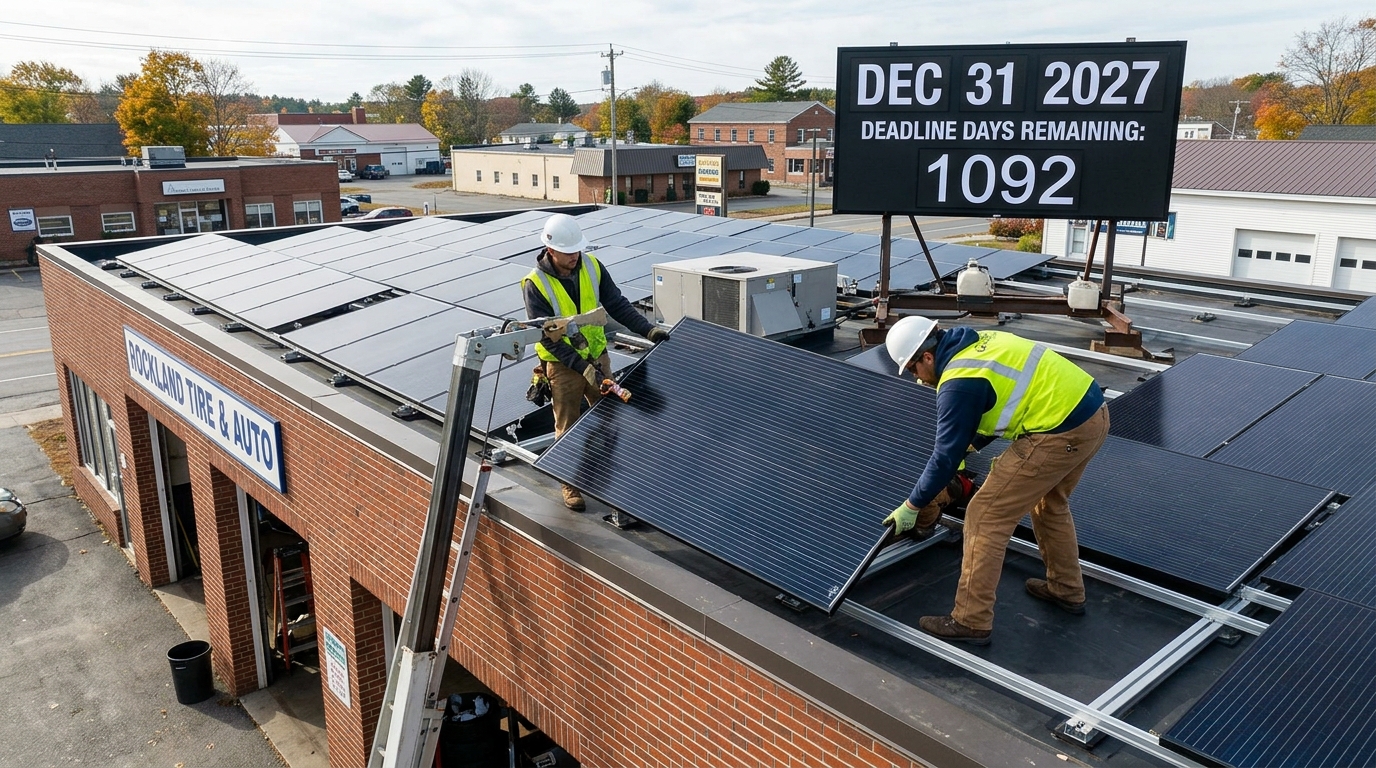
Forget the utility-scale story. The most underappreciated demand driver in commercial solar right now is a tire shop in Rockland, Maine, cutting a $1,000 monthly electric bill to under $20 after going solar. Multiply that across tens of thousands of small businesses staring at a December 31, 2027 deadline to claim a 30% federal tax credit on many wind and solar projects, and the resulting installation wave lands squarely on one stock the market sold off about 16% last month.
Why This Trade Stands Out
The Section 48E Clean Electricity Investment Credit does not end across the board on December 31, 2027. Instead, under current law and guidance, the credit generally remains available, with a phaseout tied to the later of 2032 or when U.S. power-sector greenhouse gas emissions fall to 25% of 2022 levels. However, recent tax-law changes have created a hard cutoff for many solar and wind projects: for projects that begin construction more than one year after enactment, eligibility can hinge on being placed in service by December 31, 2027. In practice, that kind of placed-in-service deadline can still create a rush to get projects built and interconnected in time.
Small businesses are not waiting. More and more businesses across multiple states, industries, and niches are racing against the clock to install solar before the deadline, and the increase in demand is already stretching timelines: commercial solar companies are filling construction calendars into 2027 and qualified contractors are booked through year-end. Businesses that wait until mid-2027 face interconnection queues, installer backlogs, and a finish line shared with every other project in the country.
The Stock Behind the Story
First Solar (FSLR) is the one domestic thin-film producer shielded from the import competition that is hammering foreign-module peers. The centerpiece of BMO’s constructive view is a Section 232 tariff framework signed by President Trump on August 6, 2026, which establishes a $0.38-per-watt minimum import price for solar modules and a 15% ad valorem duty on certain derivative products, both scheduled to take effect December 4, 2026. BMO anticipates these policies will lift U.S. module average selling prices toward $0.43 to $0.44 per watt. As a domestic producer shielded from direct import competition, First Solar is expected to benefit from this pricing environment, gaining a favorable window to secure volumes for 2029 and beyond at improved economics.
BMO Capital upgraded FSLR to Outperform from Market Perform on August 27, 2026 with a $263 price target, arguing that the stock’s roughly 16% pullback has overshot to the downside. First Solar reported a contracted sales backlog of 45.1 GW as of June 30, 2026. The stock currently trades well below both that backlog-implied fair value and the analyst consensus target.
Options Perspective
Implied volatility on the FSLR options chain is elevated, which makes outright long calls expensive. The preferred structure here is a bull call spread in the October or November expiry, buying the at-the-money call and selling a strike roughly 15% above current levels. The spread caps premium outlay while preserving meaningful upside if the Section 232 pricing lift and the small-business installation surge start moving consensus estimates. Maximum loss is the net debit paid. The spread benefits from a move higher without needing implied volatility to contract on entry.
Risk Management
This trade has clear invalidation conditions. The December 4, 2026 tariff effective date is the primary catalyst. If the administration delays or modifies the minimum import price before it takes effect, BMO’s pricing thesis weakens and FSLR’s near-term margin outlook softens. Supply-chain risk is also real for a thin-film manufacturer. Position sizing matters. The defined-risk spread format limits loss to the premium paid, which is the correct posture for a binary policy-sensitive situation.
The Beast Verdict
Small businesses scrambling to lock in a 30% federal credit before a hard December 31, 2027 cutoff for many wind and solar projects are generating the most durable near-term demand signal in commercial solar. The volume is real, the deadline is fixed for those projects, and the domestic manufacturer collecting the benefit just absorbed a tariff-driven selloff that BMO called overdone on August 27, 2026. With implied volatility elevated, a bull call spread lets traders own that thesis without paying for directionality that has not yet arrived.