September 8, 2026
Iran Declares Gulf Exclusion Zone. Traders Watch Tanker Flows.
Brent near $97, traffic at 10 ships/day, and refiners replacing barrels that stop moving.
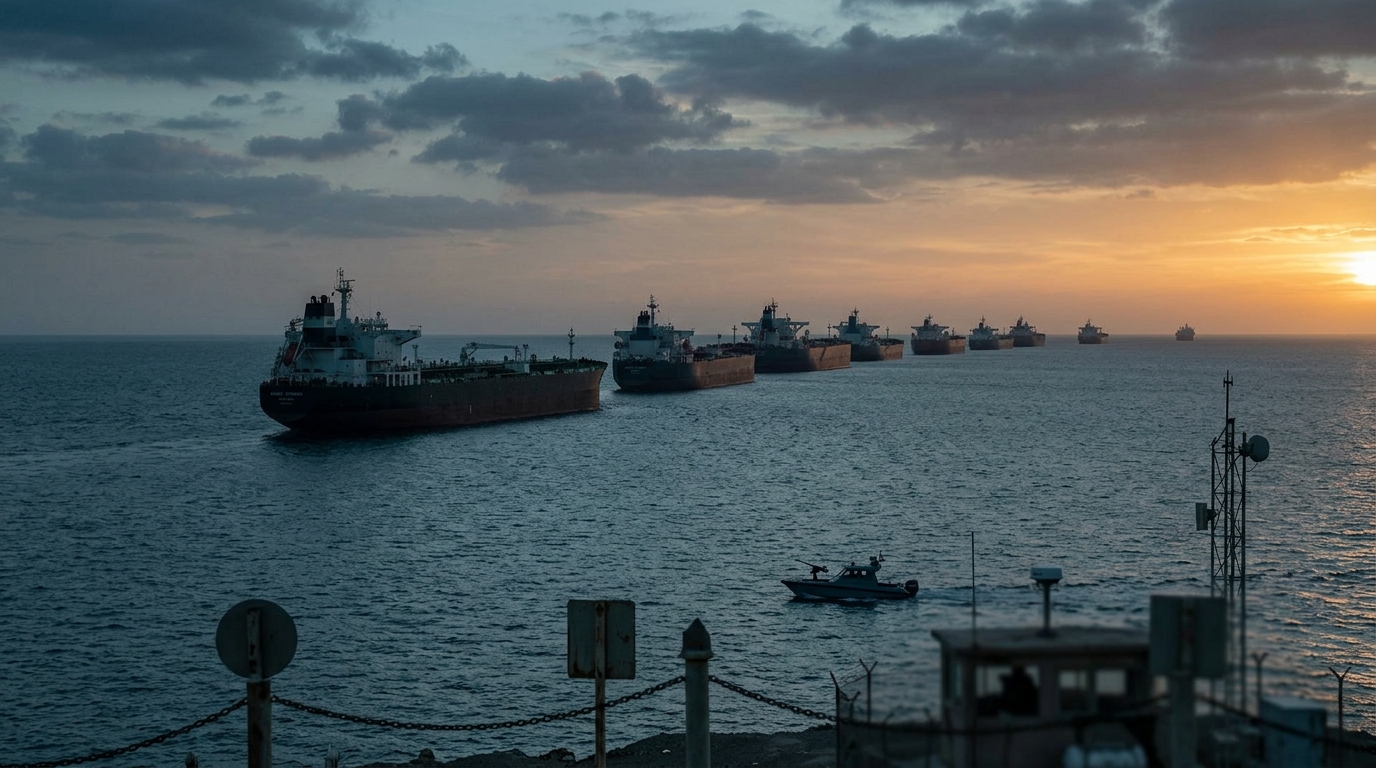
Iran’s Supreme National Security Council secretary Mohsen Rezaei announced Sunday that Tehran plans to announce a restricted maritime “exclusion zone” outside the Strait of Hormuz aimed at vessels it believes are attempting to transit the waterway. Iranian and Omani officials have also said maps for a new international shipping corridor through Iranian and Omani waters will follow “in the coming days.” The formal announcement has not yet been issued. The market has already priced the enforcement.
- Brent settled at $97.31 on September 7, a six-week high.
- WTI traded around $93 on September 7, also its highest level since late July.
- Reuters reported, citing Kpler data, that an average of about 10 commodity ships per day transited Hormuz over the past 10 days, the lowest level since May.
- Very large crude carriers (VLCCs) have largely avoided the strait in early September, with ship-tracking updates reporting no VLCC exit for several days.
- Crude-tanker equities have been strong in 2026, and BWET has posted triple-digit gains year-to-date as freight rates surged.
- ExxonMobil’s Q2 profit hit $14.5 billion; Chevron reported $12.1 billion, versus $7.1 billion and $2.5 billion, respectively, in Q2 2025.
- The U.S. Strategic Petroleum Reserve has fallen below 290 million barrels, its lowest level since 1982.
You’re Being LIED To About The Iran War
Forget EVERYTHING you’ve heard about the Iran war.
Especially the reasons why we’re bombing the country.
Market Context
The conflict that began February 28, when U.S. and Israeli forces struck Iran, has structurally priced energy higher. Public estimates before the war commonly put roughly one-fifth of global oil and petroleum liquids moving through the Strait of Hormuz, along with a meaningful share of LNG trade. Those shares are now running well below prewar levels. Before the conflict, roughly 20 million barrels per day moved through the waterway; U.S. Energy Secretary Chris Wright said current flows are averaging about nine million barrels per day. The gap between those two numbers is where the oil price lives.
Ceasefire talks that opened in June collapsed. In August, Trump said the U.S. would pursue what he called a crushing economic operation against Tehran. That escalation framing arrived just as the U.S. SPR dropped below 290 million barrels, the lowest since 1982. Inventory buffers are thin. Each fresh incident converts immediately into price.
This week brings the EIA Short-Term Energy Outlook, OPEC’s Monthly Oil Market Report, August PPI and CPI data, and the IEA’s monthly report, all landing against a backdrop of active military exchange. Traders navigating all of this simultaneously should expect sessions where a single headline moves crude two percent before the open.
Sector Breakdown
Two distinct trades are running in parallel, and they require separate frameworks.
Tanker operators benefit mechanically from disruption. The conflict has forced tankers onto longer routes and pushed up insurance costs, tightening the effective supply of vessels even as global trade keeps moving. Shipping shares and tanker-linked products have outperformed in 2026 as freight rates spiked. The logic is durable as long as routes stay long: more days at sea means higher utilization and more revenue per voyage.
The energy majors are a different calculation. Chevron’s Q2 net income was $12.1 billion, versus $2.5 billion in the same period last year. ExxonMobil reported $14.5 billion of second-quarter profit, up from $7.1 billion a year earlier. But refining is where the disruption bites: price formation gets harder when crude and products markets are being redirected by geopolitics. Middle East crude grades that previously moved west are not moving cleanly. Refiners built around Gulf Cooperation Council sour barrels are absorbing the substitution cost.
5 Nasdaq Stocks Under $5 That Aren’t What You Think
Most stocks under $5 come with a reputation. These don’t.
Each company on this list is tied to major trends like AI, cybersecurity, and next-gen infrastructure.
They may not have the spotlight yet, but they are building real businesses in real markets. That combination is not always easy to find at this price level.
Key Stocks
Frontline (FRO) and DHT Holdings (DHT) are a clean expression of the disruption trade because both run VLCC fleets. The risk is a sudden corridor agreement that immediately compresses war-risk premiums.
International Seaways (INSW) and Scorpio Tankers (STNG) carry similar exposure with more product-tanker concentration. INSW’s strength reflects institutional rotation into names with both VLCC and medium-range exposure.
ExxonMobil (XOM) reported Q2 revenues of $116 billion against analyst expectations of $97.8 billion. The company generated $17.2 billion of free cash flow and returned $9.4 billion to shareholders through dividends and buybacks. The refining variable is the one to watch if crude stays elevated.
XLE has functioned as the institutional vehicle for the broad energy trade. As of early September, Exxon and Chevron together were about 35% of the fund. Any durable ceasefire or diplomatic framework that restores meaningful tanker traffic would likely trigger rapid compression of the geopolitical risk premium in crude prices and energy equity valuations.
Technical Framework
Brent’s 30-day rally has run without a meaningful consolidation, and $97 is a six-week high. A sustained hold above $95 keeps the daily trend constructive. A close below $92 would suggest the war-risk premium is compressing faster than the physical disruption justifies.
For tanker names, early-September traffic data is the near-term catalyst that has not fully cleared. FRO and DHT are extended from their 20-day moving averages after the latest surge. Volume confirmation on any continuation matters. INSW’s breakout on above-average volume is a stronger signal than price alone.
A Forgotten Energy Source Is Powering Back Up
While investors chase the next tech story, one long-ignored sector is quietly heating up. A mix of global policy, rising demand, and tightening supply could reignite this market before 2026. See what the latest research reveals.
Scenario Modeling
Bull Case: Iran releases the formal zone maps this week, the alternative Omani corridor proves unworkable for VLCCs, and the exchange of strikes resumes. Brent pushes toward $105. Tanker names extend gains. XOM refining margins tighten further, but upstream earnings offset the drag.
Base Case: The zone declaration is issued but enforcement remains limited to Iranian sanctions listings rather than active interdiction. Any vessel identified as intending to transit while inside the zone would be added to an Iranian sanctions list, a meaningful deterrent that keeps traffic thin without triggering a direct naval confrontation. Brent holds $93 to $98. Tanker rates stay elevated. Refiner crack spreads remain volatile.
Bear Case: The Iran-Oman corridor agreement is signed, the U.S. Navy announces expanded escort operations, and VLCC transits recover toward the mid-teens per day within two weeks. Brent retraces toward $87. War-risk premiums collapse. Tanker stocks give back a portion of their year-to-date gains rapidly.
Active Trader Framework
The core positioning question is whether Iran can enforce what it has declared. Energy Secretary Wright said flows are averaging about 9 million barrels per day, a significant residual flow. That residual flow means the market is already partially pricing enforcement failure. The gap between a declared zone and a policed one is where mispricing lives.
For traders in tanker names, the risk management framework should account for headline sensitivity in both directions. A single corridor announcement can move these stocks 8 to 12% intraday. Position sizing relative to that volatility range matters more than the directional view. For XLE and the integrated majors, the key level to monitor is crude’s $92 floor. A breach on volume reopens the gap to the $87 range last traded in mid-August.
Conclusion
Iran does not need to physically intercept every tanker to move markets. Traffic around 10 ships a day is enforcement by deterrence. The formal zone maps, when they arrive, will tell traders where Iran believes it can operate versus where it is signaling. Those two geographies are unlikely to overlap cleanly, and that mismatch is the trade. Prepare across scenarios, size for volatility, and watch the corridor negotiations with Oman as the single most important variable this week.