Hi Trader,
Most “gurus” who teach beginners how to trade options start in the wrong place…
Because they immediately launch into complicated concepts like Greeks, spreads, and implied volatility.
And before long, most new traders are completely lost… and move on.
The free guide I want to share with you today takes a different approach.
Instead of overwhelming you with technical details…
It starts with the basics and shows you exactly how options work, why traders use them, and how they can fit into a simple trading plan.
If you’ve ever wanted to understand options but didn’t know where to start…
This is your chance.
Click here and get your free copy now.
To your trading success,
Dave Aquino
Lead Options Trader, Base Camp Trading
Corteva’s 84% Drop Is a Math Event. The Real Trade Starts Now.
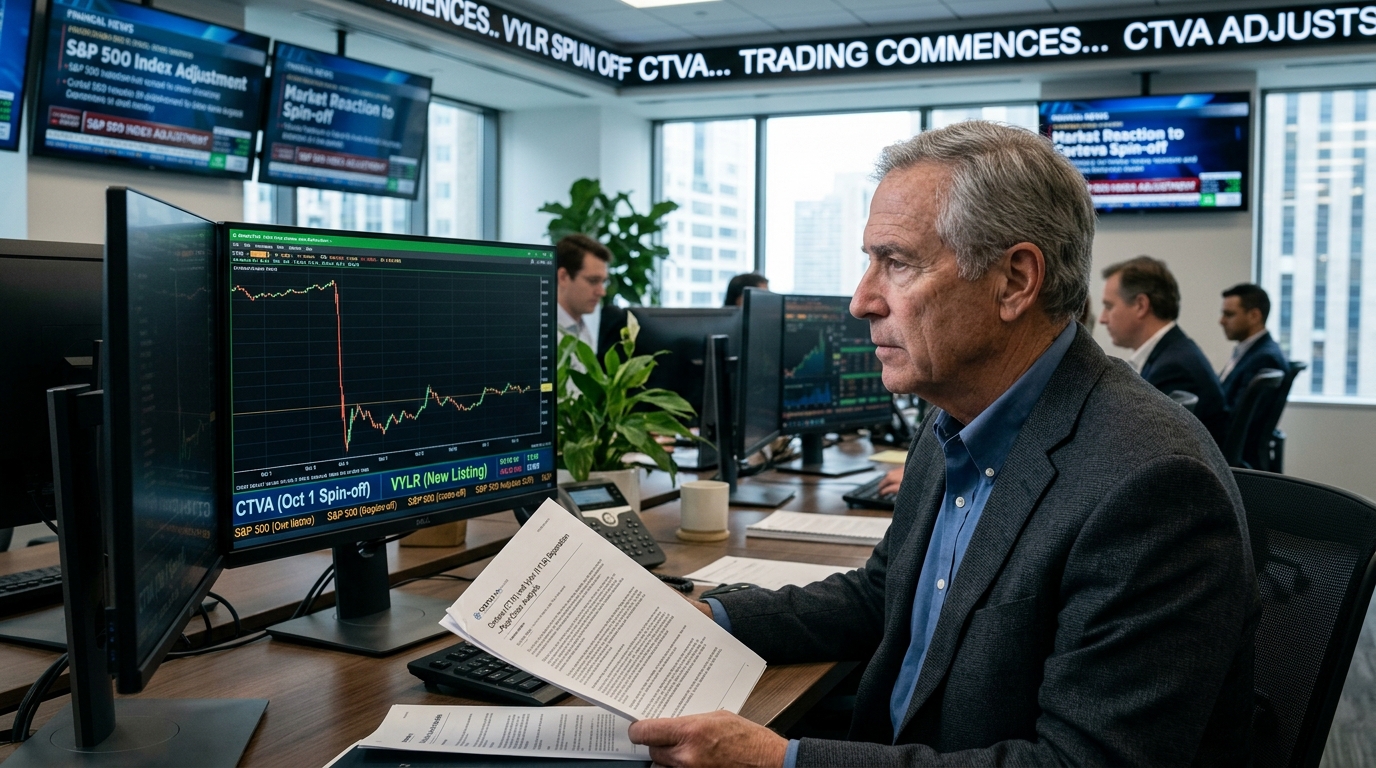
CTVA opened Thursday morning down roughly 84%. No earnings disaster, no guidance cut, no regulatory shock. On October 1, 2026, Corteva distributed Vylor shares to eligible stockholders, so Corteva stock began trading without that business embedded in its price. The separation was completed through a pro rata distribution of all outstanding Vylor shares to Corteva holders of record as of September 24, 2026. Each Corteva stockholder received one share of Vylor common stock for every share of Corteva common stock held. The price decline is arithmetic. Every dollar that used to represent seed genetics now sits in a separate ticker.
- CTVA showed a -83.81% one-day move as investors digest the transaction and related distribution mechanics.
- VYLR opened for trading October 1, closing the session at $68.26.
- After the spin-off, CTVA’s market cap is about $8.4 billion.
- Vylor Inc. was added to the S&P 500 on October 1 when Corteva spun off Vylor. Vylor replaces Corteva in the S&P 500.
- Corteva leaves the S&P 500 effective prior to the open on October 6 and moves into the S&P MidCap 400 on that same date.
- At its investor day last month, Corteva projected standalone sales to grow from about $7.8 billion in 2026 to between $8.4 billion and $8.7 billion by 2029.
- Vylor is targeting net sales of approximately $11.2 billion to $11.9 billion by 2029, representing 3% to 4% annual growth, and operating EBITDA of approximately $3.3 billion to $3.7 billion by 2029.
The Index Deletion Window
This is where mechanics create a tradeable dislocation. The formal S&P 500 deletion of Corteva takes effect prior to the open on October 6, with Corteva moving into the S&P MidCap 400 on that same effective date. Every passive fund benchmarked to the S&P 500 must remove CTVA from its portfolio by that open. That concentrated selling pressure is calendar-driven, not fundamental, and it compresses over a four-day window. Stocks deleted from large-cap indices routinely overshoot to the downside as forced sellers clear inventory, then mean-revert once the technical pressure exhausts itself.
Meanwhile, shares of Vylor rose in after-hours trading on Thursday after S&P Dow Jones Indices confirmed it would be added to the S&P 500, a change that forces index funds to buy the stock. That passive bid under VYLR partially offsets any early-week drift. Watch for VYLR volume to spike near the October 6 open as trackers finalize their weights.
What the Businesses Are Worth Separately
Corteva now becomes a pure-play crop-protection company with products spanning herbicides, insecticides, fungicides, and biologicals. Its crop protection pipeline is described by the company as about $11 billion. Crop protection net sales were $1.88 billion in Q1 2026, up 10% from $1.71 billion in Q1 2025. Segment operating EBITDA was $434 million in Q1 2026, up 15% from $377 million in Q1 2025. With a current market cap near $8.4 billion and competitors FMC and Bayer trading at materially higher revenue multiples for comparable crop chemistry exposures, the stripped-down CTVA carries a case for multiple expansion now that the seed business no longer clouds the valuation.
Vylor is an advanced seed and genetics company focused on delivering next-generation technology to farmers. It is anchored in the agriculture industry’s most elite germplasm and transformative biotech. The company has described a $19 billion technology pipeline and has guided to gross licensing income reaching $500 million in 2027.
Scenario Framework
Bull Case: Passive selling in CTVA exhausts by October 6. Post-deletion, natural buyers step in at crop-protection pure-play multiples, with CTVA recovering toward the mid-$14 range on improving relative strength. VYLR holds above $66 with index buying intact. Combined portfolio value exceeds the pre-spin CTVA close of roughly $77.65 on September 30.
Base Case: CTVA stabilizes between $11.50 and $13.50 through the deletion window as forced sellers clear. VYLR trades in the $65 to $72 range as the market calibrates standalone seed-and-genetics multiples. Combined value roughly tracks to pre-spin levels through October, with divergence building as earnings clarity improves.
Bear Case: MidCap 400 inclusion mechanics attract a second wave of forced selling. CTVA prints new lows below $11 as crop-protection pricing headwinds in Latin America weigh on the standalone margin story. VYLR falls below $65 if its GICS change to Consumer Staples effective October 6 triggers additional sector rebalancing.
Active Trader Framework
The primary risk this week is misreading the CTVA quote as a fundamental collapse. Under the terms of the split, Corteva shareholders received pro-rata VYLR common shares while keeping their existing CTVA stakes. The resulting price drop reflects this equity transfer rather than an actual loss of wealth. Traders holding legacy CTVA positions from before the record date own both legs. Those who bought CTVA after September 24 own only the crop-protection stub.
Key levels to monitor: CTVA’s intraday low on October 1 near $11.94 serves as the first support reference. VYLR’s day-one range of $65.00 to $74.95 defines the initial discovery band. Volume on both names will be heavily distorted by index rebalancing through October 6. Size accordingly, and treat any intraday readings as structurally noisy until the passive flows clear. Options chains on CTVA carry reset cost bases as well; verify strike adjustments with your broker before legging into spreads.
Corporate separations of this size produce well-documented post-spin mispricings. The discipline is isolating which side of the ledger is being dislocated by mechanics versus by genuine fundamental concern. That distinction, not the alarming headline number, is what active traders need to act on this week.