
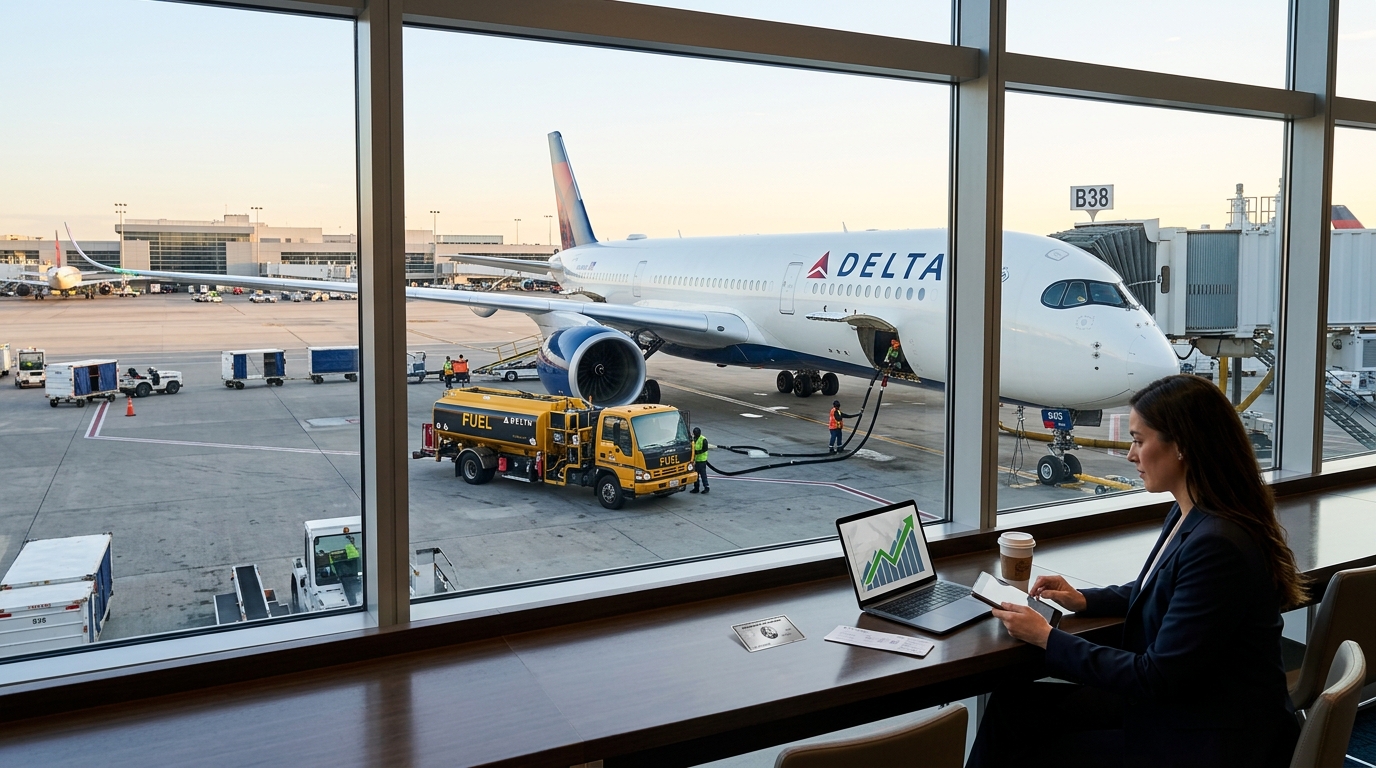
Here is the question Delta Air Lines spent all summer raising: when jet fuel costs surge year over year, does a premium-heavy revenue mix actually protect the bottom line, or does it just look good in a slide deck? The September quarter numbers, reported before the open this morning, provide the answer.
Adjusted EPS came in at $2.01, topping a consensus that had drifted to the $1.83–$1.88 range, and shares rose 3.8% on the open. That headline clears the low end of management’s own July guidance of $2.00 to $2.50, which is notable given how many analysts had stopped believing that range was achievable.
The backstory matters. In the June quarter, adjusted revenues climbed 13.9% to $17.7 billion, but adjusted EPS fell 26% to $1.56 as adjusted fuel expense rose to $4.4 billion. That collapse in earnings despite record revenue was the central anxiety heading into today: could Delta convert revenue growth into actual profit once crude reset at a structurally higher level? Rising fuel expenses were the most significant obstacle, with guidance implying a projected all-in fuel price for the September quarter of approximately $3.15 per gallon. A temporary refinery outage created a discrete headwind in the June quarter’s refinery benefit, even as Delta said the refinery was still a net positive overall.
What the Segment Mix Tells You
The beat is not about load factors or capacity tricks. The structural story running through 2026 is Delta’s deliberate shift away from main cabin dependence. Premium revenue did edge past main cabin passenger revenue in the June quarter, with premium products generating $6.92 billion against $6.85 billion from main cabin. The September quarter will show whether that lead widened or merely held.
Delta’s premium-focused approach, strong loyalty ecosystem, and diversified revenue streams distinguish it from most other carriers. In the June quarter, premium revenue grew 17% year over year and loyalty and related revenue rose 19%. Corporate sales grew at a double-digit rate, with premium corporate sales up more than 25%. Those numbers represent the fuel bill’s most effective offset: revenue that does not correlate tightly with seat count and carries far better margins than economy tickets.
The American Express relationship is worth isolating. Management said on its July earnings call that remuneration from the partnership is expected to be $9 billion this year, up 10%, and that cash flows in regardless of whether fuel is at $80 or $105 a barrel. In the June quarter, American Express remuneration was $2.4 billion. For investors, this is what a non-cyclical revenue stream inside an airline actually looks like.
The Risk That Does Not Go Away
Beating a downward-revised consensus is not the same as proving the model is bulletproof. Analyst sentiment did deteriorate into the print, with estimates moving lower as analysts grew more cautious about profitability, potentially responding to weakening fare environments or cost pressures. That caution did not disappear with today’s report; it shifts to the fourth quarter.
Full-year guidance was held at $6.50 to $7.50 adjusted EPS and $3 billion to $4 billion in free cash flow. Maintaining the range is the right move given the quarter ran in-line, but the math is tight. To hit even the low end of $6.50 for the full year, Delta needs a fourth quarter that builds on this morning’s momentum while absorbing whatever crude does next. Fuel costs remain the main risk, but a diversified revenue base and refining exposure give the airline more room to maneuver than most peers. Fourth-quarter fuel prices and holiday demand will determine whether the full-year range holds.
What Investors Should Watch Next
Two data points from the earnings call this morning are worth tracking closely through year-end. First, management’s per-gallon fuel assumption for Q4: Delta’s September-quarter guidance had implied an all-in fuel price of roughly $3.15, and any upward revision signals margin compression ahead. Second, whether premium revenue maintained its lead over main cabin in the September quarter, and by how much. That spread is the clearest real-time indicator of whether Delta’s pricing power is compounding or plateauing.
For the broader airline sector, Delta’s result sets the table. Delta is typically among the first major U.S. carriers to report each quarter, so its numbers serve as an early signal for travel demand trends across the industry. United, American, and Southwest all report in the coming week, and each will face questions about whether corporate and premium demand held as broadly as Delta suggests. This morning’s $2.01 argues it did.