October 13, 2026
Bonus Content: Oil Is at $106 Ahead of the CPI. Here Is What Traders Need to Decide.
Nations all over the world are experiencing the same problem: everyone needs copper and there isn’t nearly enough of it to go around.
They need it to expand power grids and transition away from fossil fuels. They also need it to meet the demand for data centers that is growing alongside the prominence of artificial intelligence.
But the mining industry is having trouble finding enough deposits to provide the kind of high-grade copper that can meet these skyrocketing demands.
So any projects that do appear are likely to get the kind of outsized attention that can increase their value and reward investors.
But it isn’t enough for those projects to have the right kind of copper. They also need to be large-scale, have copper that’s easy to reach, and be in stable jurisdictions.
When you take those things into account, it becomes increasingly obvious just why demand is having such a hard time being met.
One small company, currently trading under the radar, has all of these qualities and is being led by experienced management that knows exactly how to take the company to the next level.
Its district-scale property has delivered over 300 million pounds of copper in the past, and recent drilling indicates that there’s still more to be had.
That same property is located in Canada’s Yukon territory, a place with a storied mining history, strong infrastructure, and supportive regulatory environment.
The current drilling program isn’t just aiming to find copper in the ground, it’s also looking to expand the footprint and uncover more productive territory.
And to top it all off, the company is well funded, having enough capital to drill through the end of 2027 in a campaign that will involve advancing current projects, expanding current resources, and testing additional prospects.
This company gaining notoriety in the copper space is only a matter of time, so you’ll want to buy in now before the broader market learns about it.
We have all of the details in our brand-new FREE report.
You’ll learn the company name and ticker symbol, get the full details on its assets, and hear directly from management about what they’re building and what the next steps will be.
Click here to gain access today and secure your spot before more of the market learns about it.
Oil Is at $106 Ahead of the CPI. Here Is What Traders Need to Decide.
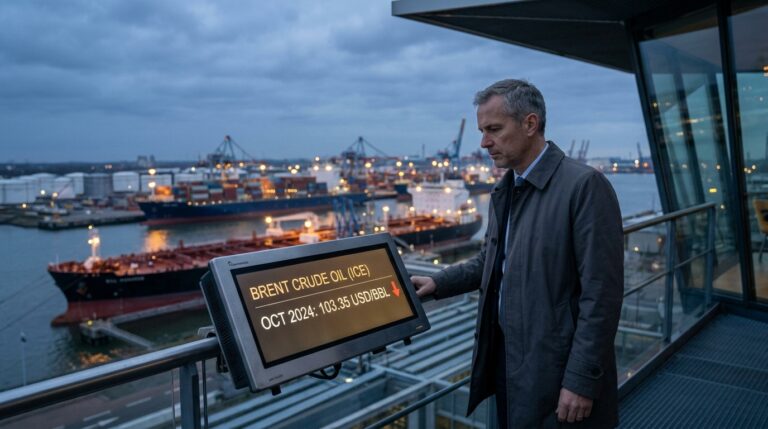
Brent crude is trading near $106 per barrel this morning, up sharply from a year ago, and the September consumer price index drops at 8:30 a.m. ET tomorrow. That collision is the week’s defining risk event for every rate-sensitive asset class, and the energy escalation of the past 72 hours has made the outcome meaningfully harder to read.
- Brent at approximately $106/bbl, up from $97.69 on September 30; year-over-year gain not confirmed
- Three tanker strikes in the Strait of Hormuz between October 9 and 11; UKMTO has posted multiple incident reports in the strait in recent days
- King Khalid International Airport hit repeatedly in recent days after multiple Houthi strikes killed at least 13 people and wounded more than 300; closure timeline not confirmed
- 29 nations including the US, UK, France, Germany and Australia jointly condemned Iran on Monday over the RAF Fairford plot
- Pentagon raised its official US death toll in the Iran war to 21 killed and 865 wounded
- September CPI consensus: headline 3.6–3.7% year-on-year, core near 2.4%; Fed funds rate at 3.75–4.00% after a September hike
- 3-2-1 crack spread near $64.83/bbl as of October 6, close to the widest level since 1986
Market Context
The macro backdrop is not merely “geopolitical uncertainty.” It is a live military conflict that the IEA has called the largest oil supply disruption in the history of the global market. The Strait of Hormuz, which carries roughly 20% of the world’s seaborne oil, is effectively closed to commercial traffic. IMF PortWatch recorded just four transits on October 4 against a pre-crisis baseline of about 85 per day. War-risk insurance for tankers is now pricing at much higher levels than pre-crisis, with some insurers pulling back from the route.
The UKMTO has posted multiple incident reports in the strait in recent days. Between September 28 and October 9, there were reports of elevated incident frequency in the area in industry shipping coverage. That is three vessels in three days.
On land, Houthi strikes on King Khalid International Airport in Riyadh have now killed at least 13 people and wounded more than 300 across recent attacks. The airport has been hit repeatedly over several days, and some airlines have suspended service. Saturday’s single strike killed 12 people and wounded more than 300, making it among the deadliest recent attacks on Saudi soil. Saudi Arabia said it intercepted additional incoming threats in subsequent incidents.
The diplomatic response is accelerating alongside the military one. On Monday, 29 countries including the US, UK, France, Germany, Canada and Australia released a joint statement condemning Iran over the RAF Fairford plot, in which British Prime Minister Andy Burnham said the IRGC “almost certainly directed” a suspected drone attack on the base the US has used to stage B-52 and B-1 sorties against Iran. The Pentagon updated its official war toll to 21 killed and 865 wounded on October 10.
Into all of this walks tomorrow’s CPI. The Cleveland Fed’s nowcast has September headline inflation at 3.60% year-on-year, up from 3.4% in August, with core near 2.4%. Consensus trackers put headline as high as 3.7%. The gap between the two is the whole problem: energy is moving the number households see while underlying inflation stays near target. The Fed hiked 25 basis points in September to 3.75–4.00% and meets again October 28. Markets currently price roughly a one-in-five chance of another hike at that meeting.
Sector Breakdown
The refining trade is the clearest structural beneficiary of this environment. The 3-2-1 crack spread sat near $64.83 per barrel as of October 6, close to the widest reading in data stretching back to 1986. Valero (VLO), Marathon Petroleum (MPC) and Phillips 66 (PSX) posted blockbuster quarter results in 2026, their strongest stretch since 2022. Marathon posted Q2 refining margins of $36.33 per barrel versus $17.58 a year earlier; Valero’s refining operating income was about $4.5 billion from about $1.3 billion in the prior year period. Claims about precise year-to-date moves for MPC, VLO, and PSX as of October 2026 were not confirmed.
Integrated majors are a different story. Exxon Mobil (XOM) and Chevron (CVX) carry upstream exposure that benefits from crude at $106, but their downstream and chemical segments face the same input cost pressure that refiners profit from. Claims about specific single-day closes and session moves for XOM and XLE in early October were not confirmed. Institutional flows have been rotating toward pure-play refining capacity and away from integrated balance sheets, a positioning that reflects a very specific view: the margin between crude input and product output matters more right now than reserve monetization.
Technical Framework
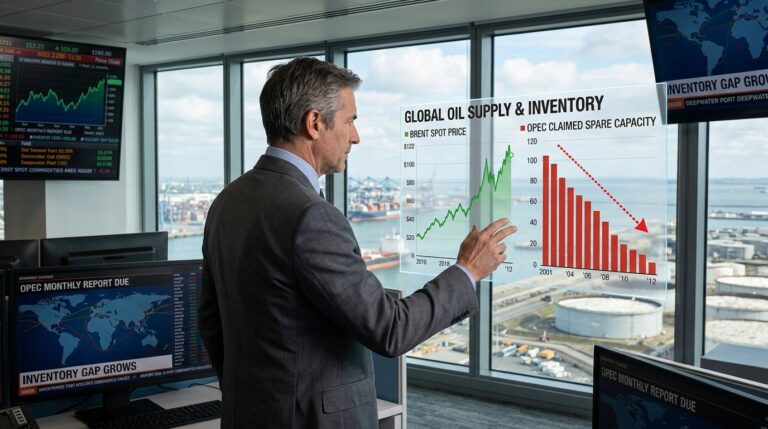
Brent has climbed from $97.69 on September 30 to a session high above $108 on October 12, before trading back near the mid-$100s. The $100 level, which held as support through the first week of October, is now the first meaningful downside reference. The $108–$110 band, tested intraday last week, is immediate resistance. Volume has been elevated on up days throughout October, consistent with institutional accumulation rather than short-covering alone. The WTI-Brent spread is a secondary indicator worth tracking: a widening spread signals Brent premium is returning, which typically front-runs another supply scare.
On the Treasury front, the two-year yield is the instrument most directly sensitive to a CPI surprise tomorrow. A headline print at or above 3.7% alongside even a modest core acceleration could reprice October Fed probabilities from 20% to 35–40%, putting pressure on the front end of the curve. That matters for energy equities: higher short rates compress the discount rate applied to refiner free cash flow at a moment when those cash flows are historically elevated.
Scenario Modeling
Bull Case
CPI comes in at or below 3.6% headline with core stable near 2.4%. The Fed holds in October. Brent holds $105 and additional Hormuz strikes keep the risk premium bid. VLO, MPC and PSX extend their 2026 gains as crack spreads remain historically wide into Q4 refinery maintenance season. Brent tests $110–$115 if Saudi Arabia formally requests US military involvement against the Houthis. Catalyst: any confirmed US strike on Houthi launch infrastructure.
Base Case
CPI lands at 3.6–3.7% headline, core stays near 2.4%. The Fed holds on October 28 but signals a December hike remains live. Brent oscillates between $100 and $108, with tanker attacks continuing but oil exports from the Gulf improving via diversions and alternative routing. Refiner crack spreads compress modestly from near-record levels as product supply catches up. MPC, VLO and PSX trade sideways to marginally lower from current levels as the CPI-driven rate scare offsets margin tailwinds.
Bear Case
CPI surprises to the upside, headline at 3.8% or higher, core breaks above 2.6% on airline fares and diesel pass-through. The Fed signals urgency. The two-year yield spikes 20+ basis points. Energy equities sell off despite strong crude, as the discount rate move overwhelms the commodity tailwind. Brent pulls back to $95–$98 on demand destruction fears. Key downside trigger: any US-Iran diplomatic signal, however tentative, that reduces the Hormuz risk premium.
The bear case hinges on a diplomatic signal reducing the Hormuz risk premium — and that signal has already been tested once. Trump’s rejection of Iran’s conditional Hormuz reopening offer shows how quickly a peace trade can collapse and reverse, giving traders a live template for sizing diplomatic headline risk.
Active Trader Strategy Framework
Tomorrow’s 8:30 ET CPI release is the fulcrum. Position sizing ahead of binary macro events requires acknowledging that the reaction will depend on which component the market chooses to weight: headline energy-driven inflation or core. A headline beat with a contained core is the scenario most likely to produce a sharp intraday reversal in both crude and front-end rates, as the market concludes the Fed has cover to pause.
For energy equity exposure, the refiner-versus-integrated spread trade has been the cleaner expression this cycle, given that crack spread dynamics are distinct from the upstream crude price. VLO and MPC carry lower crude price risk relative to their earnings power than XOM or CVX. Volatility expectations should remain elevated through October 28 FOMC. Key levels to monitor: Brent $100 as downside support, $110 as resistance; the 2-year Treasury yield relative to 4.25% as the threshold above which energy equity multiple compression becomes a real headwind.
Risk management discipline is the differentiator in environments like this one. Geopolitical escalation stories are known for producing sharp reversals on unverifiable diplomatic headlines. Size accordingly, respect stop levels, and let the CPI data clear before making directional conviction bets of meaningful size.
Conclusion
Three tankers in three days. A major international airport hit repeatedly by missiles and drones. Twenty-nine allied governments issuing a joint condemnation of Iran on the same morning that Brent sits at $106. The macro collision with tomorrow’s CPI is not incidental. It is the week’s defining event, because how the Fed interprets a headline inflation number that is being pushed by an active military conflict will shape rate expectations through year-end and beyond. Disciplined traders will not be positioned around a prediction. They will be prepared for the range of outcomes, with defined risk on both sides of the number.