Packaging Corporation of America just posted its strongest earnings beat of the year, then guided the street to a sequential step-down. Traders who stop reading there are missing the more important number.
The Q3 report, released October 21, showed adjusted EPS of $3.04 against a consensus of $2.93, on revenue of $2.60 billion, up 12.5% year over year. PKG met Wall Street’s revenue expectations in Q3 2026, with sales up 12.5% year on year to $2.60 billion, and its non-GAAP profit of $3.04 per share came in about 4% above analysts’ consensus estimates. The beat was driven by pricing power and faster-than-expected Greif integration synergies.
Q4 EPS guidance of $2.81 looks like a deceleration. It is, but the cause is structural and temporary. Management said the decline mainly reflects seasonal patterns, higher outage expense, and rising costs, partly offset by continued price realization. Maintenance outage expense for Q4 2026 is estimated at $0.72 per share, a known drag baked into the guidance.
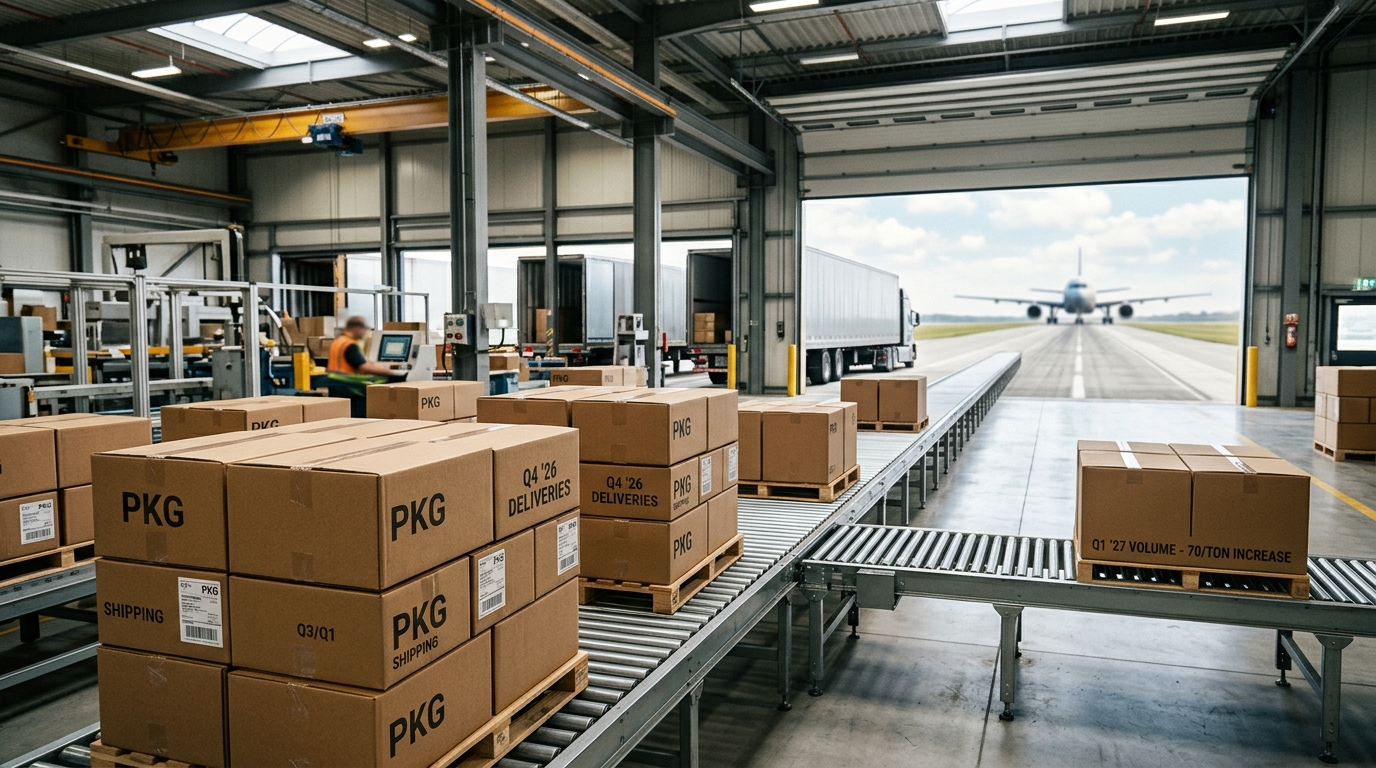
The real story is the $70-per-ton containerboard increase. PCA has substantially realized the first net $50 price increase and about half of the second $50 increase, and management expects most of the separate $70 increase to be realized in Q1 2027. That means a material portion of already-announced pricing has not yet reached the income statement. Holiday quarter box volumes are the bridge.
The company said the containerboard market remains tight and flagged a fourth-quarter seasonal pickup as an incremental tightening factor. Management forecasts volume to be roughly flat for Q4, acknowledging a tough year-over-year comparison and some December caution, while noting the agriculture sector is seeing some recovery and the mix will be more concentrated toward e-commerce.
That e-commerce skew is the operative variable entering November. Holiday fulfillment cycles compress shipping timelines and bias box mix toward lighter, lower-margin formats, which is why management flagged weaker corrugated mix in Q4 even as pricing continues to improve. The margin headwind is real. Legacy corrugated volumes remain down 0.5% per day, and higher freight, labor, and operating costs collectively created a $0.54 per share headwind in Q3.
The framework for traders: Q4 is a pass-through quarter. PCA expects almost all of the remaining second $50 price increase to be realized in Q4, while realization of the subsequent $70 increase will be divided between Q4 2026 and Q1 2027, with the majority expected in Q1. If holiday volumes hold even with year-ago levels, Q1 2027 earnings carry meaningful upside from price alone.
The firm carries a market capitalization of about $22.9 billion, with a trailing price-to-earnings ratio around 32 and a beta around 0.8, making it a relatively low-volatility vehicle for a bullish containerboard view. The Greif synergy run rate of $40 to $50 million provides an additional floor.
Watch the $2.81 Q4 print as a confirmation point. The real judgment day for PKG’s pricing cycle comes when Q1 2027 guidance lands. Disciplined traders prepare that thesis now, not after the January call.