November 6, 2026
Bonus Content: Hedge Funds Are Selling Megacap Tech. Here Is How to Spot It.
Hi Trader,
Most “gurus” who teach beginners how to trade options start in the wrong place…
Because they immediately launch into complicated concepts like Greeks, spreads, and implied volatility.
And before long, most new traders are completely lost… and move on.
The free guide I want to share with you today takes a different approach.
Instead of overwhelming you with technical details…
It starts with the basics and shows you exactly how options work, why traders use them, and how they can fit into a simple trading plan.
If you’ve ever wanted to understand options but didn’t know where to start…
This is your chance.
Click here and get your free copy now.
To your trading success,
Dave Aquino
Lead Options Trader, Base Camp Trading
Hedge Funds Are Selling Megacap Tech. Here Is How to Spot It.
When a $17 billion fund shrinks its equity long/short team, the market consequence is not philosophical. It is mechanical. Walleye Capital told investors Thursday it would cut a substantial portion of its internal stock-picking team and return capital after the firm’s worst monthly loss since March 2020. The question traders need to answer this morning is not whether Walleye is in trouble. It is what the next forced liquidation wave looks like in the order book, and which names are most exposed.
Market Context
Tech-focused equity long/short funds fell more than 4% on Thursday alone, leaving year-to-date returns roughly flat against a peak gain of 24% in June, before the AI-driven selloff, according to Goldman Sachs estimates cited by Reuters. JPMorgan estimates global hedge funds lost roughly 3% in October, also cited by Reuters. The Nasdaq 100 finished October down about 6.7%. That is the macro container. Inside it, the selling is not driven by a fresh macro view. It is driven by risk limits.
Goldman Sachs partner John Flood noted in a Thursday note that heavy de-risking into the U.S. midterm elections left some investors chasing Wednesday’s relief rally, only to be caught wrong-footed a day later, with hedge funds offloading hyperscaler exposure they had just bought, as reported by Seeking Alpha via TradingView.
The Crowding Problem
PivotalPath warned this week that large multistrategy funds face rising risks from overlapping investments and elevated leverage, with six multimanager platforms employing leverage of between eight and 14 times their net capital. Borrowing swelled their combined assets to about $2.2 trillion against roughly $360 billion in investor capital, magnifying the shared bets.
PivotalPath found that the U.S. equity holdings of the ten largest multistrategy firms overlap more with one another than with other hedge funds, and that their returns have become more correlated since 2019. The central question for allocators is whether pod-level risk limits, which manage each team in isolation, adequately capture the firm-level crowding that emerges when many teams hold similar positions. Lockups address redemption risk, but they do not change how a leveraged book behaves in a fast unwind.
In five trading days, Goldman Sachs prime brokerage data showed hedge funds erased nearly two years of AI stock purchases. Tech still made up 23.5% of Goldman’s global prime book after the selling, suggesting the unwind has further to run.
The speed of that unwind reflects how deeply AI infrastructure names were owned across institutional books. Forward estimates for key chip-supply names had already been declining even as AI capex commitments strengthened, a divergence that made crowded longs vulnerable to exactly this kind of de-risking.
Reading the Signature of Forced Selling
Forced liquidation has a recognizable pattern. Distressed selling tends to hit the same places first: big, liquid stocks that many funds hold, especially megacap tech. PivotalPath warned that the 10 largest multistrategy funds look increasingly similar, which can turn a broad de-risking into the same trade at the same time, pushing prices lower as liquidity thins.
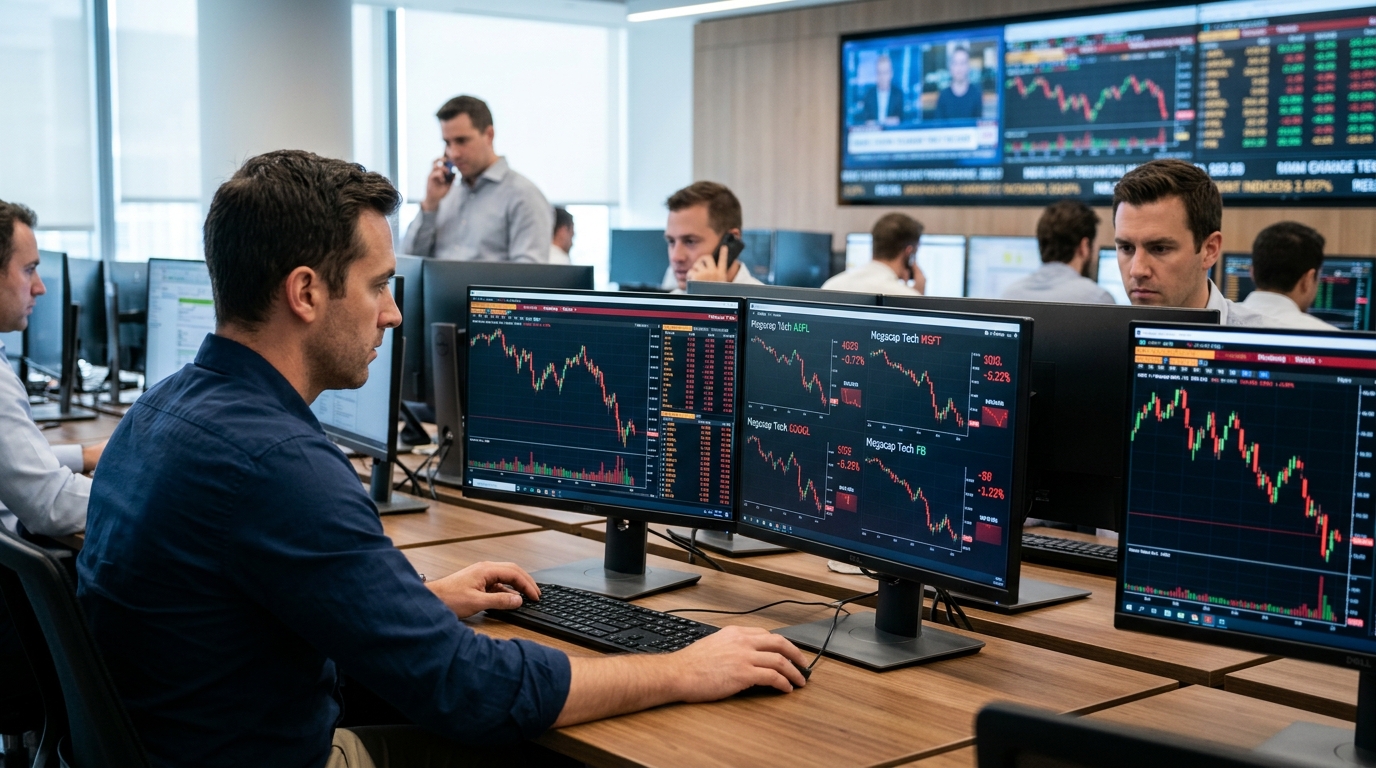
Practically, this shows up as correlation spikes. Hyperscalers and large-cap semiconductor names move together intraday without a fresh catalyst. Volume arrives in waves rather than steadily. Bid-ask spreads widen briefly then snap back, the classic sign of institutional blocks clearing. A widely circulated “Special Situations” market note listed several platforms and pods it said were seeing redemptions, liquidations, or team changes this week, including Axebrook, Engineers Gate, Lone Pine, Millennium and Verition pods, as well as Samlyn. When that many books are trimming simultaneously, correlation between megacap names is the tell.
Scenario Modeling
Bull Case: Walleye’s restructuring represents the capitulation event that clears the air. Reuters reported that several large multi-manager platforms have cut leverage and laid off loss-making teams in recent weeks. If that selling is largely done, the Nasdaq 100 stabilizes above its October close and hyperscalers regain their footing. Watch for a compression in intraday correlation across megacap tech as the signal.
Base Case: More teams face internal pressure thresholds before year-end. Reuters cited market participants saying they expect further layoffs if declines continue. The unwind continues at a slower pace through November, with megacap tech names exhibiting elevated volatility and persistent correlation. The Nasdaq 100 trades in a wide range, unable to sustainably reclaim its June highs.
Bear Case: PivotalPath warned that a simultaneous market shock affecting highly leveraged managers with concentrated positions could amplify selling pressure and create liquidity challenges, particularly for funds offering shorter investor redemption periods. If a second-wave catalyst arrives, whether from rates, earnings guidance, or macro data, the overlap in books means the same names get hit again, faster.
Active Trader Framework
Three levels matter right now. First, intraday correlation across the five largest Nasdaq 100 constituents. If they move in lockstep on no macro news, forced selling is still in progress. Second, the Nasdaq 100’s 50-day moving average. A failure to reclaim it on the first meaningful relief attempt is a continuation signal. Third, volume patterns in the opening 90 minutes: unusually heavy trades in megacap tech before 11 a.m. ET typically indicate institutional block liquidation rather than retail activity.
Position sizing should reflect a wide outcome range. The base case is not a crash; it is a grinding, correlation-driven chop that punishes both aggressive longs and complacent shorts. Volatility expectations should remain elevated through mid-November at minimum.
Conclusion
Walleye’s restructuring is an unusually transparent window into a process that is usually invisible. In a letter to investors reported by Bloomberg and Reuters, the firm said it would reduce a substantial portion of its internal equity long/short business after its worst month since March 2020. The broader industry is working through the same math, less publicly. Traders who know what forced selling looks like in the order book, specifically the correlated, liquidity-driven moves in megacap tech, are better positioned to avoid being on the wrong side of the next wave. Preparation is the product. Know your levels, watch the correlation, and size accordingly.