July 24, 2026
AMD Volatility Is Speaking
Featured: AMD Volatility Is Speaking
Hey Trader,
One of the biggest mistakes traders make with gold…
Is overpaying for exposure.
They’ll commit full capital…
Take full risk…
And still get less movement than they expected.
But there’s a way to structure the same idea differently.
One that can reduce the upfront cost significantly…
While still letting you participate in the move.
It’s not complicated.
It’s just not widely explained this way.
I laid it out step-by-step here.
It might change how you think about positioning altogether.
To a new way to trade gold,
Thomas Wood
Lead Trader, Base Camp Trading
AMD Volatility Is Speaking
The Signal
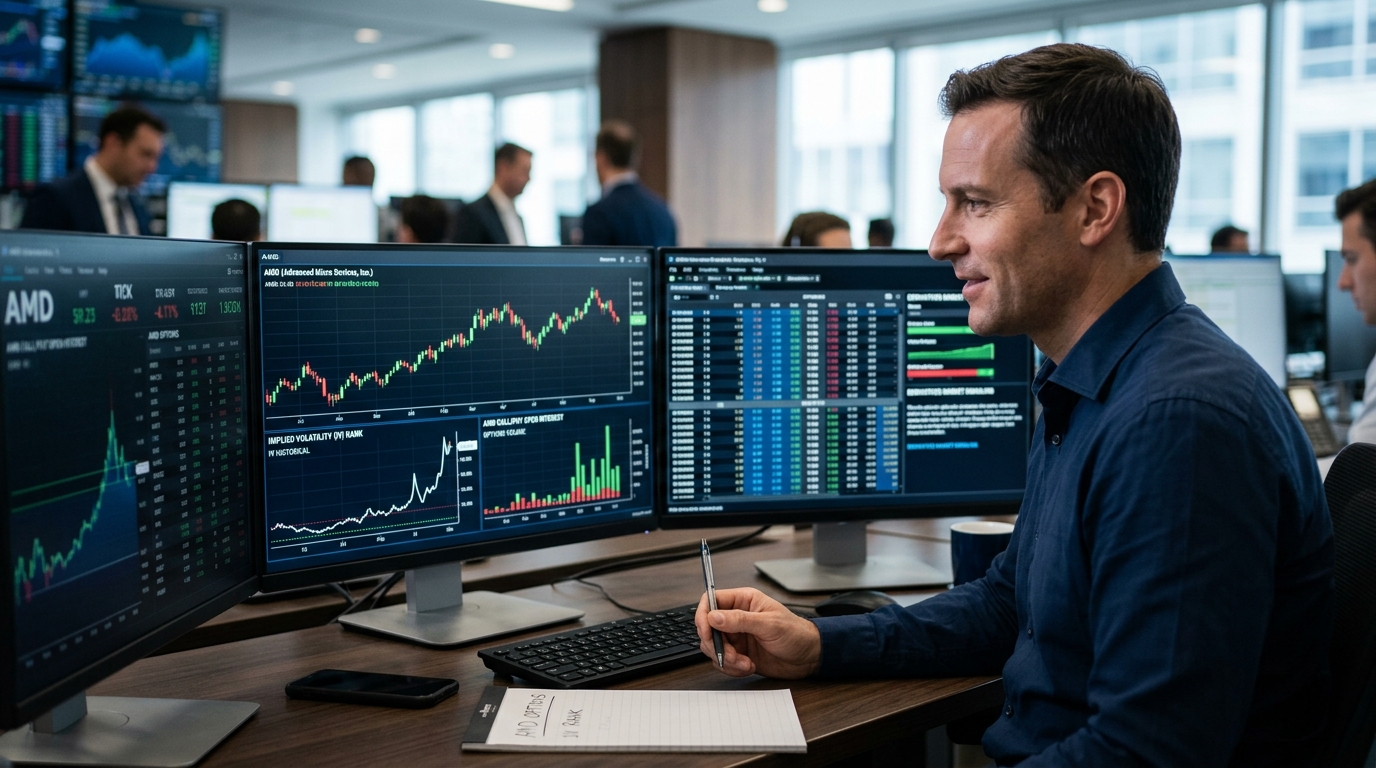
This week, AMD’s options market started charging more for time and for uncertainty.
Not because traders suddenly discovered AI. Because the catalyst calendar tightened. AMD wrapped its Advancing AI 2026 event on July 23, 2026, and then the next major waypoint is already queued: AMD reports fiscal Q2 2026 results on August 4, 2026 at 2:00 pm PDT.
When you see implied volatility stay firm, or even climb, immediately after a headline-heavy product event, it is often a clue that the market is not done. The options market is saying, “Nice slides. Now show me the quarter.”
Why It Matters
Lisa Su’s message on AI demand has been consistent: hyperscalers are spending because the payoff is arriving. The phrase floating around is “we’re seeing the returns.”
That’s not just a mood. It is a positioning problem for the market. If the returns are showing up inside the hyperscalers, then the next question is whether AMD can translate that into durable orders and repeatable deployments, not one-off announcements.
Options tend to react faster than equity analysts when that shift is underway. Not always correctly. But faster.
The Company Behind the Signal
Advancing AI 2026 sharpened the product story. AMD formally launched Helios, its rack-scale system that stitches together 72 Instinct MI455X GPUs into a single coherent domain. Helios is being positioned as AMD’s direct answer to Nvidia’s 72-GPU rack designs, and AMD is attaching an efficiency claim to it: up to 30% more tokens per dollar versus the leading competitive rack, based on internal testing.
Helios is not just a GPU pile. AMD is bundling GPUs, 6th Gen EPYC Venice CPUs, and Pensando networking as a full platform, plus ROCm as the software layer. Microsoft has already said it will deploy Helios “at scale” on Azure, which is the kind of customer validation that moves perception if it becomes visible in revenue.
The Next Big Energy Play (It’s Not Oil)
In 1859, Edwin Drake drilled America’s first oil well in Pennsylvania. John D. Rockefeller turned that single discovery into Standard Oil – and one of the largest fortunes in history.
Today, one former hedge fund manager says a new American resource is about to do the same thing. The U.S. Geological Survey just confirmed enough of it buried beneath New England to power the United States for 328 years.
And three American companies could capture the lion’s share of this opportunity.
Now the numbers, because they matter more than the stage show.
AMD’s Q1 2026 results (reported May 5, 2026) showed Data Center segment revenue of $5.8 billion, up 57% year over year. Non-GAAP diluted EPS was $1.37 on revenue of $10.25 billion. AMD also guided Q2 2026 revenue to approximately $11.2 billion plus or minus $300 million.
That Q2 guidance is the bridge. If this is truly the moment where hyperscaler spending shows measurable returns, you would expect guidance commentary to stay confident, and you would expect the mix to keep tilting toward Data Center.
Slight tangent, but it matters: Helios is easy to talk about as a single launch, but the real fight is deployment reliability. A rack-scale system is only valuable if it is repeatable at volume, with software behavior that does not embarrass the customer. This is why ROCm progress is not “nice to have.” It is existential for share gains.
Market Expectations
AMD is not a quiet stock right now. It put in an all-time high closing price of $580.91 on June 30, 2026. The 52-week range has been extreme, from $149.22 to $584.73. That is a market that has already moved from doubt to excitement in a hurry.
So what is the options market really pricing?
It is pricing that August 4 can create another discontinuity. Not a gradual drift. A gap risk event. The reason is simple: AMD has become a “prove it” story again, but from the opposite direction. Now it has to prove the scale.
And if you have been trading for any amount of time, you know what comes next. When implied volatility runs higher into earnings, buyers are paying for convexity. Sellers are betting that the market is overpaying for that convexity. Both camps can be rational. Only one side gets paid.
Strategic Considerations
I am going to keep this anchored to process, not bravado, because AMD is the type of underlying that punishes overconfidence.
1) If you want upside exposure but you respect premium cost: defined-risk call spreads can express a bullish view while avoiding the full cost of outright calls when implied volatility is elevated. The tradeoff is obvious. Your upside is capped.
2) If you think the market is underestimating the size of the earnings reaction: long premium structures like straddles or strangles can fit, but only if you have a clear plan for managing time decay and a realistic expectation for the required move. In elevated IV regimes, the break-even distances are not forgiving.
What If the Rising Prices at the Gas Pump Paid YOU?
Every time you fill up, someone’s getting rich, and it’s not you. A former hedge fund manager has a way for regular folks to come out ahead when oil and gas prices climb. Anyone can do this – without buying oil stocks.
3) If you think the market is overpaying for movement: defined-risk premium selling structures like iron condors can be the cleanest way to express that view. But AMD has shown it can move violently around catalyst points. If you sell premium here, you are selling into a stock that has already demonstrated it can run.
The important question is not whether volatility is high. It is whether volatility is high relative to what is plausible on August 4.
What to Watch
- August 4, 2026 at 2:00 pm PDT: the Q2 report and, more importantly, forward commentary around MI455X, Helios deployments, and pacing into H2 2026.
- Helios customer validation: Microsoft on Azure is a strong signal. Track whether other hyperscalers begin referencing Helios by name in their own commentary.
- Volatility behavior into earnings: if implied volatility continues to rise into August 4, the market is assigning a higher probability to a discontinuous move.
- Skew shifts: if upside calls remain persistently bid versus downside puts at comparable deltas, that is a directional tell. If it flips, treat it as information, not noise.
- ROCm traction: independent benchmarks and deployment case studies matter more than marketing claims. This is the point most people hand-wave, and it is usually the point that decides winners.
Here’s where I’m at. The market is no longer debating whether hyperscalers will spend on AI. It is debating who can deliver at scale, on time, with software that does not create operational friction.
AMD just raised its hand and said, “We can.” The options market is responding by charging more for the next 11 days.
August 4 is the checkpoint. Not the finish line.