July 25, 2026
Samsung’s $200B Broadcom Deal
The AI chip race just got a new power player.
First a note from Immersed
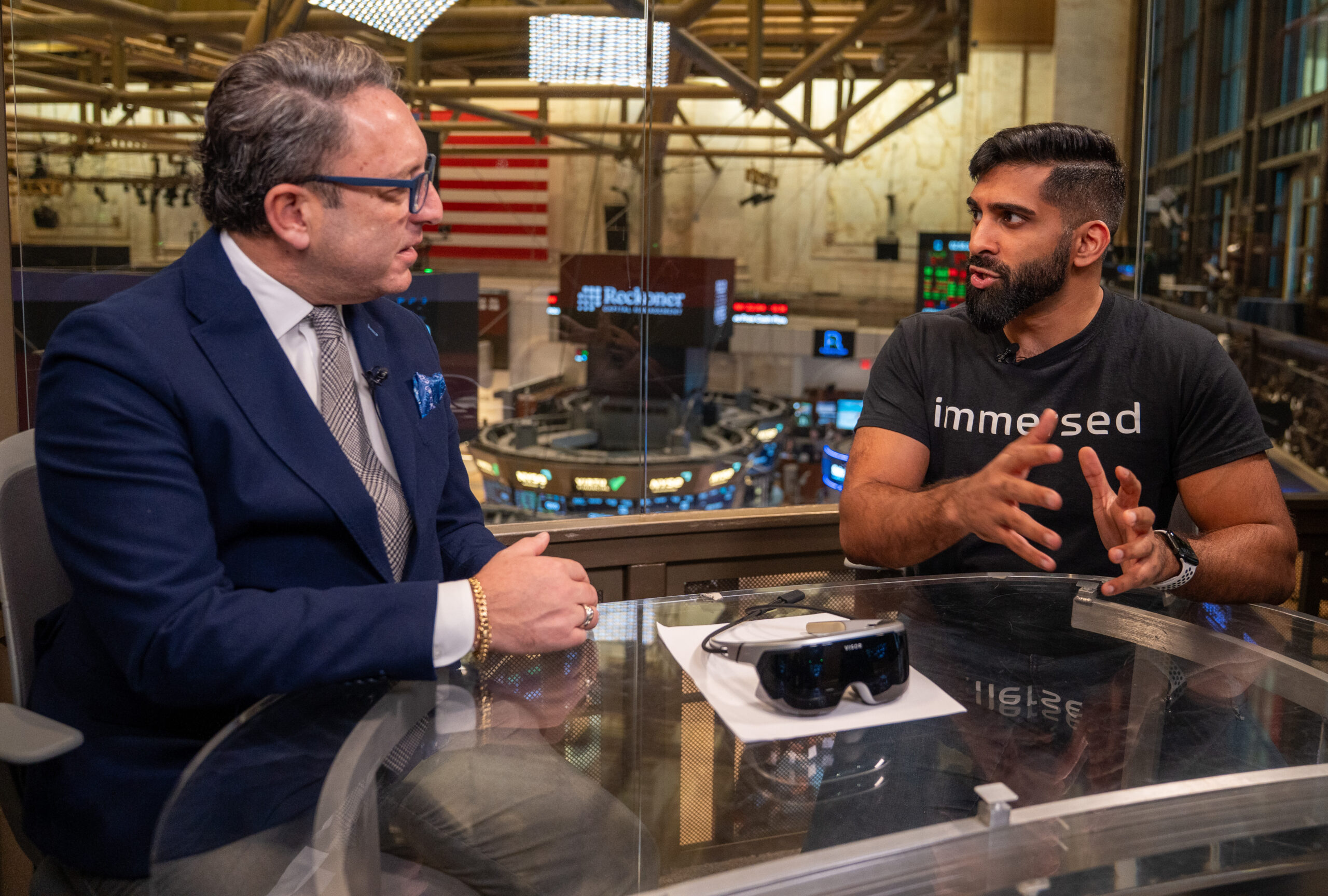
1.5M Users and NASDAQ Ticker Reserved
When Google, Meta, and Microsoft all partner with the same pre-IPO startup, investors pay attention.
But that’s not the only reason over 9,500 pre-IPO retail investors are backing Immersed.
This company is changing the game in AR/VR, developing the Meta Quest store’s most popular productivity app. 1.5 million people already use it, many up to 60 hours a week.
Their soon-to-be-released Visor headset has 2M more pixels than Apple’s Vision Pro for 70% less cost and weight. No wonder they’re projecting $71M in sales.
While their NASDAQ ticker $IMRS is reserved, you have an opportunity to invest pre-IPO in Immersed right now.
Market Snapshot
The macro backdrop heading into next week is charged. Crude oil surged above $93 a barrel Friday. The VIX spiked to 19.65, up over 18% on the session, a sign that options markets are pricing in more near-term turbulence than the equity indices are showing on the surface. The Russell 2000 dropped nearly 1% while the broader market digested a week packed with geopolitical headlines, fresh AI infrastructure commitments, and a semiconductor sector that simply refuses to slow down on a fundamental basis even as individual names chop around technically.
Samsung Electronics (005930.KS) closed at 270,000 KRW Thursday before pulling back to roughly 248,500 KRW by Friday’s close — a 52-week range that runs from 65,500 to 374,500 KRW tells you everything about how violent this stock’s re-rating has been. Then, on Saturday July 24 in San Francisco, Samsung signed what may be the most consequential single customer agreement in semiconductor history. A $200 billion, five-year MOU with Broadcom. And the market hasn’t fully processed it yet.
Bullet Summary
- Samsung and Broadcom signed a $200B+ MOU on July 24, covering HBM4 and HBM4E memory supply, 2nm and sub-2nm foundry manufacturing, and advanced 2.3D/2.5D packaging through 2030.
- The deal is part of a broader $950B South Korea-U.S. AI infrastructure framework signed at a presidential summit in San Francisco, which also includes SK Hynix’s $750B commitment tied to Nvidia.
- Broadcom’s AI semiconductor revenue hit $10.8B in fiscal Q2 2026, up 143% year over year, with Q3 guidance of $16B implying over 200% year-over-year growth — and a full-year AI chip target above $100B.
- Samsung posted Q2 2026 operating profit guidance of 89.4 trillion KRW ($58.4B), a 19-fold increase year over year, with full-segment results due July 30.
- Samsung’s foundry market share stood at just 6.5% in Q1 2026 vs. TSMC’s 72.3% — the Broadcom deal is a direct attack on that gap, not a minor customer win.
- Contract DRAM prices rose 90-95% quarter over quarter in early 2026, with supply expected to remain tight for 12-18 months — pricing power is structurally in Samsung’s favor.
- Samsung’s 52-week analyst consensus target sits at 492,537 KRW vs. a current price near 248,500 KRW, implying roughly 98% upside on average — though execution risk remains real.
Nasdaq Ticker Reserved
They’ve reserved the NASDAQ ticker FASF. They just broke ground on their $850M flagship coal reformation facility in West Virginia. Frontieras is hitting massive milestones in very little time. This positions the company for potential valuation impact. Final weeks to become an early-stage shareholder.
Join 12K+ people and invest in Frontieras at $9.01/share by 8/6.
Disclosure: This is a paid advertisement for Frontieras’s Regulation A offering. Please read the offering circular at invest.frontieras.com
Why This Stock Is in Focus
Slight tangent, but it matters. This deal didn’t happen in a vacuum. South Korean President Lee Jae Myung convened an AI summit at The Midway in San Francisco on July 24, pulling together the CEOs of Nvidia, Broadcom, OpenAI, and Anthropic alongside South Korea’s top chaebol leadership. The result: approximately $950 billion in semiconductor and AI infrastructure commitments between South Korea and the United States. Samsung’s $200 billion slice of that is the headline. SK Hynix’s $750 billion Nvidia-anchored commitment is the other half.
What makes the Samsung-Broadcom deal structurally different from a typical supply agreement is scope. This isn’t just a memory order. Samsung will supply Broadcom with HBM4 and HBM4E, its most advanced high-bandwidth memory products, for Broadcom’s next-generation AI accelerators. On the foundry side, Samsung will manufacture Broadcom’s chips on its 2nm and below process nodes — including next-generation wireless broadband communications silicon. And the collaboration extends further still into advanced packaging, specifically 2.3D and 2.5D integration technologies, aimed at stacking memory closer to logic to extract more performance per watt from AI and networking chips.
That is a full-stack, vertically integrated commitment from a single supplier. Analysts in Seoul are already calling it Samsung’s “turnkey jackpot” — a term that captures the strategic logic well. Broadcom gets a diversified supply chain away from single-source dependencies. Samsung gets the largest customer commitment in its foundry division’s history at a moment when it badly needs one.
The Fundamental Picture
Let’s start with the demand side and work backward to what this means for Samsung’s numbers.
Broadcom reported fiscal Q2 2026 revenue of $22.2 billion, up 48% year over year. AI semiconductor revenue specifically hit $10.8 billion in that quarter, a 143% year-over-year increase. CEO Hock Tan guided Q3 AI chip revenue to $16 billion — over 200% year-over-year growth — and maintained the company’s full-year AI chip revenue target above $100 billion. The company posted adjusted EBITDA of $15.24 billion in Q2, representing 69% of revenue. Free cash flow came in at $10.26 billion, or 46% of revenue. These are not the numbers of a cyclical company riding a wave. This is compounding, and it’s accelerating.
The five largest U.S. technology companies are collectively projected to spend over $630 billion on AI infrastructure in 2026. Broadcom’s custom AI accelerators — ASICs built for hyperscale cloud providers — sit directly in the path of that spending. And Broadcom needs chips to build those chips. That’s where Samsung comes in.
On Samsung’s side, the Q2 2026 operating profit guidance of 89.4 trillion KRW represents a 19-fold year-over-year jump and exceeded analyst expectations of 84.2 trillion KRW. Revenue of 171 trillion KRW was up 129% year over year. Full segment-level results drop July 30, and that release will be critical — traders will be looking specifically at foundry divisional data to gauge how much of the quarter’s strength came from memory versus contract manufacturing.
Here’s the uncomfortable truth that also has to be said: Samsung’s foundry business is still losing money. Q1 2026 foundry revenue was just $3.2 billion, down 5.8% sequentially, against TSMC’s $35.86 billion in the same period. Samsung held 6.5% foundry market share in Q1 2026 while TSMC commanded 72.3%. Management has indicated the foundry business may not reach profitability until 2028. That context is not a reason to dismiss the Broadcom deal — it’s a reason to understand what the deal actually is: a long-duration inflection catalyst, not a near-term earnings driver.
Sector Backdrop and Capital Flows
The memory market itself is a tailwind that gets overlooked in all the foundry conversation. Contract DRAM prices rose 90 to 95 percent quarter over quarter in Q1 2026, the largest quarterly spike ever recorded. NAND flash was up more than 50% in the same period. Industry analysts warn that supply will remain tight for at least 12 to 18 months, with meaningful new HBM capacity not arriving until 2027 or 2028 at the earliest.
That supply-demand imbalance is what gives the Samsung-Broadcom forward purchase agreement its real strategic value. For Broadcom, locking in five years of HBM4 and HBM4E supply at this moment converts an unpredictable spot market into a managed supply pipeline — critical when memory prices have nearly doubled in a single quarter. For Samsung, it locks in a volume-committed customer at premium memory pricing during a period of structural scarcity. The financial logic of the deal favors both sides, and that’s why it got done at this scale.
The broader semiconductor sector remains under technical pressure after what CNBC described as chip stocks’ worst week in over a year as of July 20. That creates an interesting setup: the fundamental news is accelerating while near-term technicals remain choppy. That divergence is exactly where active traders find asymmetric risk-reward opportunities — if you know what levels to watch.
The 7-point checklist that saves bad trades
You can grab my Smart Trade Options Checklist free today – normally $29.97.
It’s a one-page filter. Seven checks. Run it before you place any options trade and you’ll catch the bad ones before they cost you.
Print it. Keep it next to your screen. Use it on every trade.
Download your free copy right here
Heads up: that link expires soon.
Technical Picture
Samsung Electronics (005930.KS) on the Korea Stock Exchange is the primary vehicle to trade this story directly. The stock closed Thursday at 270,000 KRW before pulling back to approximately 248,500 KRW on Friday — about an 8% intraday reversal from a multi-week high. That pullback lands the stock near the lower end of its recent consolidation zone.
Key levels to watch on 005930.KS:
- Current price zone: 248,000-250,000 KRW (as of July 24 close)
- Immediate resistance: 270,000 KRW (Thursday’s close and recent swing high)
- Secondary resistance: 300,000-310,000 KRW (psychological round number and prior consolidation zone from earlier in 2026)
- Key support: 230,000-235,000 KRW (recent demand zone, watch for volume confirmation on any test of this level)
- 52-week low: 65,500 KRW (context only — the stock has re-rated dramatically on AI momentum)
- 52-week high: 374,500 KRW (overhead supply if the stock stages a larger recovery)
- Consensus analyst target: 492,537 KRW average, with estimates ranging from 210,000 to 850,000 KRW
The 52-week range of 65,500 to 374,500 KRW tells the story of a massive re-rating that has since partially reversed. The stock is sitting roughly 34% below its 52-week high, which is meaningful — that’s not a minor pullback, that’s a stock that has given back a substantial portion of its AI premium. The Broadcom deal announcement over the weekend could serve as the catalyst that re-engages buyers who had been waiting for a fundamental reason to step back in.
For Broadcom (AVGO) on the Nasdaq, the stock was trading around $381 as of July 24, with a 52-week range of $281.61 to $495.00. AVGO is trading roughly 23% below its 52-week high. The $360-370 zone has acted as support. A break above $392-395 resistance (Friday’s high end) on the back of the Samsung supply announcement could set up a run toward the $410-420 range, consistent with current Buy consensus targets around $412 from recent analyst coverage.
The Catalyst Layer
The catalyst stack here is unusually dense over the next one to five sessions, which is what makes this particularly relevant for active traders right now.
First, the deal itself. The Samsung-Broadcom $200 billion MOU was announced on a Saturday, meaning Monday’s KOSPI open will be the first real market reaction. Samsung’s ADR equivalent (SSNLF on OTC markets) will also see activity when U.S. markets open Monday. The gap between where the stock closed Friday and where it opens Monday is the first decision point for traders.
Second, Samsung’s full Q2 2026 results are scheduled for release on July 30. That’s five trading days away. The preliminary guidance of 89.4 trillion KRW in operating profit already exceeded analyst estimates, but the full report will break out foundry versus memory versus mobile versus Harman — and traders will be scrutinizing foundry segment trends specifically, given that the Broadcom deal’s long-term significance hinges on Samsung’s ability to actually execute on 2nm and below manufacturing at scale.
Third, Broadcom’s own Q3 fiscal 2026 guidance — targeting $16 billion in AI chip revenue — represents over 200% year-over-year growth. Any confirmation or upward revision of that figure in coming commentary would directly reinforce the Samsung supply agreement’s value.
Fourth, the broader $950 billion South Korea-U.S. AI infrastructure framework creates a diplomatic and policy tailwind that extends beyond a single company. This is the kind of macro-level commitment that tends to sustain sector flows over multiple weeks, not just a single session.
Scenario Modeling
Bull Case
Samsung opens Monday above 270,000 KRW on heavy volume, re-establishing the Thursday high as support. The July 30 full earnings release confirms the foundry division is trending toward profitability ahead of schedule, with strong HBM4 shipment data. Broadcom begins formal validation of Samsung’s 2nm process for AI accelerator production, triggering analyst upgrades. Samsung trades through 300,000 KRW within 5 sessions, with longer-duration targets toward the 374,500 KRW 52-week high re-entering analyst models.
For AVGO in the bull case: the Samsung supply lock-in relieves a key strategic concern around chip availability, AVGO gaps through $392 resistance on Monday, and the stock moves toward the $410-420 zone the market had been pricing earlier in the year.
Base Case
Samsung opens Monday with a moderate gap up, trades in the 255,000-270,000 KRW zone as investors digest the deal’s long-duration nature and weigh it against Friday’s pullback. The stock consolidates ahead of the July 30 full earnings release. Broadcom sees a modest positive reaction but remains rangebound between $370 and $392 ahead of the next quarterly update. Both stocks benefit from continued AI infrastructure flow but neither breaks to new highs before the earnings catalyst.
Bear Case
The market interprets the $200 billion MOU as a headline agreement with meaningful execution risk — which it is, given Samsung’s foundry business is still unprofitable and TSMC’s 11x revenue advantage in contract manufacturing. If Monday’s KOSPI open is on light volume or fades by afternoon, that signals skepticism. A Samsung close below 235,000 KRW would indicate the deal failed to shift near-term positioning. For AVGO, a failure to clear $392 and a close below $370 would suggest the deal isn’t yet priced as a near-term catalyst. The risk is that investors treat this as a 2027-2028 story and maintain current range-bound positioning.
Risk Assessment
The risks here deserve serious attention. This is a memorandum of understanding, not a binding purchase order. MOUs in the semiconductor industry can and do get renegotiated, restructured, or delayed. Samsung’s foundry division lost ground in Q1 2026 — revenue was down 5.8% sequentially — and the business is not expected to reach profitability until 2028 by management’s own guidance. The gap between Samsung and TSMC in foundry market share (6.5% versus 72.3%) is not narrowed by an MOU. It is narrowed by yield improvement, customer tape-outs, and volume ramp execution, none of which happen quickly.
There is also the geopolitical dimension. The deal was signed at a political summit, which adds diplomatic context that can be a double-edged sword. Trade tensions, tariff policy changes, or shifts in the U.S.-Korea relationship could complicate the supply arrangement over a five-year horizon.
Finally, Samsung shares have already had a massive run. The 52-week gain is over 279% from the lows. A significant portion of the AI re-rating is already reflected in the price. Traders chasing the Monday open gap without a defined risk framework are operating in a structurally challenging risk-reward zone.
Active Trader Strategy Framework
Here’s where I’m at on the tactical approach for the next one to five sessions.
For Samsung (005930.KS or SSNLF OTC): The deal is a legitimate long-duration catalyst, but the trade over the next week is centered on the July 30 full earnings release, not just the MOU headlines. The cleanest risk-managed approach is to watch Monday’s open for volume confirmation — heavy volume above 270,000 KRW sets up a continuation trade with a defined stop below 248,000 KRW. A muted open on light volume is a signal to wait for the July 30 data before committing.
For Broadcom (AVGO): The Samsung supply lock-in is fundamentally positive for Broadcom’s long-duration chip availability and could reduce execution risk on the $100B-plus AI chip revenue target. Watch $392 as the near-term resistance that needs to clear on meaningful volume. A close above $392 with participation sets up a run toward the $410-420 range where multiple analyst targets are clustered. The defined risk level is a return below $370.
What matters most over the next five sessions is not the deal announcement itself — it’s whether the Q3 AI chip demand signals from Broadcom and Samsung’s July 30 full results confirm that the fundamental acceleration is ongoing. That’s the real catalyst. The MOU is the context. Preparation over reaction is the framework.
Position sizing should reflect the VIX environment. At 19.65 and rising, volatility is elevated enough that options strategies — defined-risk structures — may be more appropriate than outright long exposure for traders who want participation without open-ended downside.
A Small Gold Market “Loophole”
There’s a little-known quirk in how certain gold trades behave… Especially when the market first opens. It creates moves that are often larger – and faster – than expected.
Not because of news… But because of how the gold market is structured. Most traders never notice it. And even fewer know how to use it. But once you see it, it’s surprisingly straightforward. A new report explains how this “loophole” works – and how it shows up in real time.
Trader’s Checklist
- Monitor Samsung (005930.KS) Monday open volume — above-average participation above 270,000 KRW is bullish confirmation; a gap fade on light volume is a warning.
- Watch AVGO at the $392 resistance level on Monday’s open — volume-backed clearing of that level changes the near-term technical picture.
- Mark July 30 on the calendar. Samsung’s full Q2 2026 results will include foundry segment data that either validates or complicates the Broadcom deal’s financial logic.
- Track any Broadcom commentary on supply chain and 2nm process qualification — formal validation of Samsung’s foundry capability is the next incremental catalyst.
- Monitor the broader $950B South Korea-U.S. AI framework for follow-through commitments — additional deals in this structure would extend the sector tailwind.
- Watch DRAM and HBM spot pricing trends from TrendForce — sustained high memory prices directly support Samsung’s revenue visibility through 2030.
- Note VIX at 19.65. If volatility continues to rise, reduce position sizes and prefer defined-risk structures. If VIX compresses below 17, the risk-reward improves for directional trades.
The part people skip in situations like this is the distinction between a catalyst that changes long-term expectations and a catalyst that moves a stock over the next five sessions. The Samsung-Broadcom deal does both — but in different timeframes. The five-year revenue visibility it creates for Samsung is genuinely transformational if executed. The near-term trade is about the July 30 earnings release and Monday’s market open reaction, not a five-year DCF model.
Know which game you’re playing before you make a move.
For informational and educational purposes only. Not investment advice. Trading involves risk, including loss of principal.