July 28, 2026
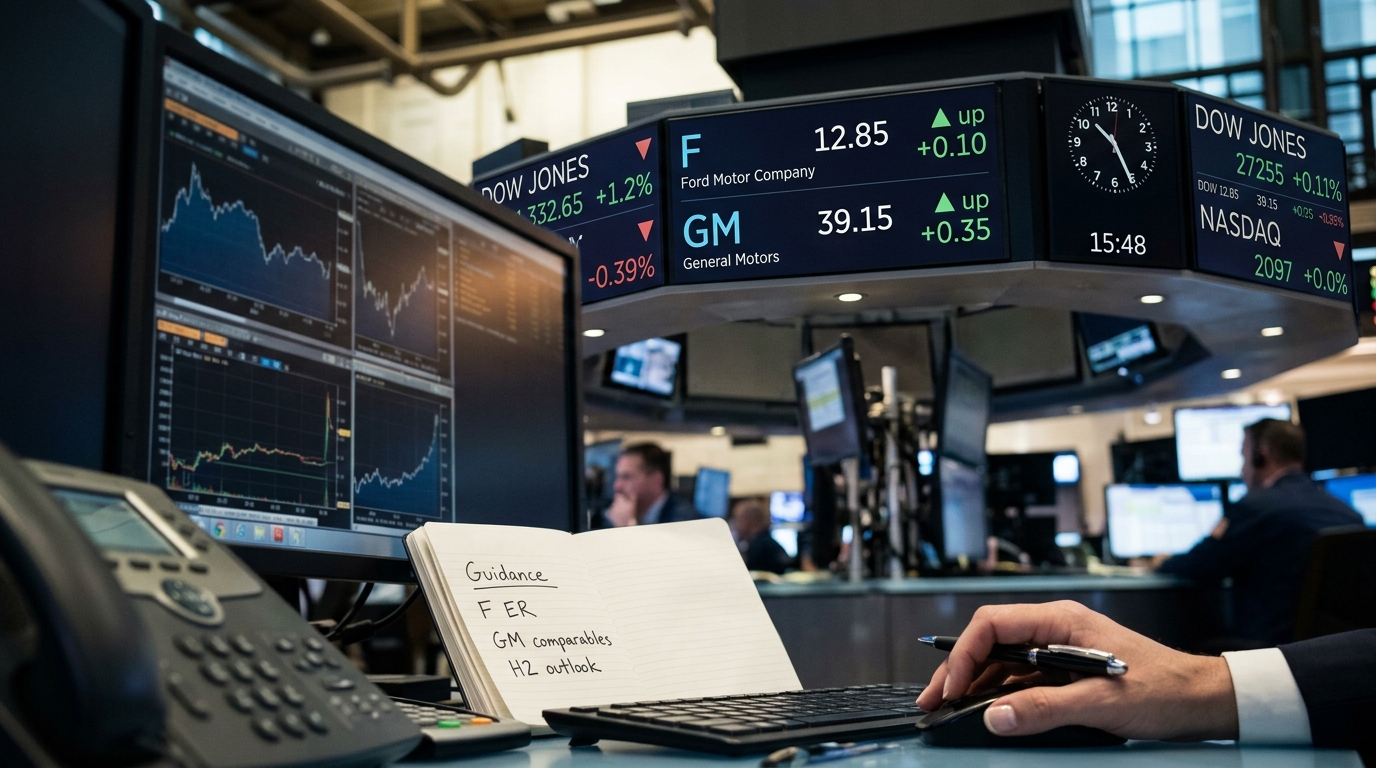
Ford Reports Tonight. Guidance Is Everything.
GM set the bar. Now the market wants to know if Ford can clear it.
1.5M+ users. 70% lighter than the Vision Pro.
AI is changing how people work. Professionals are managing more information and projects than ever, across more locations. But they’re still using screens that weren’t built for it.
1.5M+ people use Immersed to create a virtual workspace with access to up to five monitors from anywhere. The company also built Visor, a headset 70% lighter than Apple Vision Pro at one-third the cost. 75,000+ on the waitlist.
Current Reg A+ offering ends in two days. Invest today.
Disclosure: This is a paid advertisement for Immersed Regulation A+ offering. Please read the offering circular at invest.immersed.com
Market Snapshot
The broader market heads into Tuesday’s close carrying genuine momentum. Major indexes have pushed higher over the past several sessions as earnings season has broadly delivered results above expectations, and the consumer discretionary sector has been a quiet but notable participant in that move. Volatility, as measured by the VIX, remains relatively contained. Treasury yields are stable. The conditions are about as cooperative as active traders could reasonably ask for ahead of a high-impact single-stock event.
That event is Ford Motor (NYSE: F), reporting Q2 2026 results tonight after the bell, with a conference call set for 5:00 p.m. ET.
The stock came into today trading around $14.37 to $14.68, up more than 25% over the past twelve months. Jefferies upgraded the stock to Buy this morning with a new price target of $17.50, up from $14.50, and JPMorgan recently raised its target to $16.00 with an Overweight rating. There is institutional interest building here. But the real question, the one that will determine whether any of those targets are even relevant in the short term, gets answered tonight.
Why Ford Is in Focus Right Now
General Motors set the table one week ago. On July 21, GM reported Q2 2026 adjusted EPS of $3.57, beating the consensus estimate of roughly $3.18. Revenue came in at $48.03 billion, topping expectations of $46.56 billion. GM raised its full-year adjusted EBIT guidance to $14.0 to $16.0 billion, up from the prior range of $13.5 to $15.5 billion, and lifted full-year adjusted EPS guidance to $12.00 to $14.00, up from $11.50 to $13.50. GM stock climbed more than 4.5% on the report. This was the second consecutive quarter GM raised its key forecasts.
The drivers were not complicated. North American margins returned to the 8% to 10% target range, with Q2 North America adjusted EBIT up more than 40% year over year to $3.4 billion. Full-size trucks and SUVs carried the load. Warranty costs declined. EV losses narrowed. Tariff exposure came in better than feared, with gross tariff costs now expected in the $2.5 to $3.5 billion range for the full year, aided by the Supreme Court’s IEEPA ruling.
That is the blueprint. Now the market wants to know whether Ford can execute the same story, or whether the headwinds the company has been managing since late 2025 are deeper and more persistent than GM’s results might suggest.
This is not a trivial question. Ford and GM are very different businesses right now.
A Secret Plan to End Trump in November?
A high-level White House insider who’s been a lifelong friend of the Trump family just dropped this bombshell about the midterm elections.
He’s exposing the biggest political betrayal in America’s history.
“I’m excited to share some credible inside information on the Democrats and some Republicans secret plan to end Trump’s reign.”
The Ford-Specific Headwinds Traders Need to Understand
Ford entered this quarter with more moving parts than usual, and most of them were pointing in the wrong direction on the volume side.
Q2 U.S. vehicle sales fell 10.3% year over year to 549,200 units, down from 612,095 in the same period a year earlier. Pure EV sales collapsed 40.7%. F-Series truck sales, the financial backbone of the entire company, slipped 11% as Ford worked through production disruptions tied to two fires at Novelis’s aluminum plant in Oswego, New York in late 2025. Novelis holds close to 60% of the automotive aluminum sheet market and is the primary supplier for the aluminum-bodied F-150. The plant restarted production in June, and Ford has indicated that supply recovery will be weighted toward the second half of the year.
That last point matters. First-half F-Series sales reached 357,801 units. The F-Series remained America’s best-selling truck for the 50th consecutive year, outselling the second-place Chevrolet Silverado by more than 80,000 units year to date, but the pace was well below prior-year levels. Ford is betting on a meaningful volume recovery in the back half, and tonight’s guidance will either validate or complicate that bet.
There are a few other items dragging on the headline optics. Daily rental sales fell 69%. The Escape and Lincoln Corsair were phased out. Excluding those items and holding rental volumes flat, Ford estimates underlying Q2 sales would have risen approximately 0.5%. That is actually a useful data point. It means the core business, stripped of one-time headwinds, held up reasonably well. The market will decide whether to read it that way.
The Numbers on the Table Tonight
Wall Street consensus for Q2 2026 is broadly clustered around the following: automotive revenue of approximately $44.72 billion, adjusted EPS of approximately $0.35 to $0.36, and adjusted EBIT of roughly $2.15 billion, implying an adjusted EBIT margin of around 4.3%.
In Q1 2026, Ford delivered adjusted EPS of $0.66 on revenue of $43.3 billion, a 6% year-over-year increase, alongside adjusted EBIT of $3.5 billion. That quarter included a one-time $1.3 billion tariff refund under the IEEPA framework. Strip that out and the underlying business was already under visible pressure. The Q2 bar is lower. The question is whether Ford can beat it, and more importantly, what the company says about the second half.
Here is how the segments are expected to perform and why it matters for the full-year picture:
- Ford Pro (Commercial): The company’s most profitable unit. Management guided Ford Pro to $6.5 to $7.5 billion in adjusted EBIT for the full year 2026. This segment is the earnings anchor for the entire enterprise. Any deterioration here, on fleet demand, pricing, or commercial vehicle mix, would be more significant than any single EV headline.
- Ford Blue (ICE and Hybrid): Guided to $4.0 to $4.5 billion in full-year adjusted EBIT. Hybrid vehicles have been a relative bright spot across the industry in 2026, and Ford’s hybrid portfolio could provide some offset to EV weakness. How margins are trending in Blue will matter for the guidance conversation.
- Ford Model e (EV): Expected to post a full-year loss of $4.0 to $4.5 billion in 2026, an improvement from the $4.8 billion loss in 2025. Q1 Model e losses came in at $777 million, a modest $72 million improvement versus the prior year. EV sales in Q2 collapsed 40.7%, with F-150 Lightning sales down approximately 59% and Mustang Mach-E down roughly 31%. The loss of the $7,500 federal EV tax credit after September 30, 2025 has gutted near-term EV demand, and Ford has already discontinued the F-150 Lightning for the current product cycle. Model e is not going to fix anything in Q2. Traders know that. What they want to know is whether the bleeding is slowing on a per-unit basis and whether the path to breakeven, currently targeted for 2029, is still intact.
- Tariffs: Ford’s tariff exposure is structurally smaller than GM’s. Ford has a larger domestic manufacturing footprint and imports fewer vehicles. The full-year net tariff impact is expected around $2 billion, compared to GM’s $2.5 to $3.5 billion gross estimate. The Q2 adjusted EBIT already embedded approximately $800 million in adverse tariff-related impacts. Any favorable update here, particularly around sourcing changes or supply chain mitigation, could be a meaningful positive surprise.
The Guidance Question Is Not Optional
Nvidia poured over $7B into this
Take a look at this…
It’s a radical “light-speed” device that’s turning AI as we know it into “Accelerated AI”, making it 100 times faster and 100 times more energy efficient.
In fact, Jensen Huang, Nvidia’s founder and CEO, says this device is shattering the limitations of AI and without it, AI can’t scale.
If you want to discover what this technology is, why Nvidia is betting billions on it…
And the one stock we believe could be the biggest winner when “Accelerated AI” goes mainstream…
This is the part traders should not overcomplicate. The headline EPS number tonight is almost irrelevant by itself. The market already knows Q2 had volume headwinds. It already knows EV demand dropped hard. It already knows the Novelis supply disruption hit truck production. None of that is new information.
What is new, what actually moves the stock, is whether Ford management has the confidence to raise its full-year adjusted EBIT guidance beyond the current $8.5 to $10.5 billion range that was set after Q1.
After Q1, Ford raised its 2026 adjusted EBIT guidance to $8.5 to $10.5 billion, up from the original $8.0 to $10.0 billion. That was a $500 million midpoint lift. GM just did the same thing for the second consecutive quarter, raising by another $500 million at the midpoint. Analysts and investors are watching to see if Ford follows the same path.
If Ford raises guidance, it signals confidence that F-Series supply normalization is on track, pricing is holding, and the Model e drag is not worsening. The stock likely moves higher.
If Ford maintains guidance without raising it, the market may interpret that as management hedging on the F-Series recovery timeline or absorbing unexpected cost pressure. That is a more uncertain outcome.
If Ford lowers guidance, it would suggest the F-Series production disruption is deeper than communicated, or that warranty costs, tariff exposure, or EV losses have widened beyond expectations. That scenario carries meaningful downside risk.
The language management uses will matter as much as the number itself. Listen carefully to how they characterize second-half F-Series volume recovery. Listen for any commentary on pricing trends. And listen for how they characterize tariff mitigation going forward. Vague answers in those areas, without quantification, tend to lead to market haircuts on margins.
Slight Tangent Worth Noting
There is something worth tracking beyond the core auto business. Ford Energy, the company’s battery energy storage division targeting utilities, data centers, and large industrial customers, has been attracting investor interest since earlier in 2026. Ford plans to deploy at least 20 GWh annually, with first customer deliveries expected in late 2027. That is a long-duration catalyst, not a Q2 story. But if management uses the call to provide any update on Ford Energy traction or commercial pipeline, it could layer incremental enthusiasm into the longer-duration thesis. Keep an ear open for it.
Technical Picture
Ford entered earnings day trading around $14.37 to $14.68, up more than 25% over the trailing twelve months. The 52-week range runs from $10.68 at the low to $17.78 at the high.
The stock is trading above its 200-day simple moving average, which has been in the vicinity of $13.01 to $13.11, a constructive longer-term signal. Key near-term support is concentrated in the $14.25 to $14.39 zone. Resistance sits in the $14.94 to $15.00 range, which aligns with both a prior swing high and the psychologically significant $15 level.
A guidance-driven rally that carries the stock cleanly through and closes above $15.00 on heavy volume would represent a meaningful technical breakout. That could attract follow-through buying over the next several sessions as momentum players and algorithm-driven strategies respond to the level clearance.
On the downside, a guidance-driven selloff that pushes the stock back below $14.00 would retest prior support and likely put the 200-day moving average back in play as a gravitational level. Watch how the stock responds to that zone on any post-earnings weakness. Clean support there on elevated volume suggests accumulation. A clean break through it suggests the market is re-evaluating the full-year earnings recovery story.
Volume is worth monitoring carefully tonight and in the session following the release. Post-earnings moves on above-average volume tend to be more durable than moves on thin participation.
Scenario Modeling
Bull Case: Ford beats on Q2 adjusted EBIT and EPS, raises full-year adjusted EBIT guidance above the current $8.5 to $10.5 billion range, provides specific and credible commentary on F-Series production recovery in the second half, and confirms that Model e losses are tracking toward the lower end of the $4.0 to $4.5 billion full-year range. Any favorable tariff commentary, particularly quantified mitigation that reduces the $2 billion net impact, would add fuel. In this scenario, a move toward the $15.50 to $16.50 range over the next several sessions would be consistent with the setup. Jefferies’ new $17.50 target becomes a more relevant conversation.
Base Case: Ford meets Q2 expectations broadly, maintains its current full-year guidance range without raising it, and provides measured commentary on F-Series recovery. The market interprets this as acceptable but uninspiring, given that GM moved more decisively. The stock may drift modestly, with the $14.25 to $14.50 zone becoming a short-term base as traders reassess the probability of a second-half acceleration. This is a wait-and-see outcome.
Bear Case: Ford misses Q2 adjusted EBIT expectations, declines to raise full-year guidance, and management signals that F-Series production normalization is slower than expected or that tariff and commodity headwinds are worse than reflected in current estimates. Warranty cost escalation would compound the concern. In this scenario, a test of $13.50 to $13.75 becomes realistic in the near term, and the stock would need to demonstrate clear support at the 200-day moving average before any recovery thesis becomes credible again.
5 Stocks Heading Into Their Best Months of the Year
Summer is peak season for travel, home improvement, theme parks and sports betting. This free report spotlights 5 companies entering the most important stretch of their calendar year, all with real revenue, recent catalysts and strong analyst upside.
Active Trader Strategy Framework
The most important principle heading into a high-stakes earnings event is this: do not confuse having a view with having a plan. The view is easy to form. The plan requires defined levels and defined responses.
- Into earnings: Position sizing should reflect the binary nature of the event. Ford carries genuine uncertainty on guidance direction tonight. Entering with a full position before the call is a momentum bet, not a risk-managed trade. Traders who want exposure before the release should size accordingly and know their exit level if the stock reacts negatively.
- Reaction trading: The initial post-close move may not be the final move. Listen to the full conference call before drawing conclusions. Management tone, Q&A responses on F-Series recovery, and tariff commentary can meaningfully shift the stock’s direction relative to the initial headline reaction. Many of the most instructive moments come late in the call.
- Key levels to monitor: $15.00 is the line that determines whether the post-earnings move has legs to the upside. A sustained close above it on volume suggests the market is pricing a recovery. $14.00 is the key support to monitor on the downside. A decisive breakdown through that level shifts the near-term posture from neutral to cautious.
- Volatility consideration: Ford typically sees meaningful volume spikes in the session following earnings. Average daily volume runs approximately 60 to 61 million shares. Post-earnings sessions that carry significantly above-average volume in the direction of the initial move tend to confirm the new directional bias. Low-volume follow-through should be treated with skepticism.
- Risk factors: Beyond the guidance question, watch for any commentary on warranty costs, which have been an ongoing concern for Ford over multiple quarters. Unexpected warranty reserve increases would weigh on margins independent of the volume recovery story. Also monitor any language around capital expenditure commitments tied to the Universal EV Platform launch timeline, currently targeting a new affordable electric truck priced around $30,000 off the Kentucky Assembly Plant in 2027.
Trader’s Checklist
Before and during tonight’s report, active traders should track the following:
- Does Ford raise full-year adjusted EBIT guidance above the current $8.5 to $10.5 billion range?
- Does management provide specific and quantified commentary on F-Series production recovery in the second half?
- How are Ford Pro margins trending versus the $6.5 to $7.5 billion full-year adjusted EBIT target?
- Are Model e losses tracking toward the lower end of the $4.0 to $4.5 billion range?
- What is the updated tariff impact estimate, and has the $2 billion net exposure changed?
- Any commentary on warranty cost trajectory?
- Does the stock close above or below $15.00 in the first post-earnings session on meaningful volume?
- Is there any update on Ford Energy commercial pipeline or the Universal EV Platform timeline?
Professional Conclusion
GM answered the question about whether a major U.S. automaker could manage through tariff exposure, EV restructuring, and a softer demand environment while still generating improving margins and raising forward guidance. The answer, for GM, was yes. North American truck and SUV strength, pricing discipline, and lower warranty costs were enough to absorb the headwinds and then some.
Ford enters tonight’s call carrying more structural drag. The F-Series disruption was real. The EV losses are deeper and more persistent. The tariff advantage Ford has over GM is genuine but not unlimited. And the stock has already rallied more than 25% over the past year, which means the market has already priced in some degree of recovery. Tonight is where that expectation gets tested against the actual numbers.
What matters here is not just whether Ford beats or misses the Q2 consensus. It is whether management can articulate a credible path to second-half improvement with enough specificity to justify the current valuation. Traders who approach tonight’s event with a clear framework, defined levels, and a willingness to adjust in real time as the call develops will be better positioned than those who enter with a fixed view and no exit plan.
Prepare for the move. Respect the levels. Let the data lead.
For informational and educational purposes only. Not investment advice. Trading involves risk, including loss of principal.