
Electricity is quietly becoming the most strategic resource in AI infrastructure. Not compute. Not land. Power. And the utility that controls a reliable, contracted supply of it, under terms that protect existing customers from bearing the downside, holds something close to an unassailable competitive position.
Georgia Power clarified that position this week in a way that will matter far beyond Effingham County.
What Happened, and Why It Is Larger Than One Contract
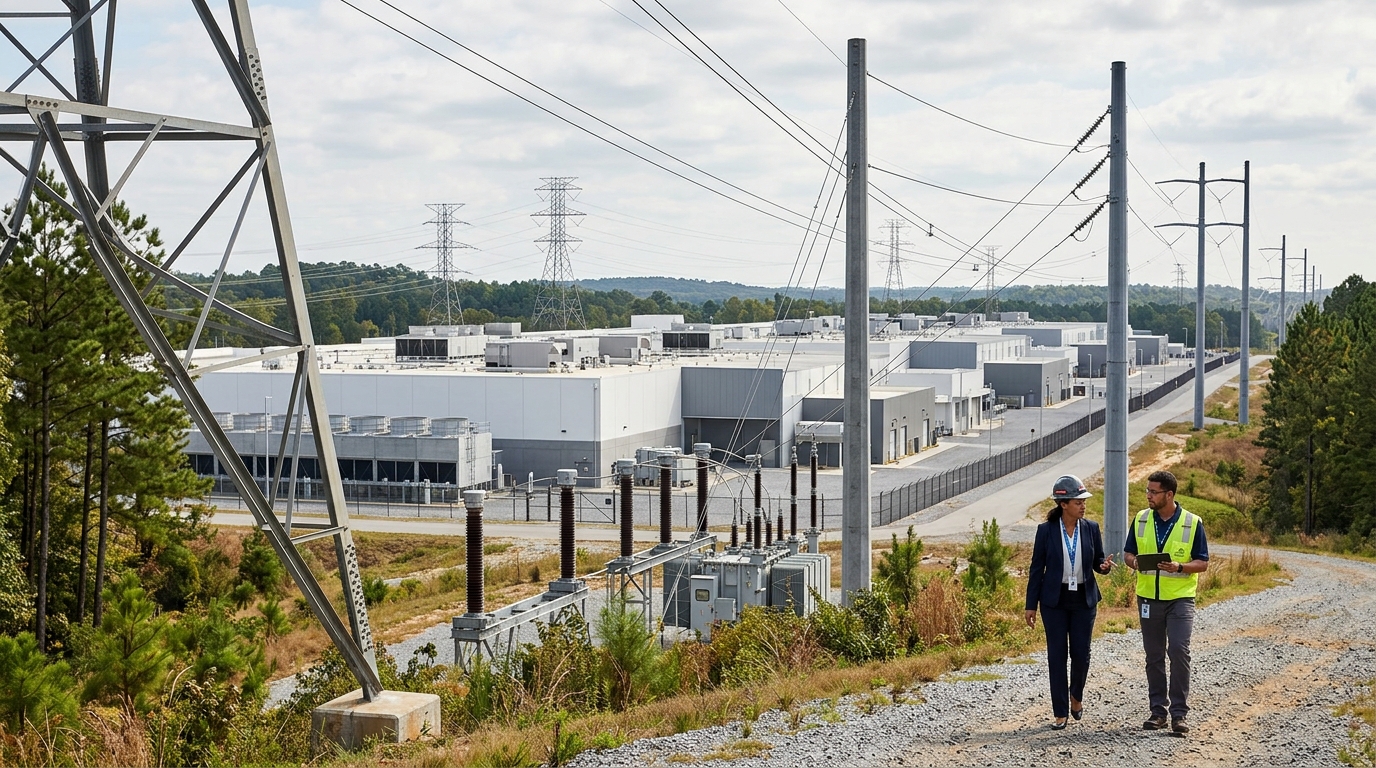
Georgia PSC staff approved a contract between Georgia Power and OpenAI clearing the utility to provide electricity for a 3.2-gigawatt hyperscale data center planned for Effingham County. The campus, part of a $20 billion OpenAI development near Savannah, is the largest single load contract yet approved in the United States. But the contract structure matters as much as the size.
Georgia Power said it would not collect any revenue shortfalls from other ratepayers if OpenAI or another data center operator terminates its contract early. If a large data center customer cancels service, Georgia Power agreed to notify the PSC within 15 days. The utility also pledged to structure its next base rate case in 2028 so that incremental revenue from large-load customers delivers at least $15 per month of savings beginning in 2029 for the typical residential customer using 1,000 kilowatt-hours per month. OpenAI will fund the infrastructure needed to support the project. Shareholders absorb the construction risk. Ratepayers collect the savings. That is the template.
OpenAI’s agreement to include up to 1,000 megawatts of flexible demand response was described as a positive contract feature and is among the first time Georgia Power has announced this type of load flexibility agreement tied to a single customer. That provision allows Georgia Power, at its discretion, to reduce electricity delivered to the facility during periods when the grid is under stress. For investors in Southern Company, this is not a footnote. It is a model for how every subsequent large-load negotiation gets anchored.
The Mogul Mindset: Regulated Monopoly as Compounding Machine
What would a disciplined long-term capital allocator see here? A regulated utility with a multi-decade contracted load pipeline, enforceable cost-recovery provisions, and a geographic position that its competitors cannot quickly replicate. Southern Company is not merely building power plants. It is locking in revenue streams for 15 to 25 years at a time, under state-supervised frameworks that limit both competitive intrusion and customer defection.
Southern Company says it added about 6 GW of large load contracts since the first quarter of 2026, bringing its total contracted large load to more than 17 GW across its territory by the mid-2030s. Data center electricity use at Southern has been described as surging 55%, with over 1.2 GW of actual load now operational. Southern now projects average annual retail sales growth of approximately 10% from 2026 to 2030 across its electric system. For a utility that historically measured load growth in fractions of a percent annually, that is a structural break, not a cyclical uptick.
The regulatory moat is widening at exactly the moment rivals face friction. On August 3, 2026, Texas Governor Greg Abbott directed the Public Utility Commission of Texas and ERCOT to conduct a comprehensive verification and audit of all data centers advancing through ERCOT’s interconnection process before additional projects could move forward. The pause puts about 20% of the total U.S. data center pipeline at risk of delay, according to BloombergNEF. Every month a hyperscaler sits in a Texas queue is a month Georgia Power’s contracted capacity looks more attractive.
What Could Go Wrong
The contract remains entirely redacted from public view under trade-secret claims, which limits independent analysis of its actual terms. Consumer advocates have warned against shifting to other ratepayers the costs of providing energy to massive data centers, especially if an AI bubble emerges. The flexible demand-response provision protects grid stability, but Southern is planning significant generation investments, including thermal, solar, and batteries, to meet future AI infrastructure demands, with potential spending exceeding $8 billion. Capital intensity is real, and the company’s filings show sizable refinancing needs in the 2028 to 2029 window.
The deeper risk is political. Two PSC seats face voters in November, and the commission’s composition will determine how strictly the new ratepayer protections are actually enforced. The template Georgia just wrote is only as durable as the regulators willing to hold the line on it.
The Long-Term Verdict
Electricity infrastructure is the one layer of AI’s supply chain that cannot be virtualized, imported, or disrupted by a competitor’s model release. Southern Company owns the regulated right to build, operate, and earn a return on that infrastructure across a geography that is actively winning hyperscale investment away from constrained markets. The Georgia Power-OpenAI contract is not just the largest power deal of its kind. It is the clearest proof yet that the utility holding the contracted megawatts, not the company training the models, may compound more predictably over the decade ahead.