Elon Musk posted two sentences on Saturday that wiped roughly $7 billion from Howmet Aerospace’s market value by Monday’s close. “The limiting factor for nat gas turbine production is casting the blades & vanes,” he wrote. “By doing in-house casting at SpaceX, we can accelerate nat gas turbines coming online by up to 18 months, which is a profound game-changer.” The post came in response to a report from The Information about a SpaceX foundry taking shape in Bastrop, Texas. Howmet shares closed down about 7.2% Monday, their worst session in roughly 16 months.
The sell-off is worth examining carefully, because the facts on the ground and the investor fear are pointing in different directions.
Why This Stock Matters Now
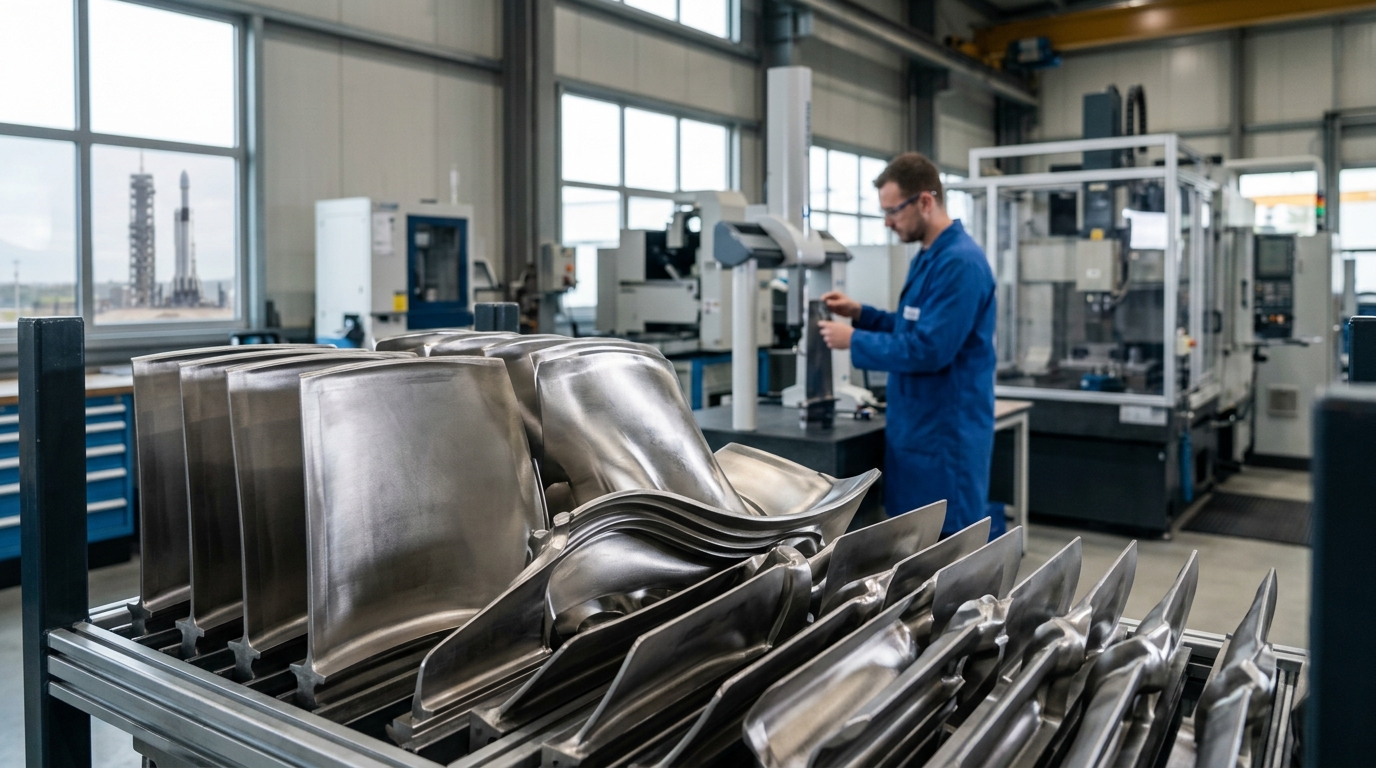
Howmet holds a market share exceeding 50% globally for turbine blades in the industrial gas turbine market. That dominance exists because the work is extraordinarily hard. Only a handful of foundries worldwide can cast the nickel-superalloy blades and vanes that run in the hottest section of a turbine at roughly 3,000 to 3,600 degrees Fahrenheit, hundreds of degrees above the melting point of the alloy itself. That is possible only because of internal cooling channels, thermal-barrier coatings, and single-crystal or directionally solidified casting in vacuum furnaces. SpaceX is not walking into a commodity business.
The Investment Thesis
Monday’s drop was driven by the fear that SpaceX might eventually take demand off Howmet’s books. The word “eventually” is doing a lot of work there. Jefferies analyst Sheila Kahyaoglu, in channel checks, pointed to about four years before SpaceX products arrive. The hard question is whether SpaceX can actually qualify and ship these parts on the schedule Musk wants. Precision casting for turbine blades is difficult for a reason, and The Information noted that replicating what established suppliers have spent decades building could take years. The market sold the headline, not that timeline.
Bernstein analysts believe SpaceX’s shift mainly reflects supply constraints, and see little risk to Howmet’s market position as the company maintains strong long-term agreements and demand remains elevated. Bernstein suggests the decline could be a buying opportunity, reiterating an Outperform rating on Howmet.
The Business Behind the Stock
Anyone selling Howmet on this news should first consider the numbers the company reported six weeks ago. Second-quarter 2026 adjusted earnings came in at $1.33 per share, up 46% year over year, beating consensus of $1.23. Revenue of $2.55 billion increased 24% and surpassed estimates of $2.41 billion. Gas turbine revenues specifically advanced 38% and accounted for 13% of total revenue. For 2026, Howmet raised its revenue outlook to $10.00 to $10.10 billion. This is not a company losing ground in its core market.
What’s Changing
Four companies worldwide cast blades and vanes at industrial scale, and all of them are at capacity. That is what Musk is responding to. The Bastrop plant, if it reaches production, is primarily built to serve SpaceX’s own power ambitions, not to sell castings on the open market. Bernstein said it has little doubt SpaceX will try to build the capability, but expects the effort to serve SpaceX’s own power needs rather than turn the company into a merchant seller of forgings and castings. That is a meaningful distinction for Howmet shareholders.
SpaceX is hiring for the Bastrop site and the intent is clearly real. But intent and qualified product are separated by years of process development, furnace qualification, and OEM approval cycles.
The Risks
The bear case is straightforward: SpaceX is well-funded, moves faster than any industrial company in memory, and Musk has now publicly committed to the foundry. If the qualification timelines compress even modestly, the long-term moat Howmet enjoys in gas turbine blades erodes. One widely circulated valuation snapshot put Howmet’s forward P/E above 50x, leaving little margin for a sustained competitive threat. A prolonged overhang, even absent actual market share loss, could keep multiple compression alive.
What Investors Should Watch Next
Three things matter from here. First, any Texas permitting filings tied to the Bastrop foundry would signal SpaceX has moved from hiring to building. Second, watch Howmet’s Q3 report for any commentary from CEO John Plant on long-term agreement renewals with GE Vernova and Siemens Energy. Third, track whether other AI infrastructure developers follow SpaceX’s insourcing lead. A shortage only a handful of companies can relieve is a pricing advantage, until the largest buyers build the capability themselves.
Bottom Line
Howmet Aerospace is a business with 50% global market share in a product that has taken decades to master, reporting 24% revenue growth, and trading at a two-month low because a competitor announced it will attempt to replicate that product from scratch. The competitive risk is real over a five-year horizon. Over the next 12 months, Howmet’s order book, pricing power, and raised guidance suggest the underlying business is as strong as it has ever been. The question is whether the market’s four-year fear is worth more than Monday’s roughly 7.2% discount.