September 26, 2026
Bonus Content: Iran’s Hormuz Offer Hits Brent at $104. Here’s Which Stocks Move First.
Hey Trader,
I have a huge problem.
I’ve developed a “genius” trading system that picks winners at a 95.3% rate – I’m talking about 838 winners out of the last 879 trades.
But the trading system is so automatic it’s almost boring!
Most days look exactly the same – place the trade in the morning, let it expire that night, and collect the cash. Repeat, repeat, repeat.
If you can stifle a yawn, this is an incredible way to grow a trading account…
Free Report: Super Boring Trade Strategy Spots 95.3% Winning Trades
To Your Success,
Dave Aquino
Iran’s Hormuz Offer Hits Brent at $104. Here’s Which Stocks Move First.
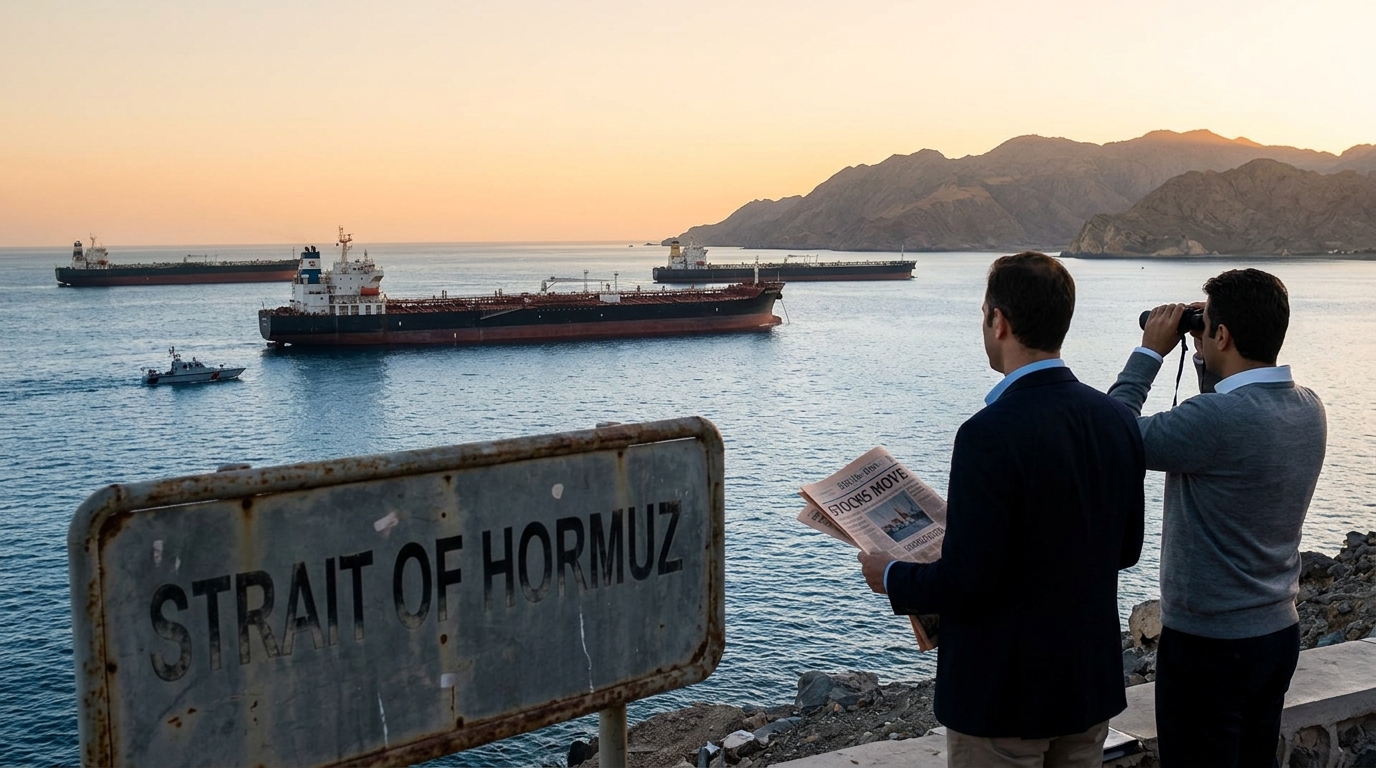
The oil market spent seven months pricing a closed strait. On Friday, it began pricing something different: a written offer to reopen it.
Iran’s Foreign Minister Abbas Araghchi proposed reopening the strategically vital Strait of Hormuz and resuming nuclear talks with the U.S. “The seven-day timeline will start as soon as the United States accepts this plan,” Araghchi told reporters on the sidelines of the U.N. gathering. That is a more specific commitment than anything Tehran has formally tabled before. Reporting this week described the back-channel process as moving beyond initial contacts into a more detailed phase.
WTI dropped 2.3% to close at $92.41, and Brent declined 2.1% to settle at $104.32. U.S. crude finished the week 7.9% lower. The 52-week range on Brent now runs from $58.72 to $126.41, which frames the scale of the war premium still embedded in current prices. Over the past month, Brent has risen more than 20%.
Supply Is Already Moving
The diplomatic signal lands against a supply backdrop that has shifted materially. Saudi Arabia is exporting about 6 million barrels per day of crude oil in September, back near its 2025 monthly average, according to Kpler. That is roughly 80% higher than August levels in widely cited tracker estimates around the low-to-mid 3 million b/d range. The Saudis managed to ramp up exports even after closing the critical East-West pipeline due to drone attack damage, redirecting shipments back through the Strait of Hormuz as the U.S. military carved out a shipping lane along Oman’s coast.
The Strait of Hormuz carried about 20% of the world’s traded oil before the war. Recent reporting has put flows still below pre-war levels, with some widely cited snapshots near the low-teens in million barrels per day versus roughly 17 million barrels per day before the conflict disrupted shipping. The gap between those two numbers is where the remaining war premium lives.
Trump Just Changed 401(k) Rules Forever
Your 401(k) may be about to change in a way most Americans haven’t heard about.
President Trump’s Executive Order #14330 is pushing a major shift in how retirement plans can invest – and it has now reached the Department of Labor for approval.
Get the full story and see how your retirement could be impacted.
Refiner Positioning: The First Rotation
The companies with the most to lose from a Hormuz re-opening are the same ones that dominated the first half of 2026. U.S. refining margins helped Marathon Petroleum, Valero, and Phillips 66 generate $12.6 billion in combined profits in the second quarter of 2026. The U.S. diesel crack spread hit an all-time high around $102.19 per barrel earlier this month. Shares of Marathon Petroleum, Valero Energy, and Phillips 66 have gained 110%, 98%, and 75%, respectively.
The risk is straightforward: September NYMEX 3-2-1 spreads sit near $69.92 per barrel, versus $44.38 implied for August 2027, meaning the market already prices in some normalization; the pre-war average from 2016 to early 2026 was $21.68. A credible Hormuz reopening compresses that gap faster than models currently assume. Morgan Stanley has lifted VLO’s target to $411, while key risks center on refining margin normalization. On September 22, Jefferies downgraded Valero to Hold from Buy, citing an unfavorable risk-reward balance at current share prices.
That downgrade follows a remarkable run that was already drawing attention weeks earlier. When Valero first hit record territory in August, the setup looked compelling precisely because crack spreads were still widening — a dynamic that has since pushed the stock even further. Traders who want context on how the refiner’s technicals and margin story developed heading into this diplomatic inflection point can find that earlier analysis in our breakdown of Valero’s all-time high and the crack spread trade behind it.
Airlines: The Mirror Trade
Every dollar off Brent is a dollar that works directly in favor of DAL and UAL. Delta Air Lines’ 2026 fuel expense is now projected at $11.17 billion, up 10.8% from estimates prior to the conflict beginning February 28. United Airlines’ 2026 fuel bill has also been revised higher versus pre-conflict estimates. Delta’s Monroe Energy refinery provides a partial hedge no competitor can replicate, but both carriers remain heavily exposed to the outright crude level.
That exposure has been building all year, and Delta’s management was set to address it directly at a major investor conference just days ago. With Brent briefly topping $108 and U.S. diesel crossing $6 a gallon for the first time, the stakes heading into that presentation were unusually high. For a detailed look at how Delta framed its fuel cost outlook and what executives signaled about the Monroe hedge, see our preview of Delta’s fuel reckoning at the Laguna conference.
Scenario Modeling
Bull Case (Hormuz reopens, war premium collapses): A confirmed deal sees Brent retrace toward $85-$90, WTI toward $75-$80. Refiner crack spreads compress 30-40% from current levels. DAL and UAL recover sharply on forward fuel cost revisions. XOM holds better, given upstream leverage to any production restart.
Base Case (technical talks continue, partial unwind): Brent consolidates in a $98-$108 range. Saudi exports sustain near 6m b/d through October. Crack spreads ease but remain well above the pre-war $21.68 average. Refiner stocks give back 10-15% from peaks; airlines recover modestly.
Bear Case (talks collapse, strait stays closed): Earlier diplomacy has broken down before amid renewed fighting, and a repeat sends Brent back toward $115-$120. Refiners re-accelerate; airlines face another leg of earnings pressure.
That scenario is not a tail risk — it has already played out multiple times since February, with ceasefires announced and then abandoned within days. Understanding the structural reasons why a durable deal has proven so elusive is essential context for sizing any peace-trade position. Our analysis of why Trump may be unable to close an Iran deal walks through the political and military constraints that keep pulling negotiations back from the finish line.
Trading Framework
The key technical level to monitor is $104 on Brent, Friday’s settlement. A sustained break below $100 on a confirmed deal accelerates the refiner-to-airline rotation. VLO’s 50-day moving average and MPC’s volume profile through the $390-$413 range offer the clearest entry/exit framework for traders managing refiner exposure into a peace scenario. On the airline side, DAL’s VWAP from the post-war low and UAL’s relative strength versus the XLE are the signals to watch.
The market has been burned before. Disciplined traders size accordingly: the proposal matters, but confirmation matters more. Preparation for both outcomes, not conviction on one, is what the data demands here.