
October 18, 2026
Bonus Content: AI Software Just Lost $260 Billion in a Day. Here Is Where the Bleeding Stops.
Most traders have never noticed the weird market anomaly that happens at 9:35 AM every morning.
They’re too busy with lagging indicators trying to predict the next move… when the market makers have already set the tone for the trading day.
It’s this weird anomaly that points us to the market maker’s key levels above and below.
And by playing the move within that range…
Regular folks like you have been able to reach for $100 or more (on a $1K stake) over 600 times in the last 2 years.
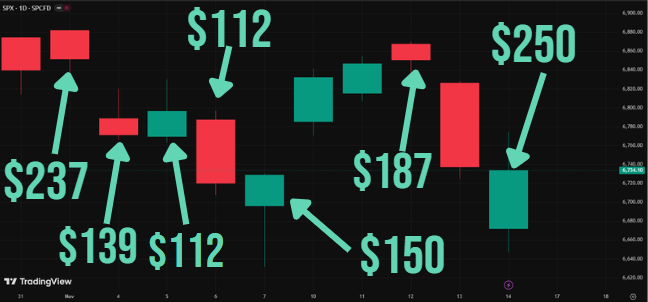
We’ve seen this straightforward approach play out whether the market broke out… broke down… or stayed choppy.
Granted, I can’t make trading guarantees here.
But I’ve opened up the data behind those trades, as well as how you can get in on the very next morning opportunity.
You’ll find the full details right here.
See you in the market.
Chris Pulver
AI Software Just Lost $260 Billion in a Day. Here Is Where the Bleeding Stops.

For most of October the AI selloff was a semiconductor problem. Friday it became a software problem, and that distinction matters because software is where the highest multiples live.
The numbers are blunt. AI-focused software shed about $260 billion in value on October 16 after a Goldman Sachs note raised alarms about debt financing. The S&P 500 fell 1.09% to 7,659.44, the Nasdaq Composite plummeted 2.15% to 26,140.03, and the Dow slipped 0.34% to 52,002.41. The Nasdaq booked its worst week since June, falling 4.50%, as investors grew more skeptical that heavily debt-funded AI expansion can stay profitable while borrowing costs remain elevated.
The Catalyst: Credit Before Equity
This rotation started in bond markets, not stock screens. US dollar high-yield AI-related debt spreads widened by about 25 basis points between October 13 and 14, reaching around 360 basis points over Treasurys. By contrast, non-AI-related debt spreads were only marginally wider. Goldman’s Friday note made that credit divergence impossible to ignore for equity desks.
Credit spread widening is one pressure on software multiples; falling AI inference costs are another. SaaS names carrying elevated multiples face a second de-rating vector as model price cuts compress the unit economics underlying their growth forecasts.
CoreWeave (CRWV) is the stress case that crystallized the concern. CoreWeave reported roughly $640 million of quarterly net interest expense in Q2 2026, versus about $128 million of operating income on an adjusted basis. Its unsecured notes due 2032 traded below 80 cents on the dollar this week, implying yields above 15%, according to TRACE data cited by Bloomberg. Bloomberg has also reported the company had about $35 billion of debt at the end of June, plus roughly $16 billion of debt-like lease liabilities. CoreWeave dropped about 12% Friday and finished down roughly 25% for the week, with its bond yields still above 15%. The 10-year Treasury yield was near 5.19% Wednesday after the September CPI release, before easing to about 5.09% by Thursday and Friday. That level is the anchor. Every AI company refinancing debt is pricing against it.
Palantir: Correction Territory, Premium Multiple
Palantir Technologies closed at $186.03 on October 16, down 7.22%, one week after its record close of $209.05 on October 9. Shares now sit 10.99% below that record, past the 10% decline that marks a correction. The move erased roughly $34 billion in market value in a single session.
The business itself has not deteriorated. Palantir’s Q2 revenue surged 93% to $1.94 billion, driven by 149% growth in US commercial revenue to $764 million. Management raised its 2026 revenue forecast to $8.150 billion to $8.158 billion, implying roughly 82% growth year over year. But the multiple is the problem. Palantir trades at a premium valuation versus the broader software complex, which leaves less room for error when rates and credit spreads move against long-duration cash flows. When a 5.09% risk-free rate competes with that kind of forward promise, the math compresses fast.
The iShares Expanded Tech-Software Sector ETF (IGV) fell about 4.8% on October 16. In a widely circulated software basket, nearly every name finished lower, with combined market-value losses estimated around $260 billion, including roughly $77 billion to $80 billion at Microsoft based on its day-over-day market-cap change.
The sector-wide damage on October 16 reversed a trade that had looked durable just weeks earlier. Capital had been rotating into IGV and away from semiconductors as recently as mid-September, when chips fell 5.9% in a single session while software gained.
Technical Framework
PLTR closed below the $188 level that technically confirmed correction status. The 200-day moving average, which traders had watched as structural support, sits materially below current price. A consensus of 32 analysts carries a Buy rating with an average 12-month target of $206.43, implying roughly 11% upside from the October 16 close. Several firms remain constructive with targets clustered in the low-to-mid $200s. Those targets assume the credit concern resolves; they do not price in further spread widening.
Scenario Modeling
Bull Case: AI debt spreads reverse the October 13 to 14 widening, CRWV stabilizes above $60, and PLTR reclaims $200 heading into November 2 earnings. Q3 US commercial revenue growth above 140% year-over-year would reassert the fundamental floor and challenge the spread-driven de-rating.
Base Case: The 10-year holds near 5.10%, software multiples remain under pressure, and PLTR consolidates in the $175 to $195 range through earnings. IGV finds a floor after its year-to-date gains are fully erased, with rotation into energy and financials continuing.
Bear Case: CRWV bond yields stay above 14%, additional bank notes widen AI high-yield spreads past 400 basis points, and PLTR breaks below the $170 area. Another hot inflation release would accelerate that scenario by pushing the ten-year back toward 5.30%.
Active Trader Strategy Framework
Three levels matter most for PLTR right now: $186 (Friday’s close and the correction confirmation close), $175 (the next meaningful volume cluster from August), and $209 (the October 9 record that would need reclaiming to signal recovery). Any position sizing in high-multiple AI software should account for the fact that Goldman credit strategist Amanda Lynam has flagged some potential for near-term stabilization in parts of US high-yield AI-related debt, while also warning that dispersion across issuers is likely to remain high. That dispersion is the trading environment: single-name moves of 7% to 12% in a session will persist until credit stabilizes.
Volatility in IGV and PLTR options has moved sharply. Traders monitoring the credit-equity linkage should watch CRWV’s 2032 bond price daily. A sustained move back above 85 cents on the dollar would be an early signal that the de-rating pressure is easing.
Preparation defines the outcome here. The macro crosscurrents, a 5.09% ten-year, AI debt spreads near recent highs, and software multiples still pricing extraordinary growth, do not resolve in a single session. Position discipline and predefined levels, not conviction about direction, are what protect capital through this recalibration.