October 26, 2026
Bonus Content: Air Products Bets on Solid-State Hydrogen. Physics Cooperates
Dear Reader,
In February 2017, I called my father and told him to buy Nvidia.
Back then, most of his friends still called it “that video game company.”
It was going for just $2.80 split adjusted….
Today his stake is worth almost $500,000 – a gain of more than 7,000%.
Why am I telling you this?
Because right now, I’m making the same kind of call.
And this time, I’m letting you in on it too.
Click here to learn all the details – including the name and ticker of my #1 stock pick, for free.
Let the money flow to you,
Jason Bodner
Founder, Inflection Point
Air Products Bets on Solid-State Hydrogen. Physics Cooperates
The hydrogen economy has a dirty secret that rarely appears in earnings calls: moving the molecule safely at scale remains brutally expensive. Liquefaction consumes roughly 10 kWh per kilogram of hydrogen at modern plants, equivalent to around 30% of the fuel’s energy content (lower heating value). Compressed tube-trailers typically run around 180 bar (and can be higher), but still deliver low volumetric density versus pipelines or liquefaction. Both methods punish margin before a single end-user fills a tank.
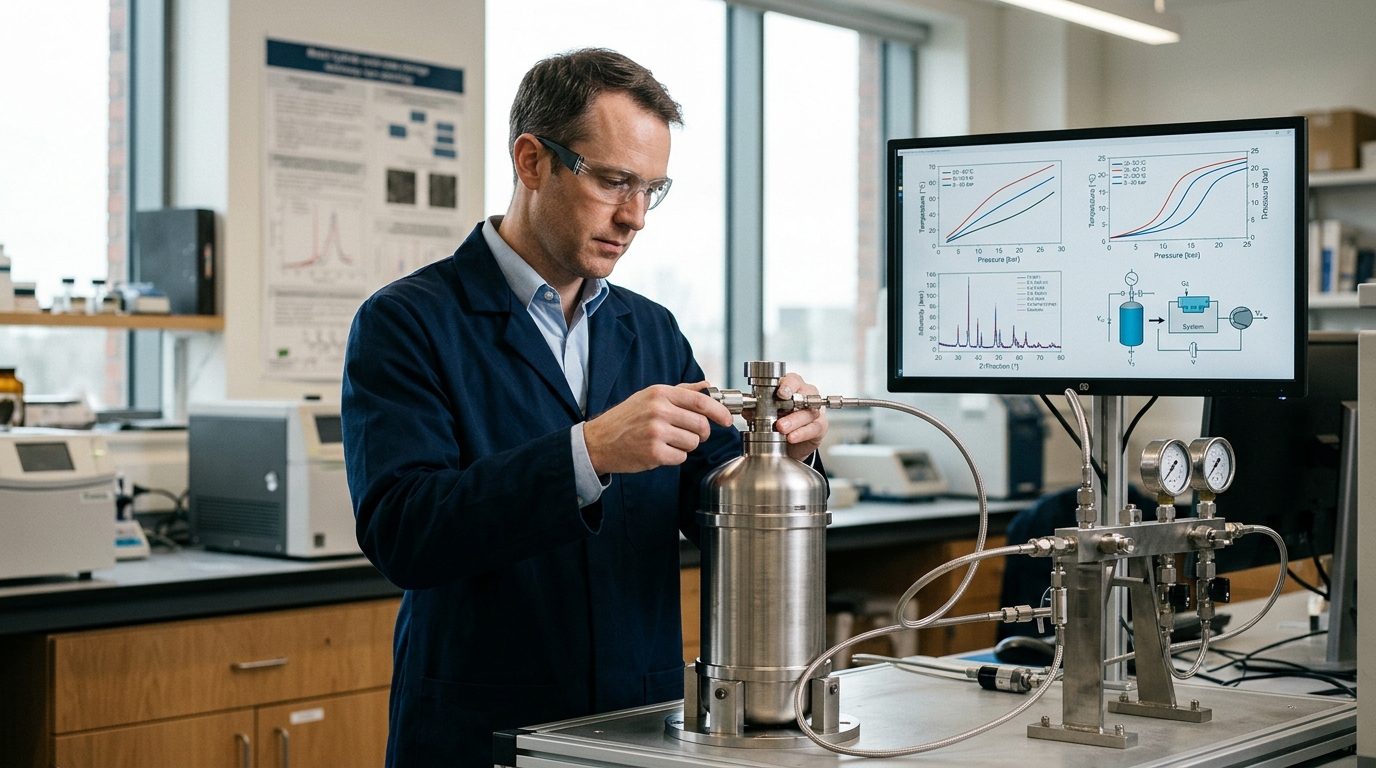
Solid-state storage through metal-hydride alloy matrices attacks both problems simultaneously. Rather than compressing or freezing hydrogen, the material chemically absorbs it into an intermetallic lattice, operating at pressures that can range from near-atmospheric up into the tens of MPa depending on alloy and temperature, generally well below the 700-bar (70 MPa) standard used for light-duty fuel-cell cars, and without cryogenic infrastructure. Volumetric storage density in select hydride systems can reach approximately 150 kg H₂/m³ in the material itself, far above both liquid hydrogen (about 71 kg H₂/m³) and 700-bar compressed gas (often cited at ≤ 40 kg H₂/m³), based on published technical literature.
That is the physical backdrop behind Air Products’ (APD) positioning. As the world’s largest hydrogen supplier, the company develops, engineers, builds, owns, and operates major hydrogen projects spanning production, liquefaction, and distribution — a fully integrated stack that makes storage economics central to its margin structure. Fiscal 2025 sales were $12.0 billion, and the company expects capital expenditures of approximately $3.5 billion for full-year fiscal 2026, down from earlier guidance around $4.0 billion.
Q3 fiscal 2026 results, reported July 30, showed adjusted EPS of $3.47, up 12% year-over-year. Adjusted operating margin reached 25.6%, an improvement of 110 basis points. The company raised full-year adjusted EPS guidance to $13.39–$13.49, implying roughly 11%–12% growth. The angle traders are underweighting is where storage technology fits into that margin expansion. If low-pressure solid-state systems reduce reliance on energy-intensive liquefaction infrastructure over time, the cost structure embedded in APD’s long-term hydrogen transport contracts shifts favorably.
The broader technology field is accelerating. TiFe-based and rare earth-Mg-Ni intermetallic alloys that absorb hydrogen reversibly at near-ambient conditions represent a commercially mature family. The remaining challenge is thermal management: heat generated during absorption must be dissipated efficiently, or cycling performance degrades. Claims of specific patent-filing surges and a 2026 market-size figure for solid-state hydrogen storage vary widely by dataset and definition, and should be treated as directional rather than precise.
Scenario Modeling
Bull Case: Q4 results on November 5 confirm margin expansion above 26%, and management provides explicit commentary linking storage technology investments to cost reduction in the hydrogen transport segment. APD trades toward analyst high targets near $373.
Base Case: Q4 adjusted EPS lands within guidance of $3.55–$3.65. Solid-state storage remains a multi-year development theme. APD consolidates near current levels around $308, with a consensus analyst target near $334.
Bear Case: Project exit charges expand beyond the up-to-$2.9 billion pre-tax impairment estimate disclosed for Q3, free cash flow disappoints, and macro headwinds compress industrial gas volumes. APD tests support near the $280–$285 range.
Active Trader Strategy Framework
November 5 earnings is the near-term catalyst. Traders should monitor adjusted operating margin versus the 25.6% Q3 level, any guidance on capital redeployment from exited Louisiana and Casa Grande projects, and language around hydrogen transport infrastructure investment. The stock sits about 2% below its 52-week high of $314.87. Elevated implied volatility heading into earnings creates option premium worth considering for defined-risk positioning.
The physics of solid-state hydrogen storage have moved from laboratory curiosity toward commercial competition faster than the industrial gas sector’s valuation has priced. APD’s integrated model is structurally exposed to that shift. Preparation around November 5 matters more than conviction on direction.