July 22, 2026
The Humanoid Robot Race Has a New Scoreboard. These Are the Numbers That Separate Real From Hype.
Goldman projects a $38B humanoid market by 2035. The infrastructure picks — Teradyne, Vishay Precision, Rockwell Automation — are already printing real revenue. Here’s the breakdown.
Worst News for Stocks in 50 Years
Wall Street’s declared what could be the worst news for the U.S. stock market in 50 years.
If Goldman Sachs and Morgan Stanley are right… this won’t be like the crashes we’re used to. What’s about to hit America next could keep your portfolio in the red for 10 years or longer – unless you make a big change now.
To hear about this decade-long crisis now being predicted by multiple Wall Street banks…
And to see what you can do to prepare your wealth before this hits…
Click here to learn how to defend your portfolio.
Regards,
Keith Kaplan
CEO, TradeSmith
P.S. You may have noticed we see “surprise” crashes every year now. Think about it: rate spikes in 2022… the bank crisis in 2023… $8 trillion wiped out in 2024… $11 trillion wiped out during the tariff crash in 2025… and, this year, $12 trillion was wiped out in 30 days during the Iran War. Something is off and Wall Street suggests this could continue (and worsen) well into the 2030s. Click here to learn the truth about this market and see what you must do now to prepare.
Jensen Huang keeps quoting a $40 trillion humanoid robot TAM. The market is doing what it always does with a number that large — rewarding concept decks and 2030 promises alongside companies that are quietly printing real revenue right now. The interesting trade is figuring out which is which.
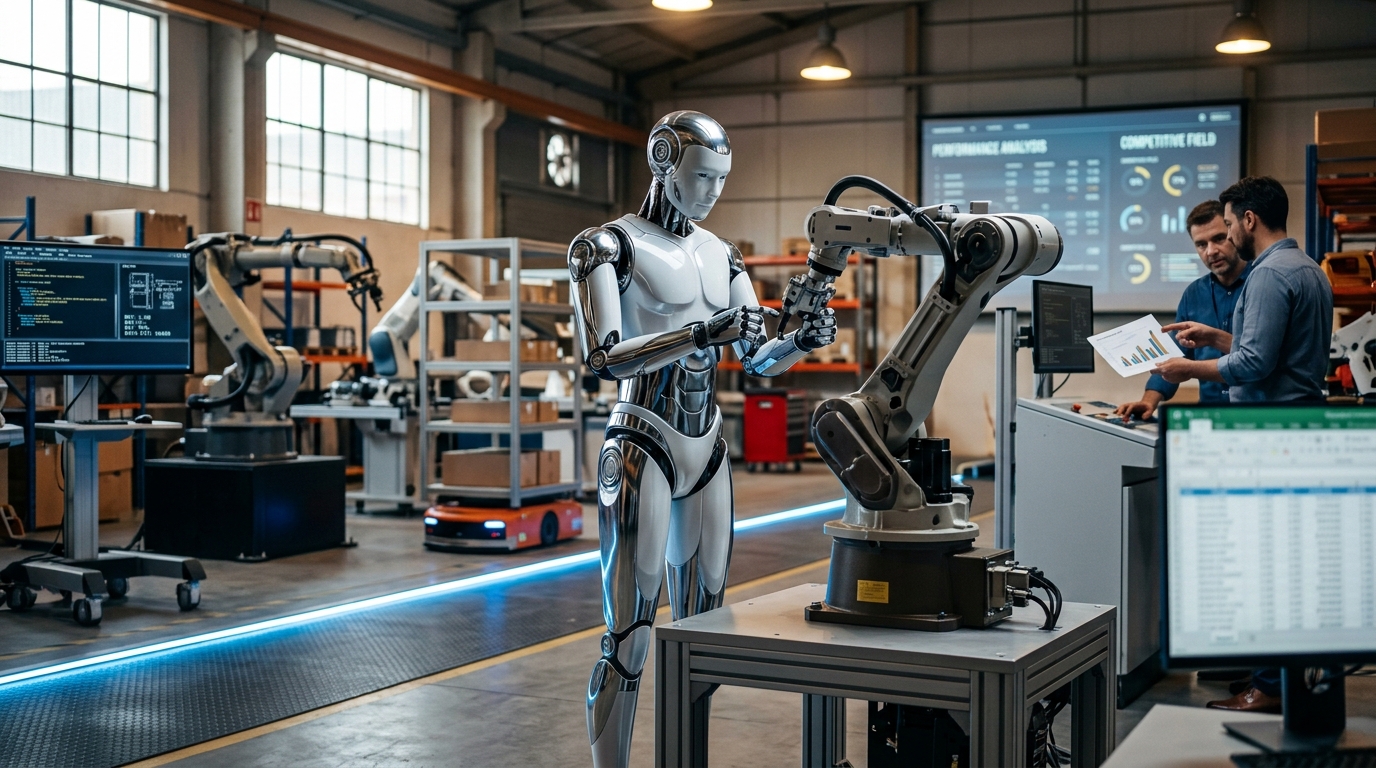
Slight tangent, but it matters: the robotics story in 2026 is not one thing. There’s the humanoid speculation layer, the industrial automation layer, and the physical infrastructure layer — sensing, testing, precision components — that supplies all of it. Those three segments are priced very differently, and understanding which one you’re buying is more important than the top-line theme.
TL;DR
- The global robotics market is projected to grow from $76B in 2023 to $218B by 2030 at a 14% CAGR; Goldman Sachs projects the humanoid robot market alone reaching $38B by 2035, with a bull case of about $154B.
- Teradyne (TER) Q1 FY2026: Revenue $1.282B (+87% YoY), non-GAAP EPS $2.56. Segment revenue: Semiconductor Test $1.111B; Robotics $91M; Product Test $80M.
- Vishay Precision Group (VPG): Q1 2026 growth-initiative orders (including components for humanoid robots) reached $37.8M, exceeding the company’s $30M target for 2025.
- Rockwell Automation Intelligent Devices segment: $1.0B in fiscal Q2 2026 sales, up 13% YoY.
- ABB’s robotics spinoff — being divested to SoftBank Group — is a corporate event worth tracking; closing was described as planned for mid-to-late 2026.
- Mind Robotics (Rivian spinout) raised a $500M Series A on March 11, 2026, and followed with another $400M round announced May 13, 2026.
- The global surgical robots market is estimated at about $6.6B in 2025, with North America at ~51% share (2025).
Three forces are converging in 2026
AI models powerful enough to actually run robots, labor shortages making automation economics unavoidable, and a reshoring push forcing U.S. manufacturers to automate rather than import. Those three forces are not speculative — they’re showing up in earnings. The question is which part of the supply chain captures the most durable margin.
What’s interesting is the picks-and-shovels layer. Teradyne’s Q1 print — $1.282B in revenue and 87% growth — was the kind of number that re-rates a stock. The Robotics arm contributed $91M, with cobot demand picking up as factory automation budgets open up. The Semiconductor Test segment alone generated $1.111B in Q1. This is not a humanoid speculation play. It’s the infrastructure that qualifies every AI chip headed for a data center or robot chassis.
Tech-Specific Financial Breakdown
- Teradyne (TER): Revenue $1.282B Q1 (+87% YoY); Robotics segment $91M; Semiconductor Test $1.111B.
- Vishay Precision (VPG): Orders related to growth initiatives, including components for humanoid robots, reached $37.8M, exceeding the company’s $30M target for 2025.
- Rockwell Automation (ROK): Intelligent Devices segment $1.0B in fiscal Q2 (+13% YoY); launched FactoryTalk Orchestration Software at Automate conference June 2026.
- ABB Robotics: Pending SoftBank divestiture (planned close mid-to-late 2026); launched the high-speed PoWa cobot family in 2026 with payloads up to 30kg and top speed up to 5.8 m/s.
- Intuitive Surgical (ISRG): Surgical robots market research cited North America at ~51% share (2025) — ISRG dominates this segment with a recurring revenue model that is structurally different from industrial robotics.
Technical Framework
- VPG: Momentum can be real, but at those levels the position requires tight risk management; watch bookings/order trends for confirmation of continued humanoid-related order flow.
- TER: The valuation requires continued execution on semiconductor test demand continuity.
- ROK: Watch the Intelligent Devices segment growth rate as the cleanest read on industrial automation capex from U.S. manufacturers.
- Humanoid robot commercial deployments are broadly expected between 2027–2028 — positioning in infrastructure names now front-runs the revenue ramp by 12–18 months.
- Defense robotics names (AeroVironment, Red Cat Holdings) operate on government contract cycles that are structurally different from commercial robotics — separate risk framework required.
Scenario Modeling
Bull Case: U.S. reshoring accelerates, labor costs remain elevated, and Nvidia’s Isaac GR00T humanoid platform drives a pull-through for sensors, cobots, and testing infrastructure. VPG and TER sustain 20%+ revenue growth through 2027.
Base Case: Industrial automation spending grows at high single digits through 2027, humanoid deployments begin at small scale in automotive and logistics in 2027–2028, and the picks-and-shovels names (TER, VPG, ROK) outperform the speculative pure-plays on a risk-adjusted basis.
Bear Case: A macro slowdown reduces manufacturing capex budgets, hyperscaler customers pause AI data center build-outs (reducing semiconductor test revenue for TER), and the humanoid timeline slips again — compressing multiples across the sector before commercial revenue materializes.
Strategy Framework
- The infrastructure layer (testing, sensing, precision components) generates audited revenue today — differentiate from pure humanoid speculation before sizing positions.
- Robotics names are high-beta; VPG at +221% YTD requires a very different risk tolerance than ROK, which offers robotics exposure inside a diversified industrial business.
- ABB’s SoftBank transaction, once closed, creates a pure-play robotics entity with access to SoftBank’s AI ecosystem — the corporate event catalyst is worth tracking separately from the fundamental case.
- Monitor Nvidia Isaac GR00T commercial availability dates — that platform launch is a near-term catalyst for broad humanoid supply chain demand.
- Surgical robotics (ISRG) and defense robotics operate on different demand curves than industrial — portfolio construction should treat them as separate thesis legs.
The humanoid robot story is real. The 2030 TAM projections may even be right. But the companies generating 87% revenue growth right now are not the ones in the concept videos. Worth keeping that distinction clear.
For informational and educational purposes only. Not investment advice. Trading involves risk, including loss of principal.