
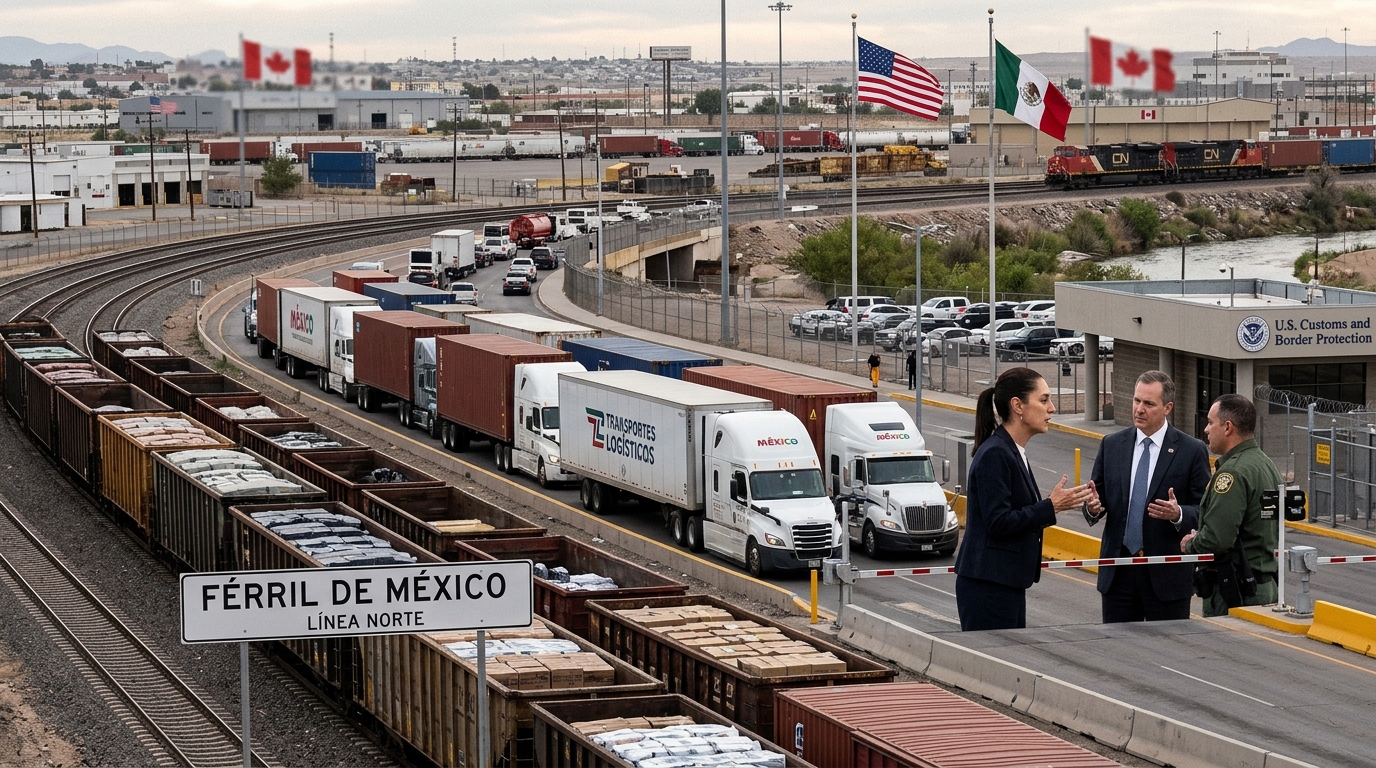
The opening picture: North America woke up this week split into two distinct tariff tracks. Mexico is at the table. Canada is fighting back. Traders need to know which side of that divide their positions sit on.
Market Snapshot
Mexican President Claudia Sheinbaum said she expects to reach a trade agreement with the United States, echoing recent comments from President Trump. Meanwhile, Canada announced retaliatory tariffs on C$27.6 billion worth of U.S. goods, matching Washington dollar-for-dollar. The counter-tariffs take effect September 8, covering more than 700 products with duties of 15%, 25%, and 50%.
The currency divergence is already visible. The Mexican peso has gained roughly 6.8% against the Canadian dollar year-to-date. With Ottawa’s retaliation confirmed and Mexico’s Economy Minister Marcelo Ebrard still in Washington seeking relief on steel and auto tariffs, that gap is unlikely to close soon. Watch MXN for strength on any positive headline out of the bilateral talks; watch CAD for further pressure as the September 8 retaliatory date approaches.
Stocks in Focus
- GM (GM): About 17% of GM’s Chevrolet Silverado production, its top-selling model, is in Canada, according to Barclays research. A deal that leaves Mexico’s auto tariffs lower than Canada’s shifts the competitive math sharply. Watch GM for any signal that production is being reconsidered northward.
- Stellantis (STLA): Canada is the sole manufacturing site for Stellantis’s Chrysler Pacifica. Trump declared a 50% levy on Canadian vehicles, auto parts, and trucks effective January 1, 2027. That is an existential cost problem for Windsor, Ontario. Mexico’s lower tariff exposure makes STLA’s Mexican operations comparatively more attractive.
- CPKC (CP) / UNP / NSC: CPKC operates a 20,000-mile rail network spanning Canada, the U.S., and Mexico, and as the only single-line railroad connecting all three countries, it is uniquely exposed to disruptions in North American trade flows. A Mexico deal that eases freight movement south of the border benefits CPKC and Union Pacific’s intermodal corridors. Canada retaliation extending into Q4 is a volume headwind on the northern network. The rail names are one of the cleaner trades on the spread between the two tariff tracks.
- EWW (iShares MSCI Mexico ETF): Mexico’s deliberate de-escalation strategy is translating directly to relative outperformance. A fourth bilateral round is scheduled for Washington in September. Any positive signal out of those talks is a catalyst for EWW.
Sector Watch
Autos and cross-border industrials are the sectors to watch. Following Trump’s hardline approach, Sheinbaum opted for diplomacy over confrontation, voicing confidence that Mexico could negotiate better conditions. Three bilateral negotiating rounds covering autos, steel, aluminum, agriculture, and electronic payment services are behind them. That progress is a real tailwind for Mexican-assembled vehicles and parts entering the U.S. market, at the direct expense of Canadian-assembled alternatives.
Catalyst Calendar
- Sept. 8: Canada’s retaliatory counter-tariffs take effect across more than 700 U.S. products. Expect elevated CAD volatility in the days before.
- Sept. 2026 (date TBD): Greer and Ebrard directed their teams to convene for a fourth bilateral negotiating round in Washington in September 2026. This is the next concrete event that could move MXN and EWW materially.
- Ongoing: The U.S. did not agree to renew the USMCA in its current form. As a result, the USMCA is not renewed, though the agreement remains in force pending resolution of outstanding issues or termination. Any trilateral breakthrough reopens that extension question and would move the whole complex.
The Cheat Sheet
- Top Theme: North America is splitting into two tariff tracks. Mexico is negotiating toward a deal; Canada is retaliating. The spread between the two is the trade.
- Stock to Watch: CPKC. It runs the only rail network connecting all three countries and is the most direct instrument on where North American freight flows next.
- Sector to Watch: Cross-border industrials and autos, specifically any company with split production across the U.S.-Canada and U.S.-Mexico borders.
- Biggest Risk: Washington moves the goalposts before the September round. Mexico’s strategy carries risk: without clear benchmarks or concessions in return, quiet diplomacy could be politically costly as expectations in Washington continue to rise.
- Biggest Opportunity: EWW and MXN on a positive September headline. Mexico has completed more negotiating progress than any public statement confirms. A deal signal could arrive before the market prices it.
- One Thing to Remember: Canada retaliated. Mexico refused to. That single policy difference is now embedded in currency levels, freight routes, and factory cost structures across the continent.